

A manufacturing business rarely loses a sale because the product was wrong. It loses the sale because someone forgot to call back after sending a quotation. Or because an enquiry from Trade India sat in an inbox for three days before anyone picked up the phone.
A manufacturing CRM solves this core problem. It gives sales and dispatch teams one place to capture enquiries, call buyers quickly, track quotations, and follow up until the purchase order arrives.
This guide explains what a manufacturing CRM actually does, how it fits into a typical B2B sales cycle, and what to look for before you choose one.
What Is a Manufacturing CRM?
A manufacturing CRM is a customer relationship management system built around how manufacturers, distributors and exporters actually sell. It handles bulk enquiries from portals and ads, quotation-heavy negotiations, sample approvals, and long buyer follow-up cycles.
Unlike a generic CRM, it follows the manufacturing sales journey step by step: enquiry, qualification, quotation, sample or negotiation, purchase order, and delivery. It typically combines lead capture, an auto dialer, quotation tracking, and reporting in one system.
Understanding the Manufacturing Sales Problem
Manufacturing and B2B sales teams face a specific set of challenges that generic sales tools don’t handle well.
Enquiries Arrive From Too Many Places
A typical manufacturer or distributor gets enquiries from B2B marketplaces, JustDial, paid ads, and their own website. Without a system to pull these into one queue, someone has to check five different portals manually every morning.
The Buying Cycle Is Long and Quotation-Driven
A single order can involve an enquiry call, a quotation, sample approval, price negotiation, and finally a purchase order. If any one of these steps slips through the cracks, the deal quietly goes cold.
Deals Depend on Speed
B2B buyers usually send the same enquiry to two or three manufacturers at once. Whoever calls back first, with the right product and price, often wins the order, regardless of who runs the better factory.
Repeat Orders Get Missed
Manufacturing revenue depends heavily on repeat buyers. Without a system that flags which accounts are due for a re-order call, that recurring revenue rests entirely on someone’s memory.
Field and Office Teams Work Separately
Sales executives visiting distributors, and telecallers working from the office, often use different systems, or no system at all. This makes it hard for anyone to see the full picture of an account.
How a Manufacturing CRM Solves This
A telecalling CRM built for manufacturing addresses each of these problems directly.
1. Centralized lead capture from every source
The system pulls enquiries from B2B marketplaces like TradeIndia, JustDial, marketplace webhooks, and website forms into one pipeline. It removes duplicates and assigns each lead to an agent automatically, so no one has to copy leads manually from five different logins.
2. An auto dialer built for volume
Manufacturing sales teams often work through long enquiry lists every day. A telecalling software with an auto dialer queues leads automatically, so agents move from one call to the next without dialing manually. The system also skips Do Not Call (DNC) numbers on its own.
3. A pipeline that matches the manufacturing sales cycle
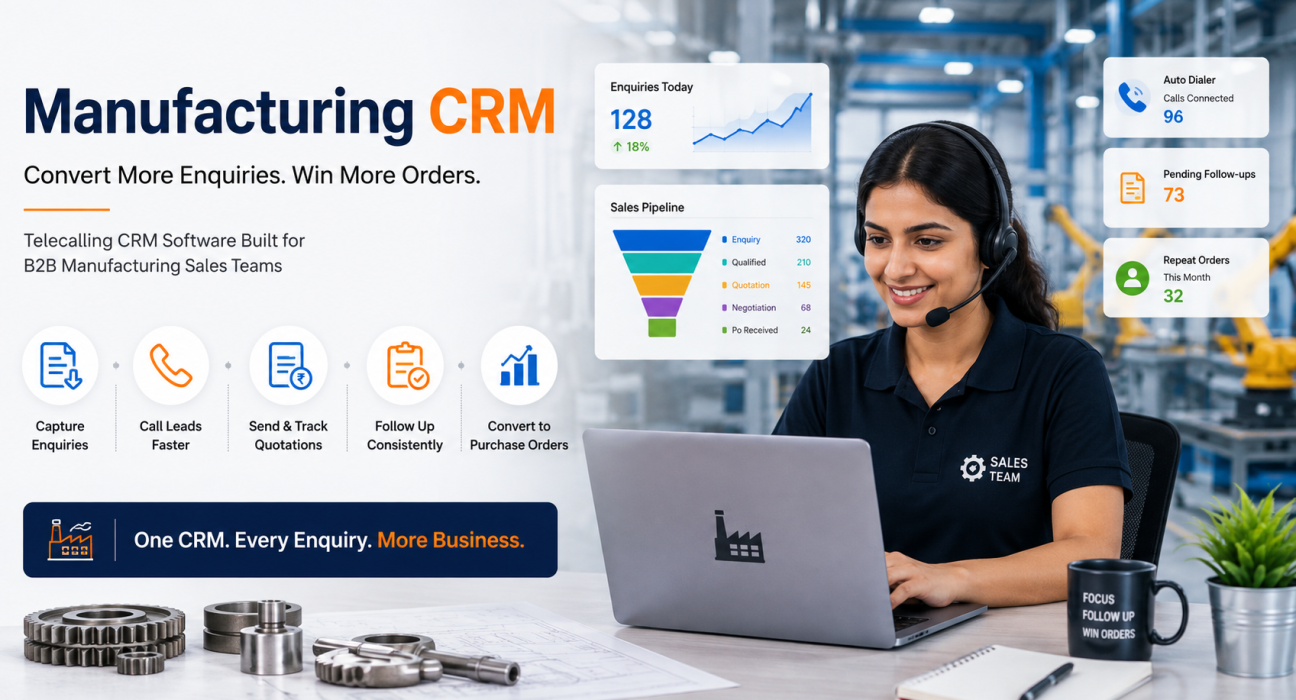
Instead of a generic “lead to won” pipeline, a manufacturing-specific setup typically moves leads through stages like:
| Stage | What Happens |
|---|---|
| Enquiry | Buyer sends or calls in an enquiry |
| Qualified | Agent confirms genuine requirement and budget |
| Quotation | Agent shares price and specification |
| Sample / Negotiation | Team sends a sample or discusses price terms |
| PO Received | Buyer confirms with a purchase order |
| Delivered / Lost | Team fulfils the order, or marks the deal lost with a reason |
Each stage can carry a deal value. This lets the sales team and management see exactly how much business sits at each point, not just how many leads exist.
4. Fields that match how manufacturing sales actually works
Generic lead forms don’t capture what a manufacturing agent needs on a call. A CRM built for this industry lets teams log product or SKU, quantity, buyer company, region, repeat-order status, and the original lead source. Agents can search and filter every field later for reporting.
5. Follow-ups that don’t depend on memory
Manufacturing deals often stall between “quotation sent” and “purchase order received” simply because no one called back. Scheduled follow-up reminders and overdue alerts help make sure a quotation doesn’t sit unanswered for a week.
Real-World Examples
These examples illustrate common manufacturing sales scenarios. They are hypothetical and show how the workflow typically applies.
- Distributors and wholesalers handling bulk enquiries can capture quantity and SKU on every call, then chase quotations through to a confirmed purchase order instead of losing track in a spreadsheet.
- Exporters managing enquiries across different regions can track deal value by region and spot which markets convert best, rather than treating every international enquiry the same way.
- Repeat-order desks can flag existing customers who buy on a cycle, say every 60 or 90 days, and schedule a re-order call before the customer even has to ask.
Key Benefits of a Manufacturing CRM
- Faster response to enquiries – the system assigns and queues leads for calling within minutes of arrival, instead of leaving them unread.
- Fewer leads falling through the cracks – the CRM tracks every enquiry from first contact to delivery, instead of losing it in email threads or notebooks.
- Clear pipeline visibility – management can see open quotations, expected order value, and win rate without asking each salesperson individually.
- Accountability across the team – everyone can see call volume, talk time and conversions per agent, which helps managers spot where coaching is needed.
- Better repeat-order retention – the system flags recurring buyers and follows up on schedule instead of letting them fall through the gap between orders.
Common Mistakes Manufacturing Teams Should Avoid
- Treating every enquiry the same way. A serious bulk buyer and a casual price-checker need different follow-up urgency. Qualify early instead of quoting everyone the same way.
- Letting quotations go unanswered. Many B2B deals fail simply because no one followed up after sending a price, not because the price was too high.
- Not tracking lead source. Without knowing whether an enquiry came from TradeIndia, JustDial, or the website, it’s hard to know where to invest advertising budget.
- Ignoring repeat customers. New leads often get more attention than existing buyers who are simply due for a re-order.
- Relying on memory or spreadsheets for follow-ups. As enquiry volume grows, manual tracking becomes the biggest reason deals slip.
How TeleCalling CRM Supports Manufacturing Sales Teams
TeleCalling CRM offers a manufacturing-specific setup with an auto dialer, automatic lead capture from sources like Trade India and JustDial, and a pipeline pre-built with manufacturing stages from Enquiry through PO Received and Delivered. It also includes custom fields for product, SKU, quantity, and repeat-order status, plus follow-up scheduling, a live team dashboard, and a mobile app for field and office agents working on the same leads.
Every plan includes the same feature set, with pricing starting at ₹999/month. A 7-day free trial lets you test it against your own enquiry volume before committing.
This isn’t the only way to solve these problems. Some teams manage with spreadsheets and discipline for a while. But as enquiry volume grows, most teams eventually need a dedicated system to avoid losing orders to faster competitors.
Frequently Asked Questions
What is a manufacturing CRM? A manufacturing CRM is customer relationship management software built around the B2B manufacturing sales cycle. It captures enquiries, tracks quotations and samples, and follows up until a purchase order is confirmed, instead of using a generic sales pipeline.
How is a manufacturing CRM different from a regular CRM? A regular CRM uses a generic pipeline. A manufacturing CRM comes pre-built with stages like Enquiry, Quotation, Sample/Negotiation and PO Received, and captures fields such as product, SKU, quantity and repeat-order status that generic CRMs skip by default.
Can a manufacturing CRM pull leads from portals like TradeIndia? Yes, this is a common integration. You can connect B2B marketplaces such as TradeIndia so the CRM fetches leads automatically instead of your team checking the portal manually.
Can I track a quotation until it becomes a purchase order? Yes. A manufacturing-specific pipeline usually moves a lead through Quotation and Sample/Negotiation stages to PO Received and Delivered, so nothing sits unanswered indefinitely.
Is telecaller CRM software useful for small manufacturing businesses? Yes. Even small manufacturing or distribution teams handling a few dozen enquiries a day benefit from centralized lead tracking and follow-up reminders, since missed follow-ups hurt revenue regardless of team size.
What data should a manufacturing sales team capture on every call? At minimum: product or SKU, quantity required, buyer company name, region, repeat-order status, and the original lead source. This makes reporting and follow-up planning far more accurate.
Does a manufacturing CRM work for field sales teams as well as office telecallers? Yes, when the CRM includes a mobile app. Field agents visiting distributors and office-based telecallers can both log calls and update the same lead record, so the account history stays in one place.
How much does a telecalling CRM for manufacturing typically cost? Pricing varies by provider. TeleCalling CRM’s plans start at ₹999/month for up to 5 users, and every plan includes the full feature set: auto dialer, lead management, pipeline, and mobile app.