

Large enterprise programs don’t fail because of bad technology. They fail because the people who understood why certain decisions were made have left the building.
If you’ve led a digital transformation initiative that stretched beyond eighteen months, you know this pain. The original architect moved to a competitor. The business analyst who mapped the legacy workflows retired. The vendor team that built the integration layer got rotated to another client. And suddenly, you’re sitting in a conference room with a new set of faces, trying to reverse-engineer decisions made two years ago, with nothing but incomplete documentation and fading institutional memory.
This is the hidden crisis in enterprise technology programs. We talk endlessly about cloud migration strategies, API architectures, and agile methodologies. But we rarely talk about the harder problem: how do you maintain knowledge continuity when the people carrying that knowledge keep changing?
Why Enterprise Programs Lose Their Memory
Enterprise initiatives are marathons, not sprints. A core banking system replacement can take three to five years. An ERP overhaul often runs longer. A digital transformation touching multiple business units and geographies can span half a decade.
During this time, attrition happens. Not just among your internal teams, but across your vendor partners, system integrators, and consulting firms. The average tenure of a technology professional in India is under three years. For mid-level managers, it’s even shorter.
The mathematics are brutal. In a four-year program, you will likely see a complete turnover of at least 40% of the people involved. In some teams, particularly vendor teams working on fixed-price contracts, the churn can be much higher.
When these people leave, they take context with them. Not the code or the documents, but the reasoning. Why did we choose this database? Why does this module have this unusual workflow? Why did we build this workaround? What were the political compromises that shaped the architecture?
The documentation rarely captures this. And even when it does, new team members don’t read hundred-page requirement documents from two years ago.
The Real Cost of Lost Context
The impact shows up in predictable ways.
Rework becomes common. A new team, unaware of past decisions, starts rebuilding something that already exists. Or worse, they dismantle something that was carefully designed to handle a specific edge case, only to rediscover that edge case in production six months later.
Technical debt accumulates. Without understanding why the original team made certain trade-offs, new developers take shortcuts that seem reasonable in isolation but create cascading problems downstream.
Vendor relationships deteriorate. When your internal team changes and the new product owner doesn’t understand the original requirements, every discussion with your vendor becomes contentious. They keep referring to what was agreed upon. You keep asking for changes. Both sides feel the other isn’t operating in good faith.
Timelines slip. Not because the work is complex, but because every two or three months, someone new joins and needs to be brought up to speed. The same context gets re-explained repeatedly. The same mistakes get made again.
Risk increases. In regulated industries, this loss of knowledge can be dangerous. Compliance requirements that were carefully embedded in the design get accidentally removed during enhancements. Audit trails break. Security controls get bypassed.
What Makes This Problem Worse in India
India’s enterprise landscape has specific characteristics that intensify these challenges.
First, we have a strong culture of vendor dependency. Most large Indian enterprises rely heavily on system integrators and offshore development centers for execution. This isn’t wrong, but it does mean that critical program knowledge sits outside your organization. When that vendor team changes, or when the contract ends and a new vendor takes over, the knowledge transfer is rarely complete.
Second, we have regulatory complexity. Indian enterprises often operate under multiple regulatory frameworks, RBI for banks, IRDAI for insurance, SEBI for capital markets, sector-specific rules, and data localization requirements. These regulations evolve constantly. A decision made in 2022 based on a specific compliance interpretation may no longer be valid in 2024. But if the person who made that decision isn’t around, how do you even know to revisit it?
Third, we have scale. A retail bank in India isn’t serving a million customers. It’s serving fifty million. An e-commerce platform isn’t processing a thousand orders a day. It’s processing half a million. This scale means that architectural decisions have long-lasting consequences. A caching strategy that made sense for a pilot doesn’t work at production scale. But if the new team doesn’t know why it was designed that way, they’ll struggle to fix it.
What Doesn’t Work
The standard responses to this problem are inadequate.
Documentation helps, but only to a point. Most enterprise documentation is either too detailed to be useful or too high-level to provide real guidance. The hundred-slide architecture deck captures the big picture but misses the nuances. The thousand-page requirements document has the details, but no one reads it. Even when documentation is good, it becomes outdated quickly in a multi-year program.
Handover sessions are better than nothing, but they’re rushed. When someone leaves, there’s usually a two-week notice period. Maybe you get a week of overlap with their replacement. In that time, you’re supposed to transfer years of accumulated knowledge. It doesn’t work.
Centralized knowledge bases sound like a good idea until you try to maintain them. Wiki pages proliferate, become stale, and turn into noise. Confluence spaces become graveyards of outdated information. People stop updating them because they’re too busy delivering the next sprint.
Hiring senior people who “stick around” is the classic solution, but it’s not realistic. Senior technology leaders are in high demand. They move for better opportunities. And even if they stay with your organization, they move up or sideways into different roles. The person who started as your program architect is now your head of engineering and no longer close to the details.
What Actually Works
Successful enterprises treat knowledge continuity as a first-class delivery concern, not an HR problem.
They build redundancy into their team structures. Not just one architect, but two or three working together, with overlapping responsibilities. Not a single product owner, but a small core team that collectively owns the product vision. This costs more upfront, but it dramatically reduces the risk of knowledge loss.
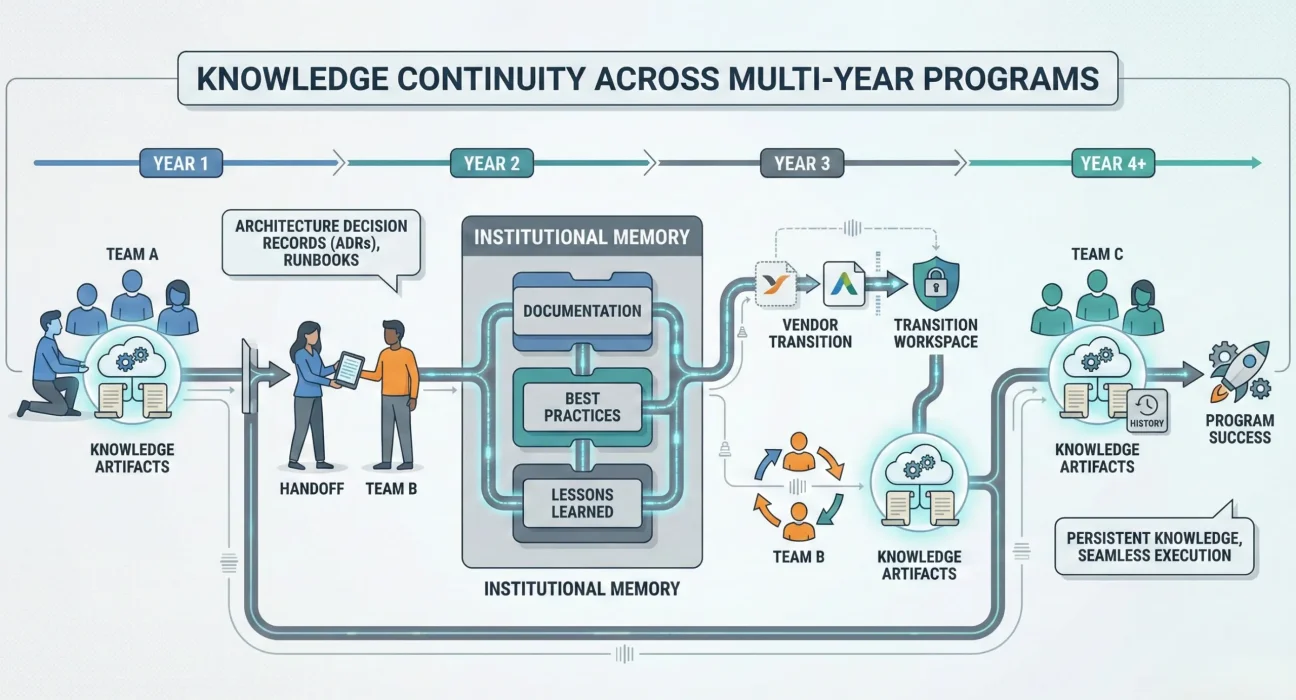
They invest in living documentation. Not static Word documents or PDFs, but documentation that’s part of the codebase, updated with every change, reviewed in every pull request. Architecture Decision Records (ADRs) that capture not just what was decided, but why. Runbooks that evolve with the system. Diagrams that are generated from the code, not drawn once and forgotten.
They design for observability from day one. When your systems are instrumented properly, you don’t need to rely on tribal knowledge to understand what’s happening. The metrics, logs, and traces tell the story. A new engineer can look at the monitoring dashboards and understand how the system actually behaves in production.
They choose partners who understand this problem. Working with a vendor who rotates their team every six months is a recipe for failure in a multi-year engagement. The right technology partner maintains consistent teams, invests in knowledge transfer processes, and takes accountability for continuity across phases.
This is where organizations like Ozrit differentiate themselves. Enterprise delivery isn’t just about writing code to spec. It’s about maintaining institutional memory across years, managing transitions gracefully, and ensuring that phase three of the program benefits from everything learned in phases one and two.
The Governance Dimension
Knowledge continuity isn’t only a technical challenge. It’s a governance challenge.
In a multi-year program, governance structures change. Steering committees get reconstituted. New executives come in with different priorities. Business sponsors move to other divisions. Without strong governance discipline, these changes create chaos.
Effective program governance requires mechanisms that outlast individual people. A charter that clearly defines decision rights and escalation paths. A RACI matrix that’s actually maintained and referred to. Regular steering committee meetings with documented decisions and action items. A program management office that maintains continuity even as individual members change.
It also requires making knowledge continuity an explicit success criterion. In your program scorecards, alongside delivery milestones and budget metrics, you should track knowledge continuity indicators. How long does it take a new team member to become productive? How often are past decisions being relitigated? How complete is your documentation coverage? How quickly can you onboard a new vendor if needed?
These aren’t soft metrics. They directly impact delivery timelines, costs, and risk.
Managing Vendor Transitions
One of the most painful moments in any enterprise program is when you need to change vendors mid-stream. Sometimes it’s unavoidable. The vendor’s performance is poor. Their technology stack is becoming obsolete. They’re getting acquired, and your contract is in flux. Or you’re simply coming to the end of a build phase and moving to a run-and-maintain model with a different partner.
Managing these transitions well requires planning that starts much earlier than most organizations realize.
From the beginning of the program, insist on knowledge being captured in a vendor-neutral way. Requirements, designs, and architectural decisions should sit in your repositories, not theirs. Code should be in your version control systems. Documentation should be in your knowledge management tools. When the transition comes, you own the artifacts.
Build transition periods into your contracts and timelines. A good transition takes three to six months, not three weeks. The outgoing team needs to document their work properly. The incoming team needs time to absorb it. There needs to be a period of overlap where both teams are working together, with the outgoing team available to answer questions.
Use the transition as a forcing function to clean up technical debt. When new eyes look at the system, they’ll spot problems the original team has been living with. This is an opportunity to refactor, to improve code quality, and to upgrade dependencies. Don’t rush through it.
The CFO’s Perspective
For CFOs evaluating enterprise technology investments, knowledge continuity has direct financial implications.
Programs with poor knowledge continuity consistently run over budget. The rework costs money. The extended timelines cost money. The risk incidents that result from lost context cost money. The premium you pay to keep senior people around just for their institutional knowledge costs money.
Conversely, investing in knowledge continuity reduces your total cost of ownership. When your team maintains good documentation and design discipline, you have more flexibility in your vendor negotiations. You’re not locked in. You can bring in new partners if needed. You can insource work that makes sense to insource. You can offshore more aggressively because the knowledge isn’t stuck in one person’s head.
It also affects your time-to-market for future initiatives. An organization with strong knowledge management can move faster on the next program because it’s building on solid foundations. They’re not rediscovering how things work. They’re not debugging mysteries. They’re executing.
Building for Continuity from Day One
The time to think about knowledge continuity is at program inception, not when your lead architect gives notice.
In your initial program setup, define how knowledge will be captured and maintained. Make it part of your definition of done. A feature isn’t complete until it’s documented. An architectural decision isn’t final until it’s recorded in an ADR. A deployment isn’t successful until the runbook is updated.
Build your team with continuity in mind. Yes, you need senior architects and specialists for complex problems. But you also need mid-level engineers who will stay with the program for the long haul. You need a mix of vendor resources and internal resources, so knowledge isn’t concentrated in one place. You need overlapping responsibilities so there’s always someone who can answer the question.
Choose technologies and patterns that reduce the need for deep tribal knowledge. Microservices architectures, when done well, create clearer boundaries. Each service is smaller and easier to understand. Modern DevOps practices, with infrastructure as code and automated deployment pipelines, reduce the number of manual steps that only certain people know how to perform. Cloud-native architectures, with managed services and standard patterns, reduce the amount of undocumented magic.
Invest in developer experience. When your development environment is easy to set up, when your deployment process is automated, and when your testing framework is comprehensive, new team members become productive faster. The system itself becomes easier to understand.
Making It Real
None of this is theoretical. Every large enterprise in India has lived through programs where knowledge loss derailed progress.
The bank couldn’t move forward with its digital banking initiative because the one person who understood the integration with their legacy core system had retired.
The insurance company that spent six months trying to figure out why their claims processing system had certain business rules embedded in unusual places, only to discover they were required for a specific regulatory scenario that no longer applied.
The e-commerce platform had to completely rebuild its recommendation engine because the original team had left, and no one could maintain the existing implementation.
The manufacturing company couldn’t complete its ERP rollout to new factories because the configuration decisions made for the first factory weren’t documented, and replicating them required guesswork.
These aren’t outliers. They’re the norm.
The enterprises that succeed in multi-year programs treat knowledge continuity as seriously as they treat security or performance. They measure it, they invest in it, and they hold people accountable for it. Their steering committees ask about it. Their program reviews track it. Their contracts with vendors include explicit provisions for knowledge transfer and documentation quality.
And they partner with organizations that understand this reality. Partners who don’t just deliver features but build sustainable systems. Partners who maintain consistent teams because they know the cost of churn. Partners who invest in documentation because they’ve seen what happens when it’s missing.
The Bottom Line
Your enterprise program will outlast many of the people working on it. That’s not a problem to solve completely, but it is a reality to manage deliberately.
Knowledge continuity doesn’t happen by accident. It requires intention, investment, and discipline. It requires governance structures that outlast individuals. It requires vendor relationships built on long-term partnerships rather than short-term contracts. It requires technical practices that make systems understandable. It requires cultural norms that value documentation and knowledge sharing.
Most importantly, it requires recognizing that enterprise technology delivery is not just about building systems. It’s about building organizational capability that persists across years, across teams, and across the inevitable changes that every long-term program faces.
The enterprises that understand this are the ones whose transformation programs actually transform. Not just in year one, when everyone is excited, and the original team is still around, but in year three and year five, when the hard work of sustaining and evolving the system becomes the real test of success.
That’s the execution maturity that separates programs that deliver lasting value from programs that become cautionary tales.