

When a CFO asks how much an AI implementation will cost, the honest answer is: it depends on how well you execute, not just how much you spend. When a CIO wants to know if their organisation is ready for AI, the real question is whether their teams can sustain what they build. And when a CEO wonders why their competitor’s AI rollout succeeded while theirs stalled, the answer usually lies in execution discipline, not technology choice.
AI adoption in large enterprises, particularly those operating under regulatory frameworks in India and globally, is less about algorithms and more about organisational readiness. The technology exists. The challenge is making it work within the constraints of compliance, legacy systems, fragmented stakeholders, and the sheer operational complexity of a mid-to-large enterprise.
This article examines what actually happens when regulated enterprises attempt AI adoption at scale and what separates successful programs from expensive failures.
The Reality of Enterprise AI Programs
Most AI initiatives begin with enthusiasm. A board presentation shows compelling use cases. A vendor demonstrates an impressive proof of concept. The budget gets allocated. Then reality sets in.
Three months later, the program is behind schedule. The vendor’s demo environment doesn’t integrate with your core banking system. Your legal team has flagged data residency concerns. The business units that were supposed to provide training data are too busy with their quarterly targets. Your cloud infrastructure team says the proposed architecture violates your security policies.
This is normal. Enterprise AI programs rarely fail because the technology doesn’t work. They struggle because the organisation wasn’t structured to adopt it.
The gap between a working prototype and a production-grade AI system running across multiple business units, geographies, and regulatory jurisdictions is where most programs lose momentum. It’s not a technology gap. It’s an execution gap.
Why Regulated Environments Are Different
Regulatory compliance isn’t just a checkbox. It’s a fundamental constraint that shapes every technical decision.
In financial services, insurance, healthcare, and pharmaceuticals sectors where India has seen significant growth, AI systems must meet standards around data protection, explainability, audit trails, and accountability. A lending algorithm must explain why it rejected an application. A diagnostic support tool must maintain patient privacy across state boundaries. A claims processing system must preserve evidence for potential disputes.
These aren’t optional features you add later. They’re architectural requirements that affect your choice of models, your data pipelines, your infrastructure design, and your testing approach.
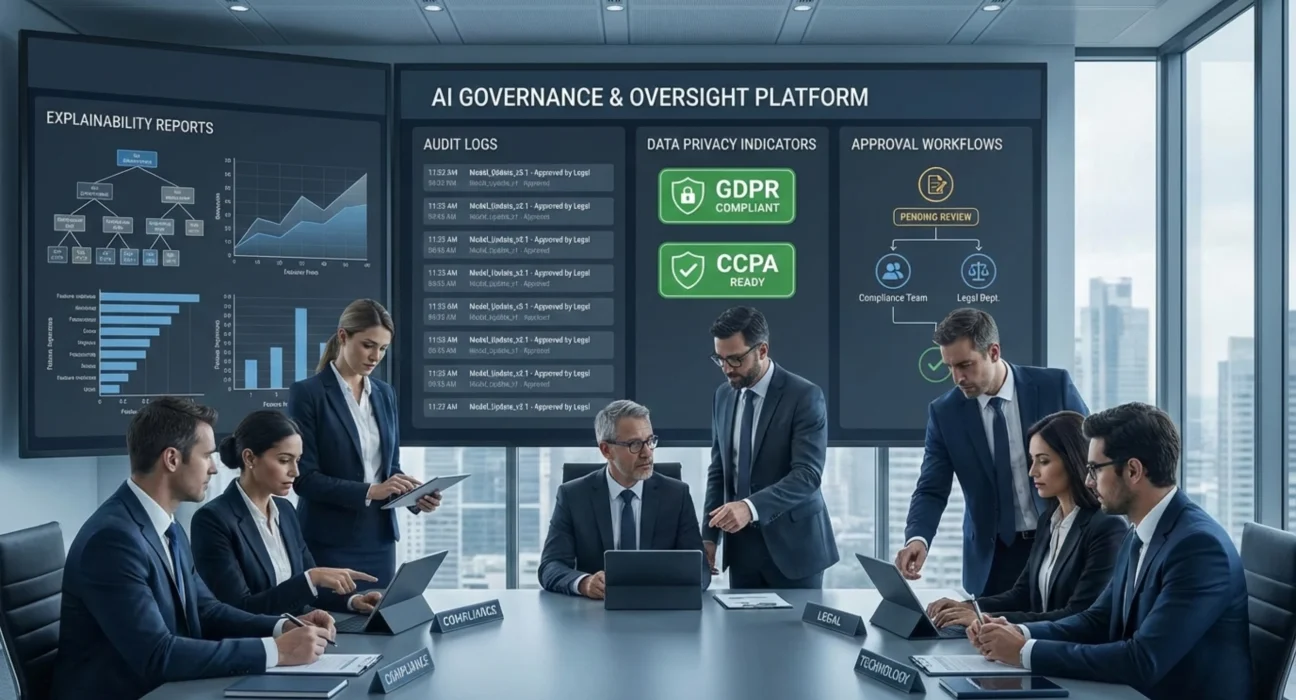
Many global AI platforms and tools assume a level of flexibility that regulated enterprises simply don’t have. You can’t just spin up a cloud environment in any region. You can’t train models on customer data without explicit consent frameworks. You can’t deploy an algorithm into production without a governance process that satisfies both your board and your regulator.
This means your AI program needs people who understand regulatory technology, not just data science. It needs legal and compliance involvement from day one, not during user acceptance testing. It needs an operating model that treats governance as a program pillar, not an afterthought.
The Hidden Complexity of Legacy Systems
Every large enterprise runs on a mix of technologies. Some systems are fifteen years old. Others were built last year. They run on different platforms, speak different protocols, and were designed by teams that no longer exist.
AI doesn’t replace these systems. It has to work alongside them.
Integrating an AI-driven recommendation engine with a legacy policy administration system isn’t a simple API call. The legacy system might not have APIs. Its data structures might not match modern standards. Its performance characteristics might not support real-time inference. Its change control process might require six months of testing for any modification.
This isn’t a technology problem you solve by choosing better tools. It’s an organisational problem that requires patient negotiation between your innovation team and your core IT operations team. It requires someone who understands both worlds and can translate between them.
Many AI programs underestimate this integration effort by a factor of three or more. The result is schedule delays, budget overruns, and a growing list of workarounds that create technical debt.
The Stakeholder Coordination Challenge
Enterprise AI programs involve more stakeholders than most people anticipate.
You have the business sponsor who funded the initiative. The technology team is building it. The data governance team ensures compliance. The security team reviewing the architecture. The infrastructure team provisioning environments. The business users who will operate the system. The internal audit team that will evaluate it. The external auditors who will question it. The regulators who might investigate it.
Each group has legitimate concerns. Each operates on different timelines. Each measures success differently.
The business sponsor wants results within the fiscal year. The technology team needs time to build properly. The compliance team needs documentation that doesn’t exist yet. The security team wants penetration testing before go-live. The business users need training that hasn’t been designed. The infrastructure team is waiting for budget approval.
Without clear governance, these dependencies create gridlock. With poor governance, they create confusion and rework. With good governance, they create accountability and momentum.
The difference isn’t in the technology roadmap. It’s in how decisions get made, how conflicts get resolved, and how progress gets measured across all these groups.
What Actually Goes Wrong in Large Programs
After observing dozens of enterprise AI initiatives, certain patterns emerge.
Programs start without a clear definition of success. Everyone agrees AI will “improve efficiency” or “enhance customer experience,” but no one defines what that means in measurable terms. Six months in, different stakeholders have different expectations, and no one is clearly right or wrong.
Programs underestimate data preparation. The assumption is that data exists and is usable. The reality is that data is scattered across systems, inconsistently formatted, poorly documented, and often wrong. Cleaning and preparing data takes longer than building models.
Programs treat vendors as solution providers rather than service providers. The vendor delivers what was specified in the contract. But the contract was written before anyone understood the real requirements. By the time the gaps are discovered, changing scope triggers commercial negotiations that delay everything.
Programs lack an empowered owner. Responsibilities are distributed across multiple teams, but no single person has the authority to make decisions and the accountability to deliver outcomes. When problems arise, meetings proliferate but decisions don’t.
Programs ignore the operational readiness required to run AI systems in production. Building a model is different from operating a model. Who monitors it? Who retrains it when performance degrades? Who troubleshoots it when it produces unexpected results? These questions get answered too late, if at all.
The Cost of Poor Execution
Budget overruns in enterprise programs are common, but AI programs face unique cost pressures.
Cloud infrastructure costs scale with usage, and AI workloads especially training and inference at scale consume significant resources. If your architecture isn’t optimised, costs spiral quickly.
Vendor lock-in happens when your program becomes dependent on proprietary tools or platforms. Switching becomes prohibitively expensive, and you lose negotiating leverage.
Rework happens when quality isn’t built in from the start. A model that needs to be rebuilt. An integration that needs to be redesigned. A compliance gap that needs to be closed. Each iteration adds time and cost.
Opportunity cost happens when delays prevent you from capturing business value. While your program struggles, your competitor launches. Your market window closes. Your business case weakens.
The financial impact isn’t just what you spend. It’s what you fail to achieve.
What Separates Success from Failure
Successful AI programs share certain characteristics.
They start with a clear, specific business problem. Not “use AI to improve operations” but “reduce claims processing time for motor insurance by 30% while maintaining accuracy above 95%.” Specific problems force specific solutions.
They invest in program governance before they invest in technology. They establish decision rights, escalation paths, and accountability frameworks. They define how the business, technology, compliance, and operations teams will work together.
They treat data as a first-class concern. They inventory what data exists, assess its quality, define what’s missing, and build the pipelines to make it usable. They don’t assume data will be ready when the models are.
They plan for production from day one. They design for monitoring, logging, explainability, and operational support. They involve the teams who will run the system while designing it, not after it’s built.
They choose partners who understand enterprise delivery, not just technology development. Building a proof of concept is different from scaling a production system across a regulated enterprise. The skills required are different. The mindset is different.
The Partner Question
Choosing the right technology partner is one of the most consequential decisions in an enterprise AI program.
Many organisations default to large global vendors, assuming size equals capability. But vendor size doesn’t guarantee delivery quality. A large vendor often assigns junior teams to all but their largest accounts. Their solution might be powerful but generic, requiring extensive customisation that isn’t in the initial quote.
Others choose niche AI startups, attracted by their technical depth. But startups often lack experience with enterprise governance, regulatory compliance, and the operational discipline required to deliver at scale. Their engineering might be excellent, but they struggle with program management, stakeholder coordination, and the organisational change required to make AI stick.
The right partner understands both technology and enterprise execution. They’ve managed complex programs with multiple stakeholders. They know how to navigate regulatory requirements. They’ve integrated AI into legacy environments. They understand that delivery isn’t just about code it’s about governance, risk management, change management, and sustainable operations.
Firms like Ozrit have built their practice around this reality. Rather than positioning themselves purely as developers or consultants, they function as execution partners who take accountability for delivery. They work within the constraints of regulated environments, manage the coordination between business and technology teams, and build systems designed to be operated, not just demonstrated.
The Role of Leadership
AI adoption requires active executive sponsorship, not just budget approval.
A CEO needs to set the strategic direction and ensure alignment across business units. AI isn’t an IT project. It’s a business capability that affects operations, customer experience, risk management, and competitive positioning.
A CIO needs to ensure the technology foundation can support AI workloads while maintaining security, stability, and compliance. This often means modernising infrastructure, rethinking data architecture, and building new operational capabilities.
A CFO needs to evaluate ROI beyond the initial business case. AI systems require ongoing investment in data, infrastructure, model maintenance, and operations. The cost structure is different from traditional software.
A CDO or Chief Analytics Officer needs to build the organisational capability to use AI effectively. This includes data literacy, governance frameworks, ethical guidelines, and the talent to develop and operate AI systems.
A COO needs to manage the operational change required to integrate AI into business processes. This includes training, process redesign, performance management, and the cultural shift required to trust and verify AI-driven decisions.
Without this leadership alignment, even well-executed programs struggle to create lasting impact.
Practical Steps Forward
If you’re leading or sponsoring an AI initiative in a regulated enterprise, consider these steps.
Start with a specific, measurable business problem. Avoid broad mandates like “explore AI opportunities.” Focus on a problem where success can be clearly defined and measured.
Invest in discovery before committing to a solution. Understand your data landscape, your integration requirements, your regulatory constraints, and your operational readiness. Many programs waste months building the wrong thing because they skipped discovery.
Establish governance early. Define who makes decisions, how conflicts get resolved, how progress gets measured, and how accountability is assigned. Governance isn’t bureaucracy, it’s the operating system for your program.
Plan for production from day one. Design your solution to be monitored, maintained, explained, and audited. Involve your operations team early. Don’t treat production as a phase that happens after development.
Choose partners based on delivery capability, not just technical capability. Ask about their experience with programs of your scale and complexity. Ask how they manage stakeholder coordination, risk, and change. Ask who will actually work on your program and what authority they have.
Measure progress by outcomes, not activity. Completed sprints and deployed features are activities. Reduced processing time, improved accuracy, and realised cost savings are outcomes.
Moving from Ambition to Execution
AI adoption in regulated enterprises isn’t a technology challenge. It’s an execution challenge.
The technology is proven. The business value is real. The barriers are organisational—legacy systems, regulatory constraints, stakeholder complexity, data readiness, operational discipline, and the sheer difficulty of coordinating large programs across multiple teams and timelines.
Success requires more than a good idea and a capable vendor. It requires clear ownership, disciplined governance, patient execution, and partners who understand that enterprise delivery is fundamentally different from product development.
The enterprises that succeed with AI are those that treat it as a business transformation program, not a technology project. They invest in the hard work of aligning stakeholders, preparing data, building governance, and creating the operational capability to sustain what they build.
They recognise that the goal isn’t to adopt AI. The goal is to solve business problems at scale, sustainably, within the constraints of a regulated enterprise. AI is the means, not the end.
And they choose partners who share that understanding partners who bring not just technical skill but program maturity, delivery accountability, and the experience to navigate the complexity of enterprise-scale execution. That’s where the difference gets made.