

Most enterprise software gets built. Very little of it gets loved.
If you’ve led a large-scale digital transformation or overseen an ERP rollout, you know this truth intimately. The system goes live. Training happens. Emails are sent. But six months later, your teams are still maintaining Excel sheets on the side, raising tickets for workarounds, or worse—silently resenting the platform they’re forced to use every day.
This isn’t a technology problem. It’s an execution problem.
The gap between what gets built and what people actually want to use is where most enterprise programs fail. Not spectacularly, not visibly, but quietly through low adoption, prolonged handholding, shadow IT, and a general sense that the organisation spent crores on something that made work harder, not easier.
As a C-level leader, you’ve likely signed off on these programs. You’ve sat through the steering committee meetings, approved the business cases, and watched the go-live celebrations. But you’ve also seen the aftermath: the support costs that don’t drop, the process efficiencies that don’t materialise, the change fatigue that sets in across teams.
So what actually separates enterprise systems that people use from enterprise systems that people tolerate?
Why Enterprise Software Ends Up Unloved
Let’s start with the uncomfortable part. Enterprise software often ends up disliked not because it’s broken, but because it was never designed with the end user’s day-to-day reality in mind.
Here’s what typically happens. A program starts with a clear business objective automate procurement, centralise customer data, digitise operations. The business case gets approved. A vendor gets selected. Requirements get documented. Development begins.
But somewhere between the signed contract and the go-live, the focus shifts. The system starts getting designed to meet compliance needs, audit trails, governance frameworks, and vendor capabilities. All important, all necessary. But the person who’ll actually use the system eight hours a day? Their workflow becomes an afterthought.
This happens for predictable reasons. Large programs have many stakeholders. IT needs security and scalability. Finance needs cost control. Legal needs compliance. The vendor needs to fit the solution into their existing product suite. Everyone has a valid concern, and everyone gets a say.
The business user, the person entering the purchase order, the manager approving the leave, the sales executive updating a lead rarely has the loudest voice in the room. And even when they do, their feedback often gets filtered through layers of abstraction: business analysts, functional consultants, technical architects. By the time it reaches the development team, it’s a requirement, not a real person’s frustration.
The result? Systems that are functionally complete but experientially poor. They do what the specification says. They pass the UAT. They meet the contract. But they don’t feel intuitive, they don’t respect people’s time, and they don’t make work easier.
And here’s the compounding issue: enterprise programs run long. Twelve months, eighteen months, sometimes longer. By the time the system is ready, the business context has shifted. Priorities have changed. The team that gave the original requirements has moved on. What gets delivered is a solution to last year’s problem, built for last year’s workflow.
This isn’t anyone’s fault. It’s a structural outcome of how enterprise programs are run.
Scale Introduces Complexity, But Complexity Shouldn’t Mean Compromise
Indian enterprises, especially those operating at scale, face a unique set of constraints. You’re managing diversity across geographies, languages, regulatory environments, legacy systems, and user maturity levels. You’re balancing cost pressures with quality expectations. You’re dealing with vendors who may understand global best practices but don’t always grasp the ground reality of Indian operations.
A system that works beautifully for the head office in Mumbai might be unusable in a branch office in Tier 2 or Tier 3 cities where connectivity is inconsistent and digital literacy varies. A workflow that makes sense for finance might create bottlenecks for procurement. A mobile-first design might ignore the fact that many of your users still rely on desktop terminals.
Scale doesn’t just mean more users. It means more variations, more exceptions, more dependencies. And the temptation especially when timelines are tight and budgets are fixed is to standardise aggressively. One workflow for everyone. One interface for all roles. One set of rules, enforced globally.
This works on paper. It falls apart in practice.
Because when you force-fit a diverse user base into a rigid system, you don’t eliminate complexity. You just push it downstream. Users create their own workarounds. IT gets flooded with customisation requests. Change requests pile up. The program that was supposed to simplify operations ends up creating more work.
The alternative isn’t to avoid standardisation. It’s to design systems that are flexible enough to handle variation without becoming chaotic. It’s to build platforms that allow localisation without breaking governance. It’s to involve users early and often, not as validators, but as co-designers.
That requires a different kind of program discipline. It requires leadership that’s willing to slow down in the requirements phase to speed up in adoption. It requires vendors and partners who understand that “done” doesn’t mean “deployed” it means “adopted and delivering value.”
What Actually Goes Wrong in Large Enterprise Programs
If you’ve overseen a few large-scale implementations, you’ve seen the patterns. The missed deadlines. The budget overruns. The scope creeps. The tense steering committee meetings where everyone’s trying to figure out why a six-month delay just became a twelve-month delay.
Here’s what’s usually happening beneath the surface.
Requirements get locked too early. The business case demands certainty, so requirements get frozen upfront. But businesses don’t stand still. By the time development is done, the market has shifted, the regulation has changed, or the organisation has restructured. The system gets delivered as specified, but it’s no longer what’s needed.
Governance becomes a reporting exercise. Steering committees meet monthly. Status reports are green until they’re suddenly red. RAG statuses get managed, not risks. By the time a real issue surfaces in governance forums, it’s often too late to course-correct without significant cost or delay.
Vendors optimize for contract compliance, not outcomes. Most vendor contracts are structured around deliverables and milestones, not business outcomes. So vendors build what’s in the scope document, even if it’s not what users need. Change requests become commercial negotiations. Flexibility becomes expensive.
Integration gets underestimated. Every enterprise has legacy systems. Some are decades old, poorly documented, and running critical processes. Integrating with them is always harder than it looks on the architecture diagram. Data migration is messy. APIs don’t behave as expected. And the people who understand the old system are often the same people who are too busy to help with the new one.
Testing is rushed. User acceptance testing gets squeezed because development ran over. Business users are pulled into UAT while still managing their day jobs. They’re testing scenarios, not workflows. They’re checking if the system works, not whether it works for them. Issues get logged, marked as “non-critical,” and deferred to post-go-live.
Change management is an afterthought. Training happens in the last month. It’s functional, not contextual. Users learn how to navigate screens, not how the new system changes their daily work. There’s no ongoing support structure. No feedback loops. No iteration post-launch.
These aren’t edge cases. These are the norms.
And the reason they persist isn’t incompetence. It’s an incentive. Program managers are measured on whether they deliver on time and on budget. Vendors are measured on whether they meet the contract. IT is measured on whether the system is stable and secure.
No one’s directly accountable for whether business users actually like the system.
What It Really Takes to Get It Right
Getting enterprise programs right isn’t about better technology. It’s about better execution.
It starts with clarity on what success looks like. Not functional success of course the system has to work but adoption success. What does good look like for the person using this system every day? What friction are we removing? What time are we giving back? What decisions are we making easier?
If you can’t answer that clearly, you’re building in the dark.
Next, involve users throughout, not just at the bookends. Don’t just gather requirements at the start and feedback at the end. Bring users into the design process. Show them prototypes. Let them test workflows in context. Let them tell you what feels clunky, what’s unclear, what’s missing.
This doesn’t mean letting users design the system. It means designing the system with users. There’s a difference.
Then, structure your governance around outcomes, not just outputs. Don’t just track whether milestones are being hit. Track whether the system is actually solving the problem it was meant to solve. Are users adopting it? Are process times improving? Are support tickets trending down? Are people finding value, or are they finding workarounds?
If your governance meetings aren’t discussing these questions, they’re not governing the right things.
Also, choose partners who understand execution, not just development. There are plenty of vendors who can build software. Fewer who can navigate the organisational complexity of actually delivering change in a large enterprise. You need partners who’ve done this before, who understand stakeholder management, who know how to manage scope without letting quality slip, who can handle the politics and the pressure without losing sight of the end goal.
Firms like Ozrit, for instance, position themselves not just as delivery partners but as execution partners, people who understand that enterprise programs succeed or fail based on how well they’re managed, not just how well they’re coded. That’s the kind of partnership that matters when you’re trying to drive real transformation, not just deploy software.
Finally, plan for iteration. No enterprise system gets it perfect on day one. The best systems are the ones that improve continuously based on real-world use. Build feedback mechanisms. Plan for a post-go-live roadmap. Budget for enhancements. Treat the first release as version one, not the final product.
The Role of Leadership in Enterprise Delivery
As a CIO, CTO, or COO, your role in these programs isn’t just to sponsor them. It’s to protect them from the forces that typically derail them.
That means protecting the user voice when it gets drowned out by technical or commercial pressures. It means pushing back on vendors when they’re optimising for their convenience instead of your outcomes. It means holding your own teams accountable not just for delivery, but for adoption.
It also means being willing to make uncomfortable calls. Pausing a program that’s heading in the wrong direction. Cutting scope to preserve quality. Extending timelines to get the design right. Investing in change management even when the budget’s tight.
These decisions are hard because they look like delays or cost increases in the short term. But they’re what separate programs that succeed from programs that technically deliver but operationally fail.
Your job is to create the conditions for good execution. Clear ownership. Realistic timelines. Proper resourcing. Governance that’s rigorous but not bureaucratic. A culture that values outcomes over optics.
When those conditions exist, good programs happen. When they don’t, even the best vendors and the most advanced technology won’t save you.
Making It Real
Here’s a simple test. Walk up to someone in your organisation who uses one of your enterprise systems daily. Ask them: “Does this system make your work easier?”
If they hesitate, you have your answer.
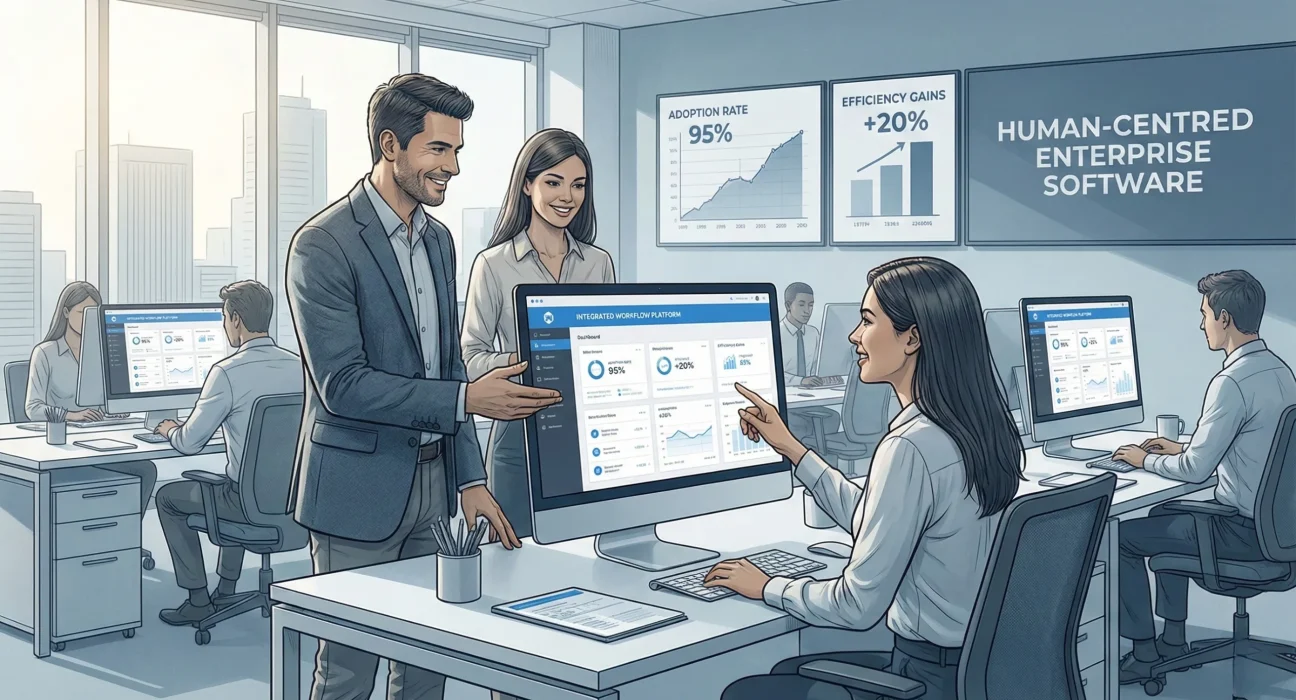
Enterprise systems should feel like tools, not obstacles. They should fade into the background of people’s workday, not dominate it. They should be something people forget they’re using because it just works.
That level of quality doesn’t happen by accident. It happens when programs are run with discipline, when user experience is treated as a core requirement, when vendors and partners are held accountable for outcomes, and when leadership is willing to prioritise long-term adoption over short-term delivery.
It’s not flashy work. It doesn’t make for exciting demos or press releases. But it’s the work that actually matters.
Because at the end of the day, the success of your digital transformation isn’t measured by how much you spent or how modern your tech stack is. It’s measured by whether your people can do their jobs better than they could before.
That’s the standard. And it’s a standard worth holding.