

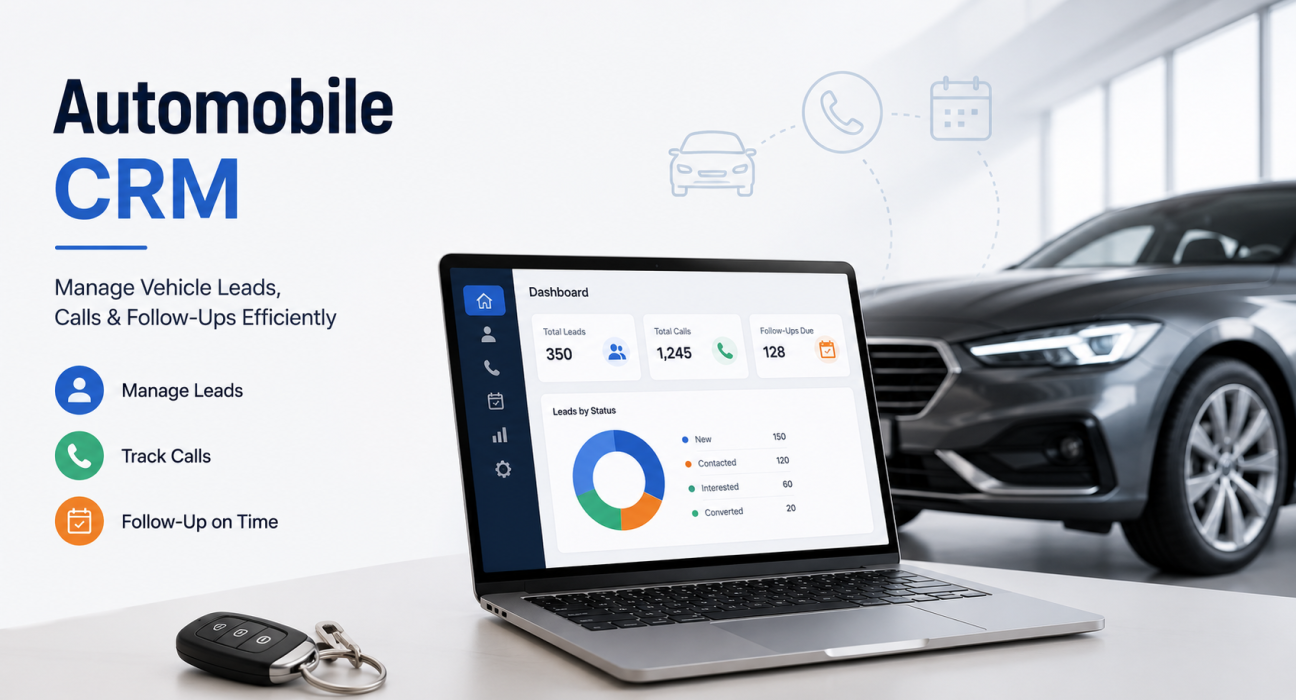
Car dealerships and automobile businesses often receive enquiries from multiple channels. A customer may enquire about a new car through a website form, Google Ads, social media, WhatsApp, a referral or a direct phone call. Managing these enquiries manually can make it difficult for sales teams to respond quickly, track conversations and remember follow-ups.
An Automobile CRM gives dealerships a structured way to capture, organize and follow up with vehicle prospects. When calling is a major part of the sales process, a telecalling-focused CRM can bring lead management, calling, follow-ups and sales tracking into one workflow. Businesses can explore Automobile CRM and lead management features to understand how this approach can support a calling-based sales team.
What Is an Automobile CRM?
An Automobile CRM is customer relationship management software designed to help automobile businesses manage prospects, enquiries, sales activities and customer interactions from one place.
For a dealership, an Automobile CRM can help organize information such as:
- Customer name and contact details
- Vehicle of interest
- Lead source
- Enquiry date
- Call history
- Follow-up date
- Lead status
- Sales stage
- Notes from conversations
- Expected deal value
Instead of keeping customer information across spreadsheets, notebooks, phone logs and separate messaging applications, a CRM creates a central record for each lead.
When the sales process involves frequent outbound calls, combining CRM capabilities with telecalling software can make the workflow more practical for sales callers.
Why Automobile Businesses Need Better Lead Management
Automobile sales usually involve multiple interactions before a customer makes a purchase decision. A prospect may first ask for a quotation, then compare models, discuss financing, request a test drive and finally decide whether to purchase.
This means the first call is rarely the entire sales process.
Without proper tracking, common problems can include:
- Leads remaining unattended
- Delayed callbacks
- Duplicate customer records
- Salespeople forgetting follow-up dates
- Difficulty finding previous call information
- Poor visibility into individual salesperson activity
- Managers relying on manually prepared reports
- Leads being distributed unevenly among sales representatives
A lead management software system helps create a defined process from enquiry to conversion.
How Does an Automobile CRM Work?
An Automobile CRM generally works by bringing customer enquiries into a central system and allowing sales teams to manage each prospect through defined stages.
A typical workflow can look like this:
Lead received → Lead assigned → First call → Requirement identified → Follow-up → Test drive/quotation → Negotiation → Booking → Won or Lost
For example, suppose a dealership receives a lead from a digital advertising campaign. Instead of sending the enquiry into a shared spreadsheet, the lead can be captured in the CRM, assigned to a salesperson and moved through the appropriate sales stages.
The salesperson can then record the call outcome and schedule the next action.
This gives both the salesperson and manager a clearer view of what needs to happen next.
Key Features to Look for in an Automobile CRM
Not every CRM is equally useful for an automobile sales team. If telecalling is an important part of the sales process, businesses should evaluate the CRM based on the actual workflow of their salespeople.
1. Lead Management
The CRM should make it easy to import, capture, assign and track leads.
For example, TeleCalling CRM supports lead management, bulk CSV/Excel import, lead scoring, tags, custom fields, lead distribution and call history.
For automobile businesses, custom fields can be useful for recording information such as the vehicle model, variant, purchase timeline or other sales requirements.
2. Auto Dialer
Salespeople can spend considerable time manually searching for numbers and dialing individual leads.
A smart sales calling software solution can automate the next-call process. TeleCalling CRM’s auto dialer automatically moves through assigned lead lists, captures call duration and allows agents to record outcomes after calls.
The goal is not simply to make more calls. It is to reduce unnecessary manual work so salespeople can spend more time speaking with prospects.
3. Follow-Up Scheduling
Follow-ups are particularly important in automobile sales because customers may not be ready to purchase during the first conversation.
A prospect might say:
- “Call me tomorrow.”
- “I want to discuss this with my family.”
- “I will visit the showroom this weekend.”
- “Send me the quotation first.”
- “I am comparing two models.”
A CRM should allow the salesperson to record the next action and schedule the follow-up.
TeleCalling CRM provides one-tap follow-up scheduling, reminders, overdue alerts and smart follow-up timing based on call outcomes.
4. Sales Pipeline
An automobile sales pipeline helps managers understand where prospects are in the buying journey.
A dealership might create stages such as:
| Sales Stage | Example Activity |
|---|---|
| New Lead | Enquiry received |
| Contacted | First conversation completed |
| Qualified | Requirement understood |
| Test Drive | Customer interested in a test drive |
| Quotation | Price or offer shared |
| Negotiation | Customer discussing final terms |
| Booking | Booking initiated |
| Won | Vehicle sale completed |
| Lost | Prospect did not proceed |
The exact stages should reflect the dealership’s own process rather than copying a generic CRM template.
TeleCalling CRM supports custom pipeline stages, deal values, expected close dates and revenue forecasting.
5. Call History and Notes
A customer may speak with different members of a sales team during the buying process. Without a shared history, the next salesperson may not know what was discussed earlier.
A CRM should maintain the lead’s interaction history so authorised team members can understand previous conversations, notes and follow-up actions.
This can also help managers review how leads are being handled.
6. Lead Distribution
Lead distribution becomes important when a dealership has several sales representatives.
Instead of manually deciding who receives every enquiry, automated assignment rules can distribute leads according to the business’s chosen process.
TeleCalling CRM supports assignment methods such as round-robin, language matching and fixed-agent assignment, along with availability-aware distribution.
7. Messaging
Not every customer wants to communicate only through phone calls.
Depending on the business process and applicable communication rules, sales teams may also need email, SMS or WhatsApp communication for activities such as sharing information, confirming appointments or sending follow-up messages.
TeleCalling CRM provides SMS, email and WhatsApp messaging capabilities with scheduling and a unified conversation view.
How a Telecaller CRM Can Support Automobile Sales Teams
A telecaller CRM is particularly useful when sales representatives spend a large part of their day calling prospects.
Consider a simple example.
A dealership receives 100 vehicle enquiries. The sales manager assigns the leads to five callers. Each salesperson sees their assigned leads, calls prospects, records outcomes and schedules the next follow-up.
A prospect interested in a test drive can be moved to the relevant stage. Another prospect who needs more time can receive a future callback. A lead that does not respond can be placed into an appropriate follow-up workflow.
The manager can then review team activity without asking every salesperson for a separate spreadsheet update.
This creates a more consistent process from lead generation to follow-up to conversion.
Benefits of Using Automobile CRM for Dealerships
Better Lead Organization
All important prospect information can be maintained in a structured record instead of scattered across multiple files.
Faster Lead Assignment
Automated distribution can help incoming enquiries reach the appropriate salesperson without unnecessary manual coordination.
More Consistent Follow-Ups
Scheduled reminders and overdue alerts can make it easier for salespeople to manage callbacks.
Better Sales Visibility
A pipeline allows managers to see how many leads are new, qualified, in negotiation, booked or closed.
Easier Team Monitoring
Managers can review calling activity, talk time, follow-ups and other sales indicators through CRM reporting.
Better Customer Context
Call history, notes and lead information give salespeople more context before they contact a prospect again.
Reduced Spreadsheet Dependency
A structured CRM can replace several manual processes that otherwise require spreadsheets and separate tracking sheets.
What Should Automobile Businesses Consider Before Choosing a CRM?
Choosing an Automobile CRM should start with the dealership’s sales process rather than the feature list alone.
Before selecting a platform, ask:
- Where do our leads come from?
- How quickly are new leads assigned?
- How many calls does each salesperson handle?
- How are follow-ups currently tracked?
- Can we customize our sales stages?
- Can managers see team activity?
- Can we import existing leads?
- Can the CRM maintain call history?
- Does it support the communication channels our team uses?
- Can the system work for both office and mobile sales teams?
It is also important to check data access, permissions, recording policies and applicable communication regulations before implementing calling and customer-data workflows.
Common Automobile CRM Mistakes to Avoid
Treating the CRM as Only a Contact Database
A CRM should support the sales process, not simply store names and phone numbers.
Creating Too Many Pipeline Stages
A complicated pipeline can make adoption difficult. Start with stages that reflect real sales activities.
Not Defining Follow-Up Rules
If every salesperson follows a different process, lead handling becomes inconsistent. Define basic follow-up expectations.
Ignoring Lost Leads
Lost leads can contain useful information. Recording why a prospect did not proceed can help managers understand recurring objections and sales patterns.
Tracking Activity Without Context
The number of calls alone does not explain sales performance. Managers should also look at connection rates, lead quality, follow-up completion and movement through the sales pipeline.
How TeleCalling CRM Can Help Automobile Sales Teams
TeleCalling CRM is built around outbound sales workflows, combining calling, lead management, follow-ups, pipeline management, messaging and reporting in one platform. Its current feature set includes a smart auto dialer, lead distribution, call recording, AI call analysis, follow-up reminders, sales pipeline management, messaging, team monitoring and analytics.
For an automobile business, these capabilities can be organized around its own lead-to-sale process. For example, vehicle enquiries can be assigned to sales representatives, call outcomes can be recorded, follow-ups can be scheduled and prospects can be moved through customized pipeline stages.
The platform also supports lead sources including Facebook and Instagram Lead Ads, Google Ads, websites and other listed sources, which can be useful for businesses receiving enquiries from multiple digital channels.
Businesses evaluating implementation can also review the TeleCalling CRM documentation and setup guides to understand how lead import, assignment and integrations work.
Frequently Asked Questions
What is an Automobile CRM?
An Automobile CRM is software that helps dealerships and automobile businesses manage vehicle enquiries, customer information, sales activities, calls, follow-ups and pipeline stages from one system.
How does CRM help automobile dealerships?
A CRM helps dealerships organize incoming leads, assign them to salespeople, maintain interaction history, schedule follow-ups and monitor the sales pipeline. It can reduce dependence on spreadsheets and separate manual tracking systems.
Is an Automobile CRM useful for telecalling teams?
Yes. When sales teams rely heavily on outbound calls, a CRM with telecalling capabilities can combine lead management, auto dialing, call outcomes, follow-ups and sales tracking in one workflow.
What features should an Automobile CRM have?
Important features include lead management, lead assignment, call tracking, follow-up scheduling, sales pipeline management, reporting, customer notes and mobile access. Teams that rely heavily on calls may also benefit from an auto dialer and call recording.
Can an Automobile CRM track follow-ups?
Yes. CRM systems can allow salespeople to schedule callbacks and record completed follow-ups. TeleCalling CRM includes follow-up scheduling, reminders and overdue tracking.
Can automobile businesses manage leads from different sources?
Yes, depending on the CRM’s integrations. TeleCalling CRM currently lists lead sources including Facebook, Instagram, Google Ads, websites, Google Sheets and several Indian lead platforms.
Should a small automobile dealership use a CRM?
A small dealership can benefit from a CRM when it receives enough enquiries to make manual tracking difficult. The right system should be simple for salespeople to adopt and should match the dealership’s actual lead and follow-up process.
What is the difference between a CRM and telecalling software?
A CRM focuses broadly on customer and sales management, while telecalling software focuses more heavily on calling workflows. A telecalling CRM combines both, allowing teams to manage leads and customer records alongside calls, follow-ups and sales activities.
Conclusion
Automobile sales depend on timely communication, organized lead handling and consistent follow-up. When enquiries are managed through spreadsheets, individual phone records or disconnected tools, it becomes harder for sales teams to maintain a clear view of every prospect.
An Automobile CRM can bring lead information, calls, follow-ups and sales stages into one structured workflow. For dealerships where outbound calling is central to sales, a telecalling-focused CRM can make this process even more connected.
Before choosing a platform, businesses should focus on their actual sales workflow, lead sources, team size, follow-up process and reporting requirements. If calling is a major part of that process, explore Automobile lead management and telecalling CRM capabilities to see whether they fit your team’s workflow.