

A honeymoon enquiry comes in through Facebook at 11 PM. A JustDial lead calls in for a Kerala package on a Saturday. A corporate client fills a website form asking about a group tour. By Monday morning, three agents are trying to figure out who should call whom. One of these enquiries has already booked with a competitor.
This is the daily reality for most travel agencies and tour operators in India. Enquiries arrive from many channels at once. Follow-up still happens on WhatsApp chats, Excel sheets and sticky notes. A travel CRM built on top of a telecalling system closes this gap. It captures every enquiry automatically and helps agents call, follow up and share itineraries before the traveller loses interest. Agencies can see how this works in practice with a telecalling CRM for travel and tourism built specifically around holiday enquiries, itineraries and travel dates.
What Is a Travel CRM?
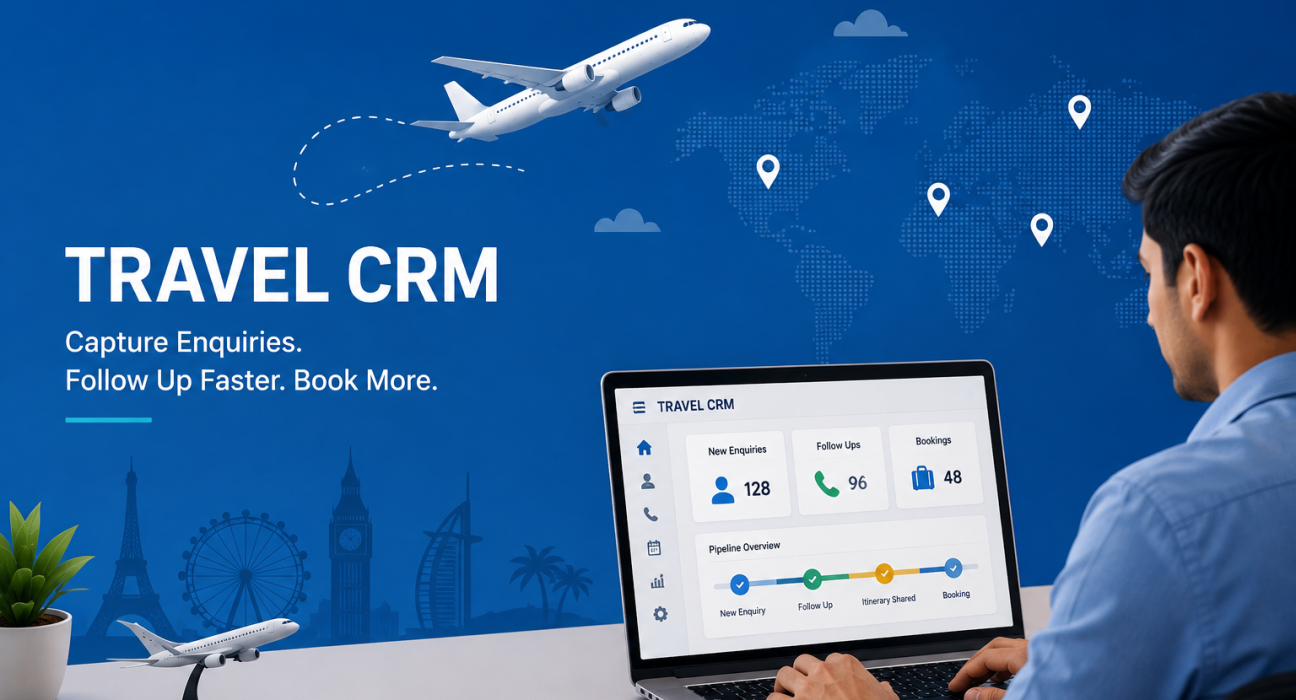
A travel CRM is software that helps travel agencies, tour operators and DMCs (destination management companies) capture holiday enquiries from ads, portals and websites. It assigns each enquiry to an agent and manages the journey from first call to confirmed booking. Most travel CRMs combine lead management, an auto dialer and follow-up scheduling. They also use a sales pipeline built around travel-specific stages, such as itinerary sharing and booking confirmation.
Why Travel Enquiries Go Cold So Quickly
Travel is an impulse-heavy, comparison-heavy category. A traveller researching a Goa package usually enquires with two or three agencies at the same time. The agency that responds first with the right itinerary and price often wins the booking, regardless of who has the better package.
The gaps that slow travel agencies down
- Enquiries arrive from many sources at once. Website forms, Facebook and Instagram ads, JustDial, Google Ads and marketplace webhooks all bring in leads. Without one system, these leads scatter across five different inboxes.
- Seasonal spikes overwhelm manual processes. Long weekends, school holidays and wedding season can multiply enquiry volume overnight. Spreadsheets do not scale with that.
- Follow-up needs a cadence, not a single call. Most travellers need an itinerary, a follow-up call once they’ve discussed it at home, and a nudge closer to the travel date.
- Leads get duplicated or missed. This happens when multiple agents work off the same spreadsheet without clear ownership.
- Nobody tracks deal value. Without this, it is hard to know which packages, destinations or lead sources actually bring in revenue.
Left unmanaged, these gaps mean genuinely interested travellers stop responding. It is rarely because they lost interest in the trip. Usually, nobody called them back on time.
How a Telecalling CRM Solves This for Travel Businesses
A telecalling CRM designed for travel brings lead capture, calling and follow-up into one workflow. Here is how the pieces fit together.
1. Leads land in one place automatically
Enquiries from Facebook and Instagram ads, Google Ads, JustDial, website forms and other portals flow directly into the CRM. The system de-duplicates them and auto-assigns each one to an agent. No two people call the same traveller, and no enquiry sits unclaimed.
2. The auto dialer keeps agents calling, not dialing
Agents work through a queue instead of manually dialing each number. The dialer moves to the next lead automatically. It logs call duration and skips numbers on the Do Not Call (DNC) list to stay compliant.
3. The pipeline matches how travel actually sells
A generic sales pipeline does not reflect how a holiday enquiry moves forward. A travel-specific pipeline typically looks like this:
| Stage | What happens |
|---|---|
| New Enquiry | Lead captured from ad, portal or website |
| Contacted | Agent has spoken to the traveller once |
| Itinerary Shared | Package and pricing sent to the customer |
| Follow-up | Agent is checking back after the itinerary review |
| Booking | Customer has confirmed and paid |
| Travelled | Trip is complete |
| Lost | Enquiry did not convert |
A deal value attached to each stage lets a manager see, at a glance, how much revenue sits in “Itinerary Shared” versus how much has actually closed.
4. Follow-ups don’t get forgotten
Callback reminders and overdue alerts nudge an agent to call back exactly when they said they would. That could be the next day, or closer to the travel date.
5. WhatsApp keeps the itinerary conversation going
Most Indian travellers expect an itinerary or price list on WhatsApp. Workflows can send a WhatsApp template automatically the moment a lead moves to “Itinerary Shared.” Agents don’t have to do this manually for every enquiry.
Real-World Examples
The following are illustrative examples, not case studies of actual customers.
A tour operator running Diwali packages. Enquiries spike three weeks before the festival across Facebook ads and the website. Without auto-assignment, two agents can end up calling the same family. A travel CRM splits leads evenly, and each agent’s queue fills automatically. The dialer keeps ringing through the list without anyone manually managing spreadsheets.
A visa and holiday package seller. A customer enquires about a Southeast Asia package with visa assistance. The agent shares the itinerary on day one, but the customer typically needs 5–7 days to decide. A follow-up sequence with reminders on day 2, day 5 and day 7 keeps the conversation alive. The agent doesn’t have to remember every enquiry manually.
A DMC handling both B2B and B2C enquiries. A destination management company gets bulk group-tour enquiries from corporate clients alongside individual family bookings. Tracking both in the same pipeline, with deal value attached to each, shows which segment actually drives revenue for the quarter.
Benefits of Using a Travel CRM
- Faster first response, since the system auto-assigns and queues new enquiries for calling immediately
- Fewer missed follow-ups during peak season, when call volume is highest
- Clear visibility into which lead source (Facebook, JustDial, website) actually converts into bookings
- Deal value and win-rate reporting by destination, agent or package type
- One system for the whole team, instead of a dialer, a spreadsheet and a separate WhatsApp workflow
Common Mistakes Travel Businesses Should Avoid
- Treating every enquiry the same way. A last-minute weekend getaway enquiry needs a call within minutes. A wedding-season group booking six months out needs a longer follow-up cadence. Build stages and reminders that reflect this.
- Letting leads sit in a shared inbox. Without clear assignment, agents either call an enquiry twice or miss it entirely.
- Not tracking deal value. Without a rupee figure attached to each stage, it’s hard to know which destinations or campaigns are actually profitable.
- Ignoring DNC compliance. Repeatedly calling numbers on the Do Not Call registry risks complaints. An auto dialer that skips DNC numbers avoids this.
- Relying only on calls, and skipping WhatsApp. Most Indian travellers expect the itinerary and price list on WhatsApp after the call. A verbal quote alone isn’t enough.
How TeleCalling CRM Helps Travel & Tourism Teams
TeleCalling CRM includes a travel-specific pipeline, from New Enquiry through Travelled. It offers lead fields built for the industry, such as destination, travel dates, number of travellers and budget. It also integrates with website forms, Facebook and Google Ads, JustDial and marketplace webhooks. Every plan includes the auto dialer, follow-up scheduling and a live war room for monitoring agent activity. It also includes WhatsApp templates that send itineraries automatically when a lead moves stages. Teams can review the full feature list for telecalling software to compare what’s included in each plan.
This setup works whether an agency runs five agents or fifty. The same lead-capture and follow-up structure applies at either scale.
Context: Why This Matters for the Travel Industry Right Now
Domestic tourism in India is growing fast, and manual follow-up processes are becoming a real bottleneck. According to the Ministry of Tourism’s India Tourism Data Compendium 2025, domestic tourist visits reached 2,948 million in 2024. That is a 17.5% increase over the previous year. For travel agencies, this growth means higher enquiry volumes and less room for enquiries to get lost in spreadsheets or missed callbacks.
Frequently Asked Questions
What is the difference between a travel CRM and a general CRM?
A travel CRM is built around how holiday enquiries actually move forward: destination, travel dates, itinerary sharing and booking confirmation. A general CRM usually needs heavy customisation to capture this correctly.
Can a travel CRM handle enquiries from multiple sources like Facebook, JustDial and the website?
Yes. A telecalling CRM built for travel typically connects to ad platforms, listing portals and website forms. Enquiries land in one pipeline automatically, without manual copy-pasting.
Is a travel CRM only useful for large travel agencies?
No. A small agency with five agents benefits as much as a larger one. Missed follow-ups and duplicate calling happen at any team size.
How does a CRM help with seasonal demand spikes?
Auto-assignment spreads new enquiries evenly across agents. The auto dialer keeps every agent working through their queue, so a sudden spike in leads doesn’t overwhelm one or two people.
Can agents share itineraries and follow up over WhatsApp?
Yes. Most telecalling CRMs built for travel support automated WhatsApp templates. These can send an itinerary or price list the moment a lead moves to that stage.
Does a travel CRM help track which marketing channel brings the best bookings?
Yes. The system tags each lead with its source and tracks it through to a booked or lost outcome. This lets agencies see which channel – Facebook Ads, JustDial, Google Ads or the website – actually converts.
What should a travel agency look for in lead management software before switching?
Look for de-duplication, auto-assignment, DNC compliance, a pipeline built for travel stages, WhatsApp integration and a mobile app for agents working outside the office.
Conclusion
Travel bookings are won or lost on the speed and consistency of follow-up, not just the quality of the itinerary. A travel CRM built around how travel enquiries move, from first contact to a booked trip, helps agencies respond faster and follow up on time. It also shows which leads are turning into revenue. Agencies ready to move away from spreadsheets and missed callbacks can explore affordable telecalling CRM plans that fit their team size.