


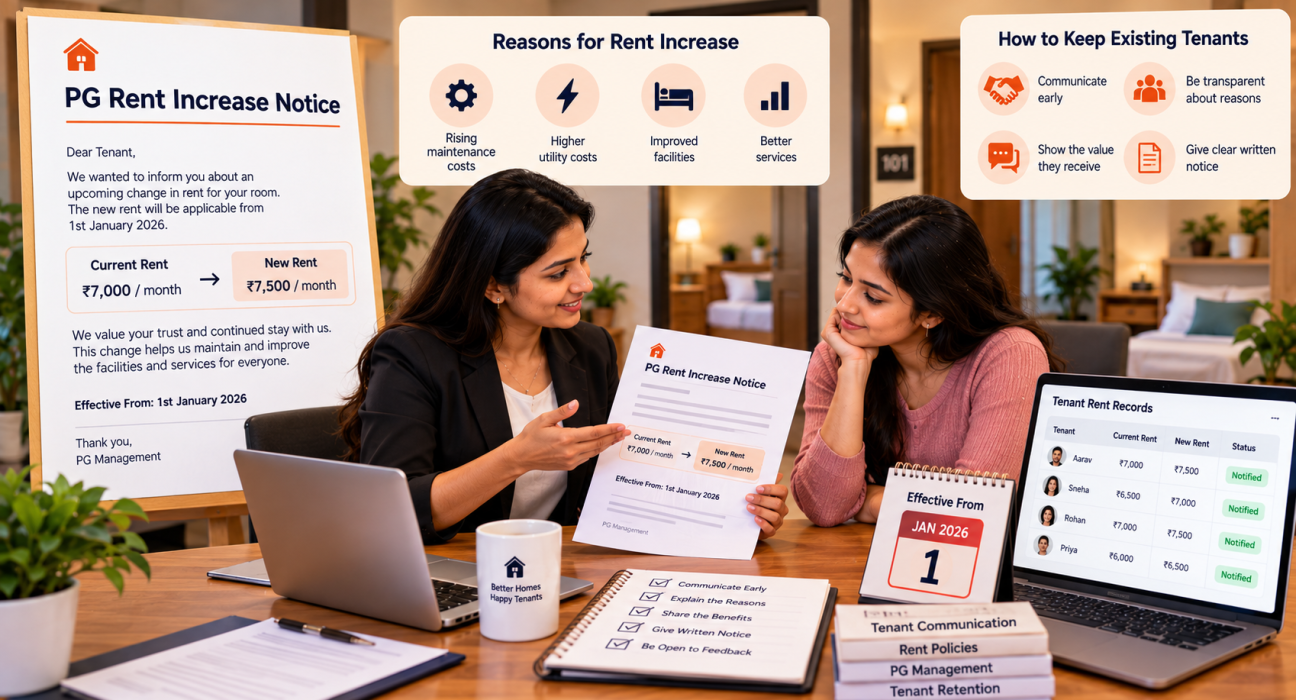
Costs go up whether you announce it or not. Electricity, the cook’s salary, building maintenance, and the water tanker – none of them waits for your rent to catch up. Eventually the numbers force a decision, and that’s where many owners stumble. They send a one-line message on the 28th saying “rent will be ₹X from next month,” and then spend a week answering angry replies and wondering who’s quietly looking at the PG down the road.
A good PG rent increase notice does more than announce a number. It gives tenants time, shows them the reason, treats everyone the same and leaves room for a conversation. This guide covers how to decide the amount, when to give notice, what to say and how to handle pushback. If you use PG and hostel management software, your rent records and tenant details are already in one place when you start.
The Short Answer
To raise rent without losing tenants, decide the increase from your real costs and nearby rents, give written notice well ahead of time as your agreement requires, explain the reason in plain words, keep the rise modest, apply it fairly to everyone, offer something in return where you can and be ready to talk. Put the final terms in writing and record them.
Why Rent Increases Cause So Much Friction
Tenants rarely object to the idea that costs rise. What bothers them is how it’s done.
- Short notice. They have no time to plan or compare options.
- No explanation. An unexplained rise feels arbitrary.
- Unequal treatment. Finding out a neighbour pays less for the same bed stings.
- A big jump. Large rises make people start searching.
- Poor timing. An increase right after a service failure feels insulting.
- No conversation. A message with no room to respond feels like a decree.
Fix these, and most increases land far more gently than owners expect.
Step 1: Work Out Whether and How Much to Raise
Start with your own numbers, not a feeling. Look at three things.
Your costs
Compare this year’s expenses with last year’s: electricity, staff, repairs, groceries, water, internet and building rent or loan payments. If you haven’t tracked them, use recent bills. The question is simple: what has actually changed?
Your market
Check what nearby PGs charge for similar beds and facilities. Compare like with like: sharing type, food, WiFi, location and condition. If you’re already near the top, a big rise is risky. If you’re well below, you may have room.
Your value
Ask honestly whether tenants are getting something better than a year ago. Faster repairs, cleaner rooms, better WiFi and reliable water all support an increase. Neglect doesn’t.
A quick sense check
Here’s an example with assumed figures.
| Item | Amount |
|---|---|
| Current rent per bed | ₹6,000 |
| Proposed increase | ₹300 (5%) |
| Beds | 20 |
| Extra rent per month if everyone stays | ₹6,000 |
| Extra rent over a year | ₹72,000 |
| If 2 tenants leave and each bed sits empty 20 days | About ₹8,000 lost rent |
| Extra rent from the 18 who stay, over a year | About ₹64,800 |
The numbers show a modest rise can pay for itself even if a couple of tenants leave, especially since new tenants join at the new rent. They also show why a large jump is riskier: the more you ask, the more tenants may leave, and the cost of each vacancy adds up. Use your own figures, and take care not to assume that nobody will leave.
Step 2: Choose Timing Carefully
When you raise rent matters nearly as much as how much.
- Give plenty of notice. Check your agreement and local practice for notice requirements, and add extra time if you can.
- Link it to a natural point, such as renewal, the start of a new term or an annual review, instead of mid-stay surprises.
- Avoid awkward moments, such as just after a long outage, during exams for student PGs or in the middle of a dispute.
- Think about your calendar. If many tenants renew around the same time, you may want to stagger or at least prepare for the busy period.
- Don’t change rent mid-term unless your agreement allows it.
If your agreement doesn’t mention rent changes, fix that in your template for new tenants, and handle existing ones carefully. Check whether any local rules limit rent increases or require specific notice before you finalise anything.
Step 3: Decide How to Apply the Increase
You have several options, and the right one depends on your PG and tenants.
| Approach | How it works | Pros | Cons |
|---|---|---|---|
| Increase for everyone at once | Same date, same percentage | Simple and equal | Can feel like a big moment |
| Increase at each tenant’s renewal | Applied when their term ends | Feels natural and spaced out | Rents differ for a while |
| Increase for new tenants first | Existing tenants stay at the old rent for a period | Gentler on current tenants | Leaves money on the table, and creates a gap |
| Phased increase | A small rise now, another later | Easier to absorb | Needs clear communication of both steps |
Whatever you pick, apply it consistently. If long-stay tenants get different treatment, say so in your policy so it’s clear why. If you have a rent concession policy, check how it interacts with an increase, such as a freeze for long-stay tenants.
Step 4: Prepare the Reason
“Costs have gone up” is a start. Specifics are more convincing, and honest ones are more respected.
Good reasons, if true:
- Electricity, water or maintenance costs have risen
- Staff salaries have increased
- You’ve upgraded something, such as WiFi, furniture, mattresses or security
- Building rent or loan payments have gone up
- Rents in your area have risen, and you’ve kept yours below market for a while
Reasons to avoid:
- Anything that isn’t true
- Blaming tenants
- Vague phrases like “market conditions” with no detail
- Reasons that contradict what tenants see, such as claiming upgrades that haven’t happened
You don’t need to share your accounts. A short, honest summary is enough: “Electricity and maintenance costs have gone up this year, and we’ve upgraded the WiFi. We’re raising rent by ₹300 from [date].”
Step 5: Write a Clear Notice
A good notice is short, specific and polite. It answers the questions tenants will ask before they ask them.
What to include
- Tenant name, room and bed
- The current rent and the new rent
- The effective date
- The reason, in a sentence or two
- What stays the same, such as deposit, services or terms
- How to ask questions, and who to contact
- The date of the notice and who sent it
A sample notice
Adapt this to your PG. The figures are placeholders.
Dear [Name],
We hope you’re settled and comfortable. We’re writing to let you know that the rent for your bed in Room [number] will change from ₹[current amount] to ₹[new amount] per month, starting from [date].
Our costs for electricity, staff and maintenance have risen over the past year, and we’ve [mention any real improvement, such as upgraded WiFi]. This is our first rent change in [period].
Your deposit and all other terms stay the same. This change applies to all tenants in the same room type.
If you’d like to talk about this, please reach out to me at [contact] before [date], and we’ll be happy to discuss it.
Thank you for staying with us.
[Your name]
Send it in writing, by message or print, and keep a copy. Check your agreement and local practice for how notice must be given.
Step 6: Tell Tenants Personally, Not Just by Message
A written notice protects you. A conversation protects the relationship. Do both.
- Speak to long-stay tenants in person, or by phone, before or alongside the message.
- Pick a calm moment, not the middle of a complaint or a busy evening.
- Lead with appreciation, and mention how long they’ve been there.
- State the change clearly, and give the reason.
- Ask how they’re doing, and listen to any concerns about the PG.
- Don’t over-apologise, and don’t be defensive. Be matter-of-fact and kind.
A tenant who hears it from you, with a reason, is much more likely to stay than one who finds it in a group chat.
Step 7: Sweeten It Where You Can
An increase feels easier to accept when something comes with it. You don’t have to give anything away, but small gestures help.
- A rent freeze period for the longest-staying tenants, if you have a concession policy
- A real upgrade delivered around the same time, like a new mattress, better lighting or repainted rooms
- A fixed term at the new rent, so tenants know it won’t rise again soon
- A phased approach, spreading a larger rise over two steps
- Faster fixes on any open complaints before the notice goes out
- An option to change bed or room, if there’s a lower-priced one available
Don’t promise upgrades you can’t deliver. Delivering the improvement before or alongside the rise is the most convincing approach.
Step 8: Handle Pushback Calmly
Some tenants will push back. That’s normal, and most conversations are manageable.
Common reactions and how to respond
“Why now?”
“Our costs have gone up over the past year, and this is the first change in [period]. I wanted to give you plenty of notice.”
“My friend pays less in another PG.”
“I understand. It’s worth comparing what’s included, like food, WiFi, cleaning and power backup. If our rent still doesn’t suit your budget, I’m happy to talk about what could work.”
“I can’t afford it.”
“Thanks for telling me. Let’s talk about it. Could I check whether a different bed or sharing type would help, or whether we can agree a short phased step?”
“You’re only doing this because you can.”
“I understand it feels that way. The change is tied to higher costs, and it applies the same way to everyone. I’m glad to explain more if you’d like.”
“I’ll leave.”
“I’d be sorry to see you go. If it helps, let’s talk about options. If you do decide to move, I’ll make the move-out as smooth as I can.”
Listen first, avoid arguing and don’t make promises you can’t keep. If the reaction is strong, let it sit for a day and speak again.
Step 9: Decide in Advance How Flexible You’ll Be
Going into conversations without a plan leads to inconsistent decisions. Decide the limits beforehand.
- Who can you flex for? Long-stay, reliable tenants who ask politely, perhaps.
- How far can you go? A smaller rise, a delay or a phased approach, within a limit you’ve set.
- What won’t you flex on? The principle that the policy applies to all.
- Who decides? You, or a manager within set limits.
- How will you record exceptions? Note the reason, the amount and the end date.
Check the break-even before agreeing to any exception. If a smaller rise keeps a good tenant, it’s often worth it. If it quietly becomes the norm, it isn’t.
Step 10: Record and Follow Up
After the notice goes out, make sure the rest of your system follows.
- Update the rent in your records from the effective date, for each tenant.
- Keep copies of notices and replies.
- Note any exceptions with reasons and end dates.
- Check the first bills. Are they correct, and do reminders show the new amount?
- Watch for move-outs over the next few months, and note the reasons given.
- Review in six months. Did the increase cover your costs? Did you lose more tenants than expected?
PGCRM saves rent against each tenant, records cash and UPI payments, sends automatic reminders before rent is due and shows income reports, so you can check that collections match the new amounts. It supports monthly or join-date billing cycles, which helps when tenants’ due dates differ. It doesn’t list a rent-increase notice template or bulk notice sending, so write and send notices yourself and keep a log of who was told what, and when.
A Short Checklist Before You Send a Notice
- Costs and market rents checked
- Increase kept modest and justified
- Agreement and local rules checked for notice and limits
- Effective date set, with generous notice
- Reason prepared, honest and specific
- Notice written clearly, with contact details
- Long-stay tenants told in person
- Open complaints and visible problems fixed
- Flexibility limits decided, with exceptions recorded
- Records and reminders ready to update
Common Mistakes With a PG Rent Increase Notice
- Giving short notice. People need time, and your agreement may require it.
- Raising rent without a reason. Silence invites suspicion.
- Making a big jump. Smaller, regular changes land better than one large one.
- Applying it unequally without explanation. Tenants compare.
- Sending it only by message. Important notices deserve a conversation.
- Raising rent just after a service failure. Fix problems first.
- Arguing during pushback. Listen, then respond.
- Promising what you can’t deliver. Upgrades must be real.
- Forgetting to update records and reminders. Billing errors cause fresh disputes.
- Not tracking what happens next. Without review, you won’t know if it worked.
FAQ
How do I write a PG rent increase notice?
Include the tenant’s name and room, the current and new rent, the effective date, a short honest reason, what stays the same and who to contact with questions. Keep it polite and brief, send it in writing, and keep a copy. Check your agreement for how notice must be given.
How much notice should I give before increasing PG rent?
Give as much as is reasonable, and at least what your agreement and local practice require. Longer notice gives tenants time to plan and compare options, which usually softens the reaction. Check your agreement and any local rules before choosing a date.
How much can a PG increase rent each year?
There’s no universal figure. Base it on your actual cost increases and nearby rents, and keep it modest. Rules or practices may limit increases in some places, so check your agreement and local requirements before deciding.
How do I raise rent without losing tenants?
Give early notice, explain the reason honestly, keep the increase modest, apply it fairly, tell long-stay tenants personally and, where you can, pair it with a real improvement or a small concession. Be ready to listen and to discuss options with tenants who struggle.
What if a tenant refuses to pay the increased rent?
Talk to them first, understand the reason and consider a phased step or another bed type if it works for you. If they still refuse, follow the process in your agreement and check local rules before taking serious steps. Never use lockouts or threats.
Can software help with PG rent increases?
It helps with the records. PGCRM saves rent against each tenant, records cash and UPI payments, sends reminders, supports monthly or join-date billing and shows income reports. It doesn’t list a notice template or bulk notice feature, so write and track notices yourself.
Conclusion
A good PG rent increase notice is honest, early and kind. Base the rise on real costs and local rents, choose your timing and approach, explain the reason in plain words, tell long-stay tenants in person, add something of value where you can and listen to the response. Record everything, and review the results after a few months.
Clear, current records make the whole process smoother. If you’d like tenant details, rent, reminders and income reports in one place, explore PGCRM to simplify your PG and hostel management.