

How to Improve First-Call Conversion Rates in Telecalling
Most telecalling teams don’t lose leads because their agents lack effort. They lose them in the first few minutes of contact: a slow callback, a poorly timed call, or an agent who dials without knowing the lead’s history. Teams that fix these basics usually see better results without increasing their call volume. A telecalling CRM with lead management and follow-up tools can help you build that process, but the process itself matters more than any tool.
This guide explains what the first call conversion rate is, why first calls fail, and eight practical steps to improve it.
What Is First Call Conversion Rate, and How Do You Improve It?
First call conversion rate is the percentage of leads who reach your agreed outcome on the very first call. That outcome could be a sale, a booked demo, a site visit, a counselling slot or a document submission.
You improve it by reaching leads quickly, preparing before every dial, asking better questions, agreeing a clear next step during the call, and reviewing calls regularly. Most of the gains come from process discipline, not from a cleverer pitch.
How to Measure First Call Conversion Rate
Decide what “converted” means for your business before you measure anything. A real estate team may count a confirmed site visit. An insurance team may count a completed proposal form.
A simple formula:
First call conversion rate = (Leads converted on the first call ÷ Total leads called for the first time) × 100
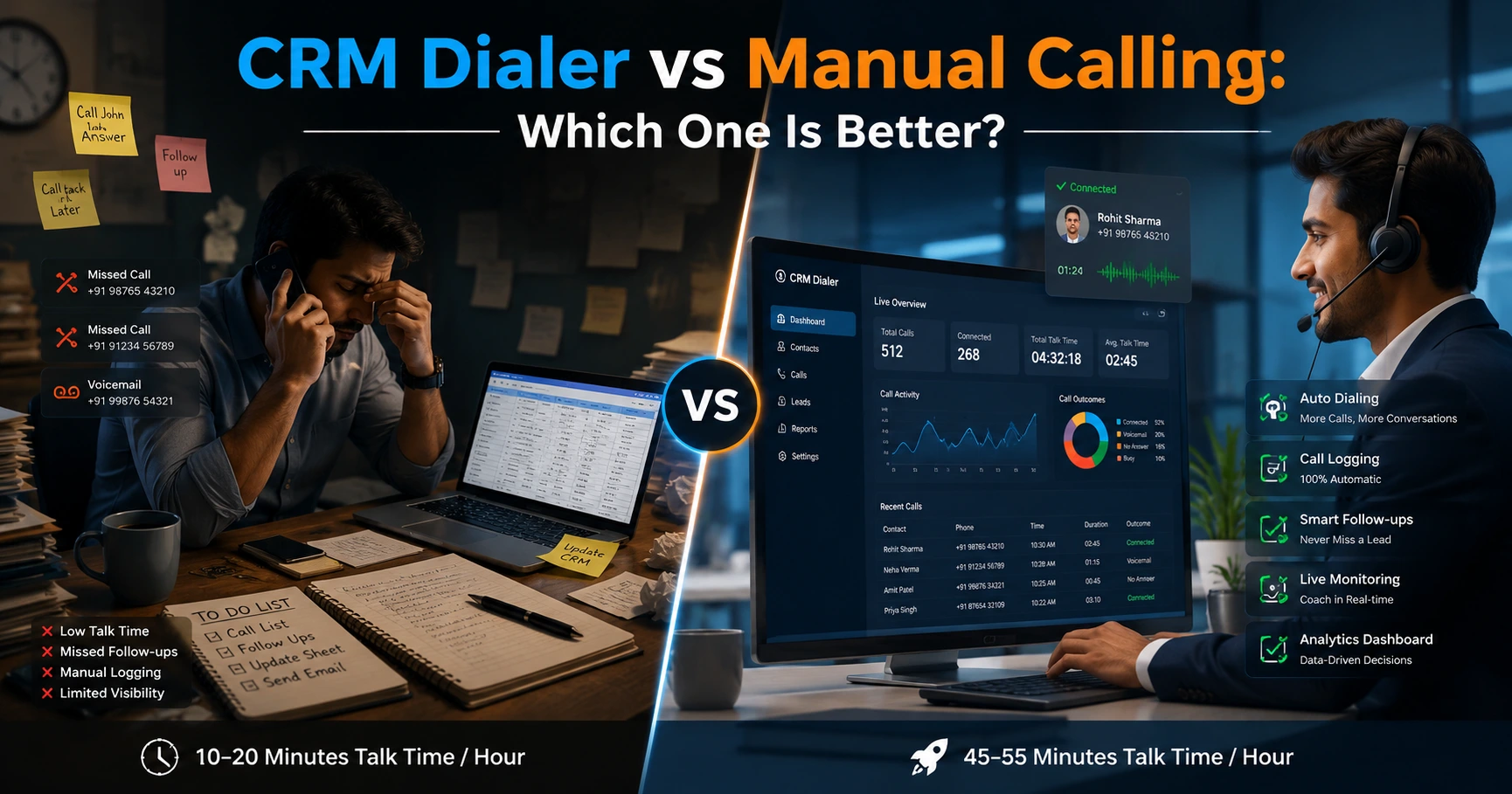
Track a second number alongside it: the first-call connect rate, which is the share of first dials that reach a live person. A low conversion rate can simply mean agents aren’t reaching people, and the fix for that is different from the fix for a weak conversation.
Why First Calls Fail
Before improving anything, find out where your first calls are breaking down. The usual causes are:
- Slow response. The lead enquired in the morning and got a call the next evening, by which time they had spoken to someone else.
- Poor lead quality or wrong routing. The lead was assigned to an agent who doesn’t handle that product, city or language.
- No context. The agent doesn’t know which ad, form or portal the lead came from.
- Bad timing. The lead is called during working hours or when they are clearly busy.
- Weak opening. The agent starts with a long pitch instead of a reason to talk.
- No clear next step. The call ends with “I’ll think about it” and nobody follows up.
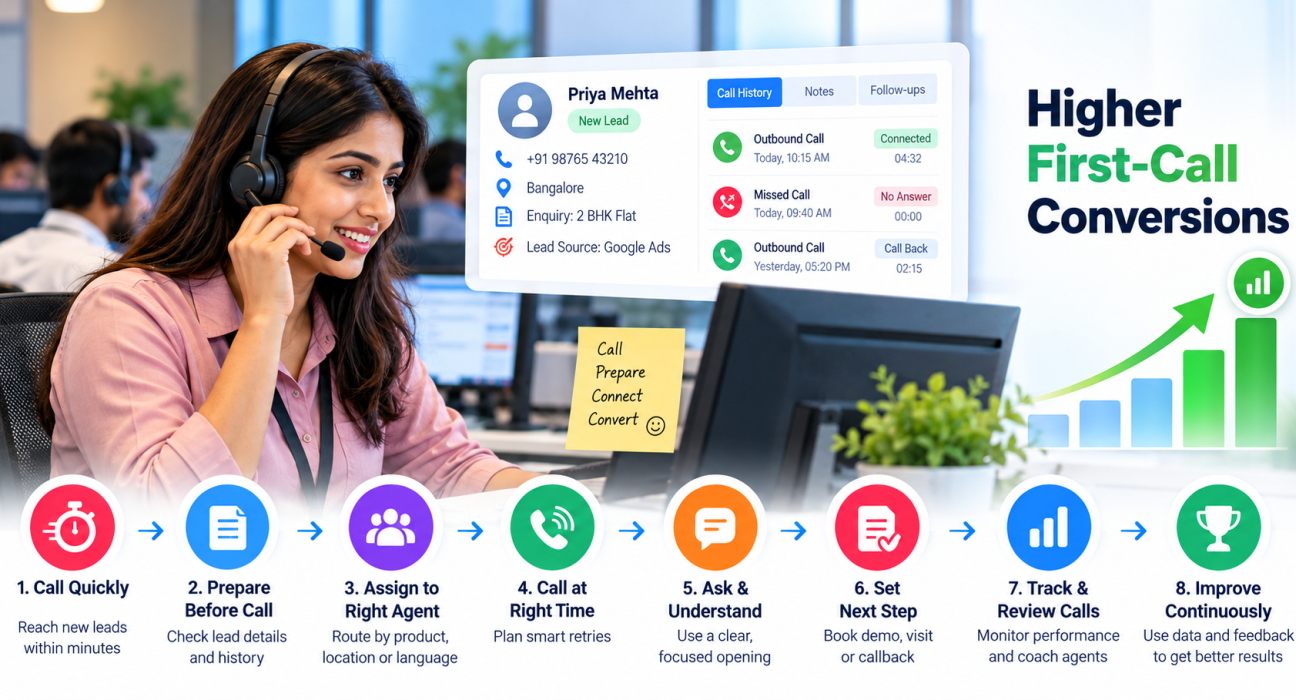
8 Practical Steps to Improve First-Call Conversion Rates
1. Call new leads as fast as you can
Speed is the most repeatable lever in telecalling. A well-known Harvard Business Review study, The Short Life of Online Sales Leads, looked at how companies handled online enquiries. It found that many firms responded slowly or not at all, and that firms contacting leads within an hour were far more likely to have a meaningful conversation with a decision maker than those who waited longer. The research covered US companies, so treat the exact multiples as directional for India. The principle still holds.
Set a clear response target, such as “every new lead is called within 15 minutes during working hours,” and measure it every day.
2. Prepare for 30 seconds before each dial
A quick look at the lead record changes the tone of the call. Before dialling, the agent should know:
- The lead source and the enquiry details
- Any previous calls, notes or WhatsApp messages
- The product or course the lead asked about
- Name, city and preferred language
“I saw you enquired about 2-BHK flats in Whitefield” sounds very different from “Hello, did you fill a form?”
3. Route leads to the right agent
Random assignment wastes first calls. Assign leads by product, location, language, lead source or agent skill. Remove duplicates before assigning, so two agents don’t call the same person on the same day. Also screen numbers against your Do Not Call list, since calling people who opted out damages trust and creates compliance risk.
4. Call at sensible times, and plan retries
If the first dial isn’t answered, don’t give up and don’t hammer the number either. A simple retry pattern works better:
- Call immediately when the lead arrives.
- Retry after 30 to 60 minutes.
- Retry at a different time of day, such as evening or lunch hour.
- Send a short WhatsApp message saying you tried to reach them.
Track the outcome of every attempt (not answered, busy, switched off, wrong number) so retries are planned and not random.
5. Open with a reason, then ask questions
The first 20 to 30 seconds decide whether the lead stays on the line. Introduce yourself, state why you are calling, and ask permission for a short conversation.
Then ask before you pitch. Good discovery questions are short and specific:
- What made you enquire about this?
- What are you comparing right now?
- By when do you want to decide?
- What would make this a good fit for you?
A lead who explains their need is more likely to accept your recommendation.
6. Use scripts as guides, not as scripts to read out
A call script should give structure: the opening, key questions, common objections and the closing step. It should not sound like a recording. Let agents adapt the wording and keep the flow. Update scripts based on real objections your team hears, such as price, timing, “send details on WhatsApp” or “call me later.”
7. End every call with a specific next step
“I’ll call you back” is not a next step. “I’ll call you Thursday at 5 pm after you’ve spoken to your family” is. Even if the lead doesn’t convert on the first call, a booked callback, a scheduled demo or a document request keeps the deal alive.
Log the next step and the date in your CRM immediately, with a reminder, so it doesn’t depend on the agent’s memory.
8. Review calls and coach agents every week
Averages hide the real problems. Listen to a few calls from your best and weakest agents each week and compare:
- How quickly they establish why they are calling
- How many questions they ask before pitching
- How they handle price objections
- Whether they confirm the next step clearly
Share one or two specific improvements per agent. Short, regular coaching beats long monthly reviews.
Realistic Examples (Hypothetical)
These are illustrative scenarios, not customer case studies.
Real estate. A builder’s team gets leads from property portals and Facebook ads. If an enquiry about a 3-BHK is called within minutes and the agent already knows the budget range and location from the form, the conversation can move straight to a site visit. If the same lead waits until the next day, they may already have visited two other projects.
Education. A coaching institute receives admission enquiries in the evening. An agent who calls next morning without knowing which course the student asked about will spend the first minute on basics. A better approach is to call quickly, confirm the course, then book a counselling slot with a counsellor who handles that stream.
Metrics to Track Alongside First Call Conversion Rate
| Metric | What it tells you |
|---|---|
| Speed to first call | Whether leads are contacted while interest is fresh |
| First-call connect rate | Whether your dialling times and retry plan work |
| Talk time per connected call | Whether agents are having real conversations |
| Next-step booking rate | How many unconverted first calls still move forward |
| Follow-up completion rate | Whether promised callbacks actually happen |
| Conversion by lead source | Which sources send serious buyers |
Common Mistakes to Avoid
- Measuring only call volume. More dials don’t help if the first calls are poor.
- Not defining “conversion.” Each team member counts something different.
- Reading scripts word for word. Leads can tell.
- Calling without context. It signals that you don’t value the lead’s time.
- Letting follow-ups depend on memory or Excel notes. Callbacks get missed.
- Blaming lead quality without checking the data. Compare conversion by source before deciding.
How TeleCallingCRM Can Help
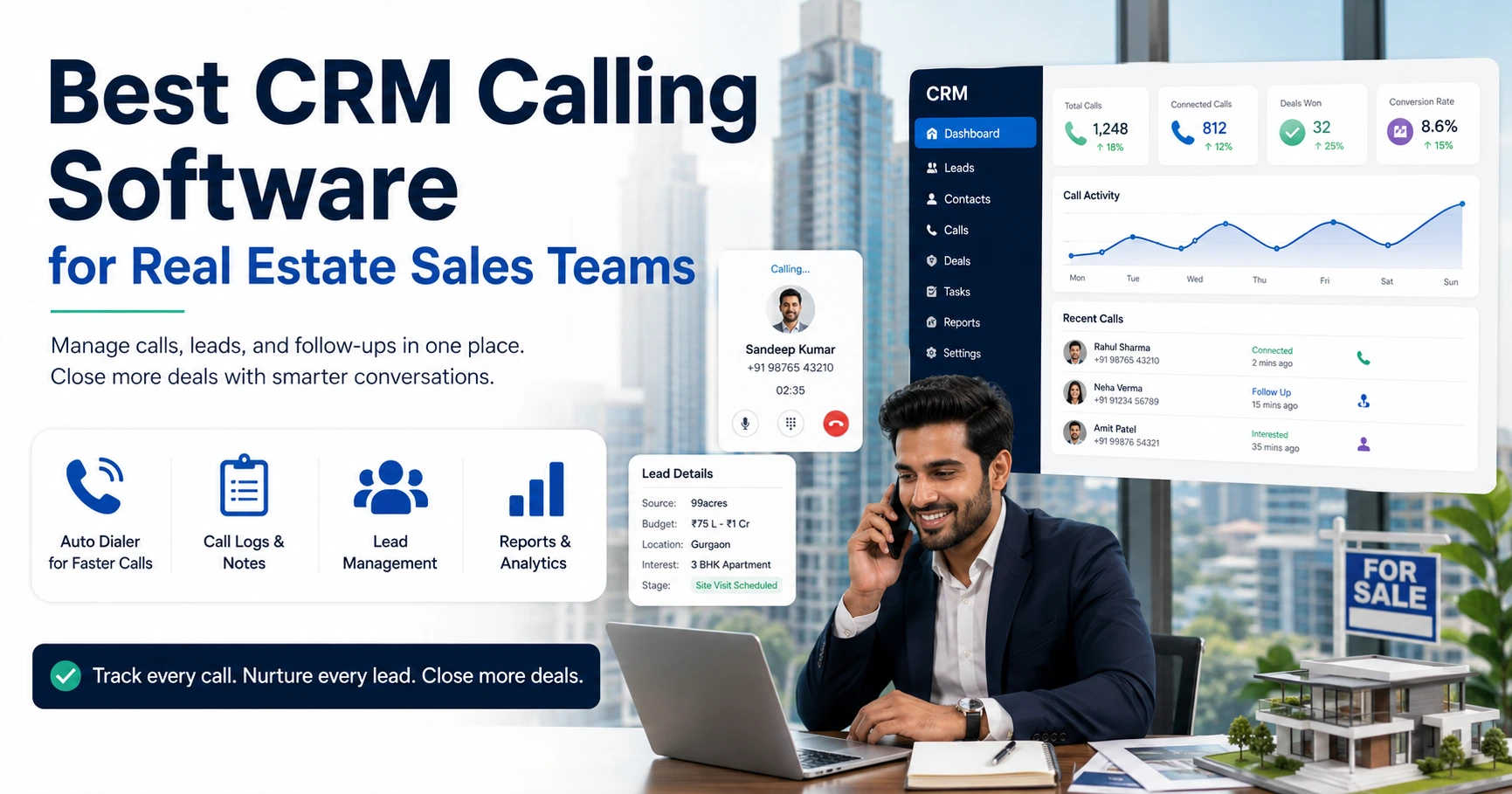
A CRM doesn’t fix a weak pitch, but it removes many process gaps that hurt first calls. According to the TeleCallingCRM features page, the platform includes:
- Lead import with automatic de-duplication and DNC checks
- Lead assignment rules and lead scoring
- Lead integrations with sources such as Facebook and Instagram Lead Ads, Google Ads, 99acres, MagicBricks and JustDial
- An auto dialer, call recording and notes
- Follow-up scheduling with reminders and overdue alerts
- Call scripts and custom fields
- AI call analysis with transcripts, summaries, sentiment and coaching notes
- Reports on connection and answer rates, plus a live team monitor
Businesses with specific workflows can also look at industry pages such as the real estate CRM and education CRM. Managers who want to understand live team monitoring can read how the Live War Room and reports work.
You can compare plans on the pricing page and check what is included before deciding.
Frequently Asked Questions
What is a good first call conversion rate in telecalling?
There is no single benchmark. It depends on your industry, lead source, ticket size and how you define conversion. Instead of chasing a general number, measure your own baseline for a month, split it by lead source and agent, and aim to improve it steadily.
How can I improve first call conversion rate quickly?
Start with response speed and lead context. Call new leads within a fixed time window, make sure agents see the lead source and past notes before dialling, and end every call with a dated next step. These changes need no extra budget.
How soon should I call a new lead?
As soon as possible, ideally within minutes during working hours. Research on online lead response shows that contact within the first hour is far more likely to lead to a real conversation than later contact. Set an internal target and track it daily.
Should every first call aim to close the sale?
Not always. For high-value or complex products, the realistic goal may be a demo, site visit or qualified conversation. Define a clear first-call outcome for each product so agents know what success looks like.
How many times should agents retry unanswered leads?
There is no fixed number. A common approach is several attempts across different times of day over a few days, supported by a WhatsApp message. Always respect DNC preferences and stop when a lead asks not to be contacted.
Can a telecalling CRM improve first call conversion rate?
It can help by speeding up lead assignment, giving agents lead history, scheduling follow-ups and recording call data for coaching. It works best alongside a clear calling process and regular training.
What is the difference between connect rate and conversion rate?
Connect rate is the share of dials that reach a live person. Conversion rate is the share of leads that reach your target outcome. Tracking both shows whether the problem is reaching people or persuading them.
Conclusion
Improving your first call conversion rate comes down to a few habits: respond quickly, prepare before each call, route leads sensibly, ask good questions, set a clear next step and coach from real calls. Start with one or two changes, measure the result for a few weeks, then add more.
If you want to see how lead follow-up software fits into this process, you can request a demo from the TeleCallingCRM team and check whether it suits your workflow.