


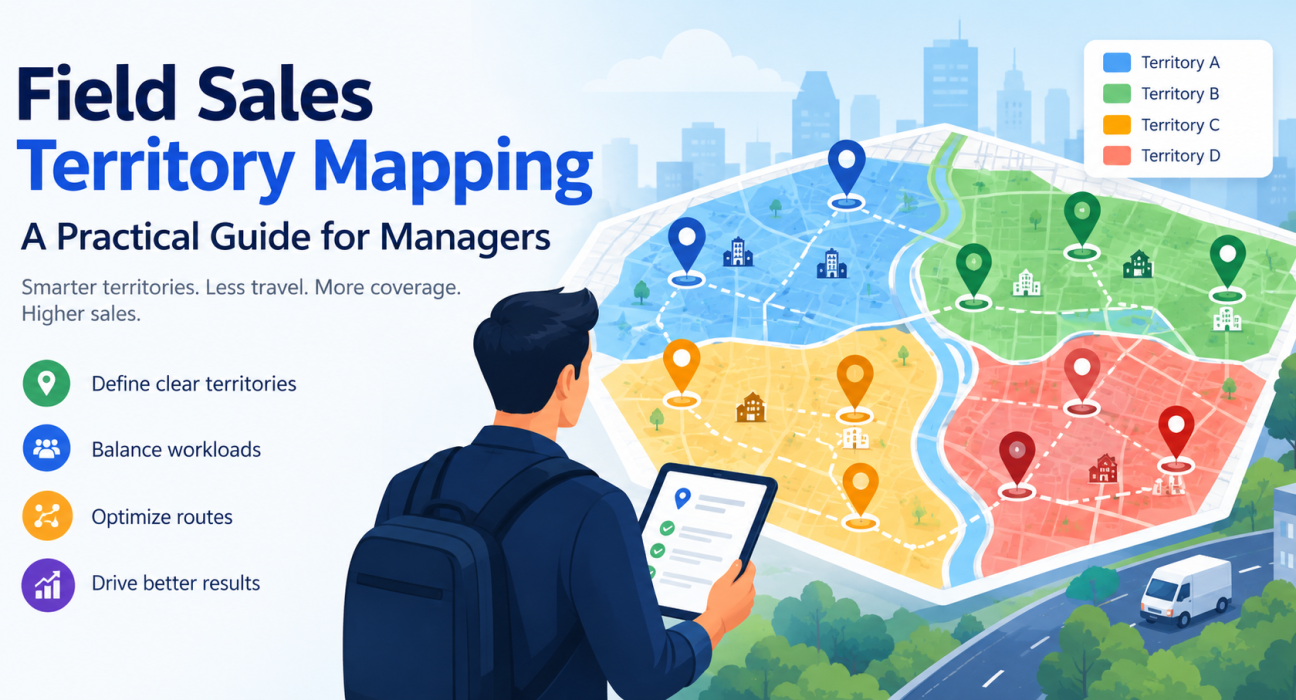
Field Sales Territory Mapping: A Practical Guide for Managers
Two reps chase the same customer while a profitable pocket of the city gets no visits for weeks. Another rep spends half the day in traffic and closes fewer deals than a colleague with a compact patch. These are usually not performance problems. They are territory problems.
Field sales territory mapping is how managers fix them. This guide covers what it is, how to build territories step by step, which mistakes to avoid, and how software can keep your map accurate as the business changes.
What Is Field Sales Territory Mapping?
Field sales territory mapping is the process of dividing a market into defined geographic areas and assigning each one to a sales rep or team. The map shows where customers and prospects are, how far apart they sit, and how much work each area holds.
A good territory map gives every rep a workload they can actually cover. It also reduces overlap between reps and keeps high-potential areas from being neglected.
Territory mapping is the visual and geographic half of sales territory management. Management adds the ongoing work of reviewing performance, rebalancing workloads and adjusting boundaries.
Why Territory Mapping Matters for Field Sales Teams
Field reps are paid to meet customers, not to drive. Poorly drawn territories waste selling time and create friction between reps.
- Lower travel time: Compact, logical territories mean less backtracking between visits.
- Better coverage: Every account and prospect has an owner, so none fall through the cracks.
- Fairer workloads: Reps carry comparable opportunity, which makes targets and incentives easier to defend.
- Fewer conflicts: Clear boundaries reduce disputes over who owns an account.
- Better forecasting: When territories are defined, you can compare like with like across the team.
The Main Types of Sales Territories
The right model depends on what you sell and how your customers are distributed.
| Territory Type | How It Is Divided | Best For |
|---|---|---|
| Geographic | By city, district, PIN code or region | Distribution, retail, general field sales |
| Account-based | By named customers or segments | Enterprise or key-account selling |
| Industry-based | By vertical, such as pharma or FMCG | Specialized products needing domain knowledge |
| Revenue-potential | By estimated sales opportunity | Teams balancing high- and low-value areas |
| Hybrid | A mix, such as geography plus account tier | Larger, more complex teams |
Most field teams start with geographic territories and layer other factors on top.
How to Map Field Sales Territories: Step by Step
To map field sales territories: define your goals, gather customer data, choose a division method, balance workloads, assign reps, and review regularly.
Step 1: Define What the Territories Should Achieve
Decide what you are optimizing for before you draw a single boundary. The goal might be more customer visits, fewer idle hours, better coverage of new areas, or higher revenue from key accounts. That goal drives every decision that follows.
Step 2: Gather and Clean Your Customer Data
List every active customer, dormant account and qualified prospect, along with a location for each. Add what you know about their value, such as past order volume, visit frequency and account tier.
Territory maps are only as good as the data behind them. Duplicate records and missing addresses produce distorted territories.
Step 3: Choose Your Territory Building Blocks
Pick a unit that matches how your team works. Common choices are PIN codes, city zones, districts or customer clusters. Smaller units give you finer control when you need to rebalance later.
Step 4: Balance Workload and Opportunity
Equal geography does not mean equal work. A small, dense market can demand more than a large rural one. Compare territories on factors such as:
- Number of accounts and prospects
- Expected visit frequency per account
- Travel distance between customers
- Revenue potential or account value
- Time needed per visit
Your aim is territories where a rep can realistically complete the planned visit cycle.
Step 5: Assign Reps to Territories
Match reps to territories using experience, language, local relationships and product knowledge. Where possible, keep existing rep-customer relationships intact. Disrupting trusted relationships can cost more than a slightly imperfect boundary.
Step 6: Translate Territories Into Visit Plans
A territory is only useful once it becomes a schedule. Break each territory into beats or daily routes with a clear visit frequency for each account tier. This is where beat planning and route optimization come in.
Step 7: Track, Measure and Realign
Review how territories perform against targets, visit completion and travel time. Markets shift, customers move and reps join or leave, so a map set once and never revisited soon goes stale.
Key Data Points to Consider When Designing Territories
The strongest territory designs combine several inputs rather than relying on geography alone.
- Customer density: Where accounts cluster and where they are sparse
- Historical sales: Which areas have delivered results and which have underperformed
- Market potential: Untapped areas with realistic growth
- Travel and accessibility: Road conditions, distances and typical travel time
- Rep capacity: Number of visits a rep can complete in a day or week
- Account priority: Key accounts that need more frequent attention
Common Territory Mapping Mistakes
Even experienced managers repeat a few predictable errors.
- Dividing by area alone. Equal square kilometers say nothing about equal opportunity.
- Ignoring travel time. Two accounts close on a map may be far apart in real traffic.
- Setting territories and forgetting them. Unreviewed boundaries drift away from reality.
- Overlapping territories without rules. Overlap can be intentional, but it needs clear ownership rules.
- Relying on rep opinion alone. Experience helps, but decisions need data.
- Having no visibility into actual coverage. Without field data, you cannot tell whether a territory is truly being covered.
Territory Mapping vs. Route Planning vs. Beat Planning
These terms are related but not interchangeable.
| Concept | What It Answers | Time Horizon |
|---|---|---|
| Territory mapping | Which area and which accounts belong to which rep? | Weeks to months |
| Beat planning | On which day and how often should each account be visited? | Weekly or monthly cycle |
| Route planning | In what order should today’s visits happen? | Daily |
Territory mapping sets the boundaries. Beat plans organize visits inside them. Route planning sequences each day to cut travel time.
How Software Supports Field Sales Territory Mapping
Spreadsheets and static maps work for small teams. As the team grows, they struggle to show what is actually happening in the field.
Field force management software helps in several practical ways:
- Live visibility: See where reps are and which customers have been visited.
- Verified visits: Confirm that planned visits happened, using location and proof of visit.
- Data for rebalancing: Compare planned coverage against actual coverage by territory.
- Beat and route support: Turn territories into daily plans that reduce unnecessary travel.
- Consistent reporting: Track KPIs by rep, route or territory in one place.
These capabilities do not replace the strategic thinking behind territory design. They give managers the evidence to design territories well and correct them quickly.
How FieldExecutives Can Help
Businesses looking to simplify these processes can use field force management software such as FieldExecutives.
According to the FieldExecutives website, the platform supports location-based roles, territories and routing, along with several capabilities that connect territory plans to daily execution:
- Live GPS tracking and a team map to see how field activity unfolds across territories
- Geofenced attendance and proof of visit (photo, signature or OTP) to verify that planned visits took place
- AI route and beat-plan optimization to organize each rep’s day and reduce travel
- Real-time KPIs and reports to compare performance across reps and areas
- Custom forms and workflows to capture the information your team needs on each visit
Industry-specific setups are available for teams such as FMCG and distribution and pharma and medical reps, where coverage and beat discipline matter most.
Best Practices for Managers
- Start from data, not assumptions. Build maps from customer records and visit history.
- Review territories on a fixed schedule. Quarterly or half-yearly reviews work for many teams.
- Protect strong customer relationships. Avoid reshuffling accounts without a clear reason.
- Set visit frequency by account tier. High-value accounts deserve more attention.
- Communicate changes early. Explain the reasoning so reps see boundaries as fair.
- Compare plan to reality. Use field data to see where coverage actually falls short.
Conclusion
Field sales territory mapping decides where your team’s hours go. Done well, it reduces wasted travel, spreads opportunity fairly and makes sure every account has an owner. Done once and ignored, it drifts out of step with the market.
The practical takeaway is simple: build territories from real data, turn them into beat and route plans, and review them against what your field team actually does. Software that provides live visibility and verified visit data makes that review far easier.