

Best Field Sales Tracking Software for Indian Businesses
A sales manager in Pune finds out a client visit never happened only when the client calls to complain. A distributor in Indore pays fuel reimbursements based on a rep’s word, with no way to check the route actually taken. A pharma company discovers, weeks later, that half its doctor visits for the month were never logged.
These aren’t rare stories. They’re what happens by default when field sales teams run on phone calls, WhatsApp updates, and paper diaries. Field sales tracking software exists to close exactly this gap — giving businesses real-time visibility into where their sales reps are, what they’re doing, and whether the work is actually getting done.
This guide walks through what field sales tracking software actually does, the features that separate a useful tool from a glorified GPS pin, and how to evaluate options for an Indian business — where connectivity, geography, and team size vary widely from one region to the next.
What Is Field Sales Tracking Software?
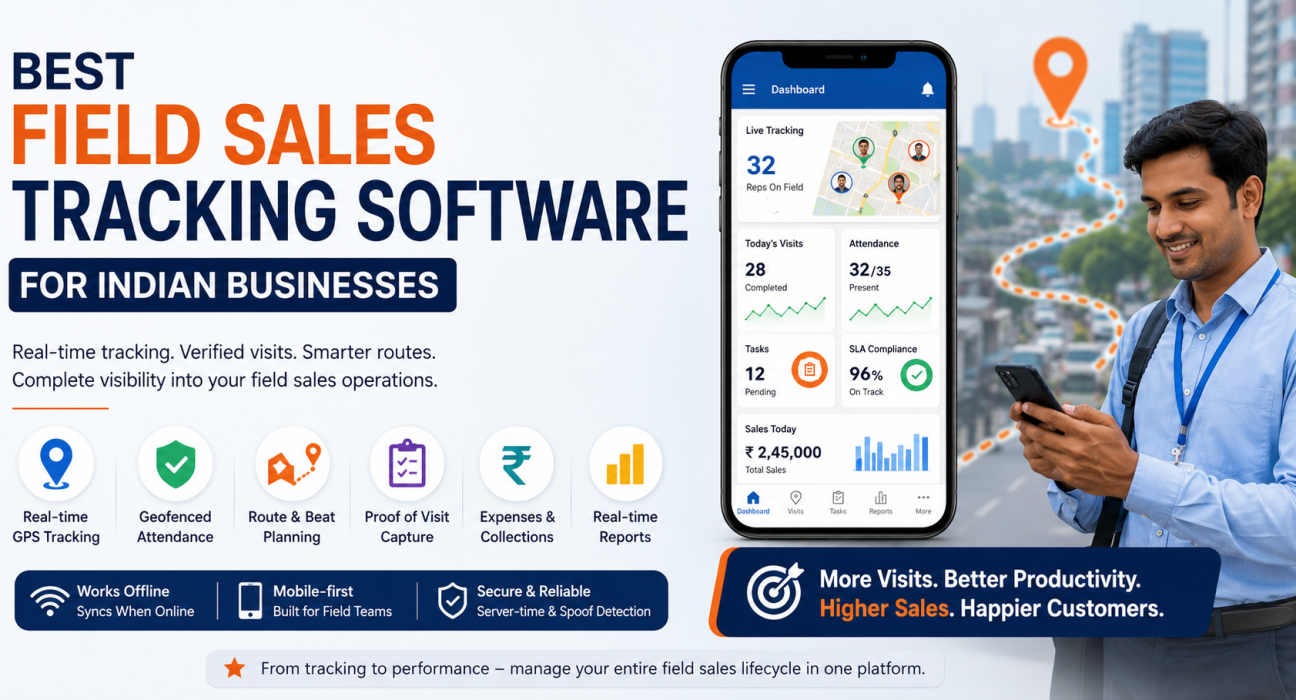
Field sales tracking software is a mobile-and-web platform that lets businesses monitor and manage sales representatives working outside the office. It typically combines GPS location tracking, attendance capture, visit verification, route planning, and reporting into a single system, replacing manual check-ins, phone calls, and spreadsheets.
In short: it answers three questions in real time — where is my team, what are they doing, and is it working?
Why Indian Businesses Are Moving Beyond Diaries and WhatsApp
Field sales in India runs on scale and geography that manual tracking simply can’t handle. A single FMCG distributor might have reps covering dozens of towns; a pharma company might have medical representatives visiting hundreds of doctors and chemists every month. Manual processes break down fast at that scale.
Common problems businesses run into without a proper system:
- No visibility once reps leave the office — managers have no idea who’s where, or whether a scheduled visit happened at all.
- Unverifiable attendance — punch-ins based on a phone’s local time or a WhatsApp “good morning” message are easy to fake.
- Inefficient routes — reps plan their own day, often covering fewer outlets than they could with a planned route.
- Manual, delayed reporting — sales visit data trickles in through calls or end-of-day messages, so managers are always reacting late.
- Expense and collection leakage — cash collections and expense claims recorded on paper are hard to reconcile and easy to inflate.
Each of these translates directly into lost revenue, wasted fuel and time, and decisions made on incomplete information.
Core Features to Look For in Field Sales Tracking Software
Not every “tracking app” does the same job. Some only show a location pin; others manage the entire field sales workflow. Here’s what to actually evaluate.
| Feature | What It Does | Why It Matters |
|---|---|---|
| Real-time GPS tracking | Shows live location and movement of each rep | Removes guesswork about where the team actually is |
| Geofenced attendance | Marks attendance only within a defined location radius, using server time | Prevents proxy punch-ins and time fraud |
| Route and beat planning | Plans the most efficient sequence of customer visits | Cuts travel time and increases visits per day |
| Visit verification / proof of visit | Captures photo, signature, or OTP at each stop | Confirms a visit actually happened, not just a claim |
| Expense management | Digitizes claims with receipt uploads and approval workflows | Reduces reimbursement disputes and delays |
| Collection management | Tracks field payment collections through to settlement | Closes the gap between cash collected and cash recorded |
| Real-time reporting | Live dashboards on visits, attendance, sales, and SLAs | Lets managers act on data the same day, not weeks later |
| Custom forms and workflows | Lets businesses build their own checklists, job types, and approvals | Fits the software to the business, not the other way around |
| SLA management | Tracks and flags visits or tasks that breach a defined time limit | Keeps service and follow-up commitments on track |
Real-Time GPS Tracking
This is the foundation. Managers should be able to see, on a single live map, where every field rep is and what their status is — on the move, at a customer location, or idle. Without this, everything else in the workflow is guesswork.
Geofenced Attendance
Attendance tied to a phone’s local clock or a manual entry is trivially easy to manipulate. Look for software that stamps punch-ins with server time, checks the rep’s location against a defined geofence, and can detect mock-GPS or spoofing apps.
Route and Beat Planning
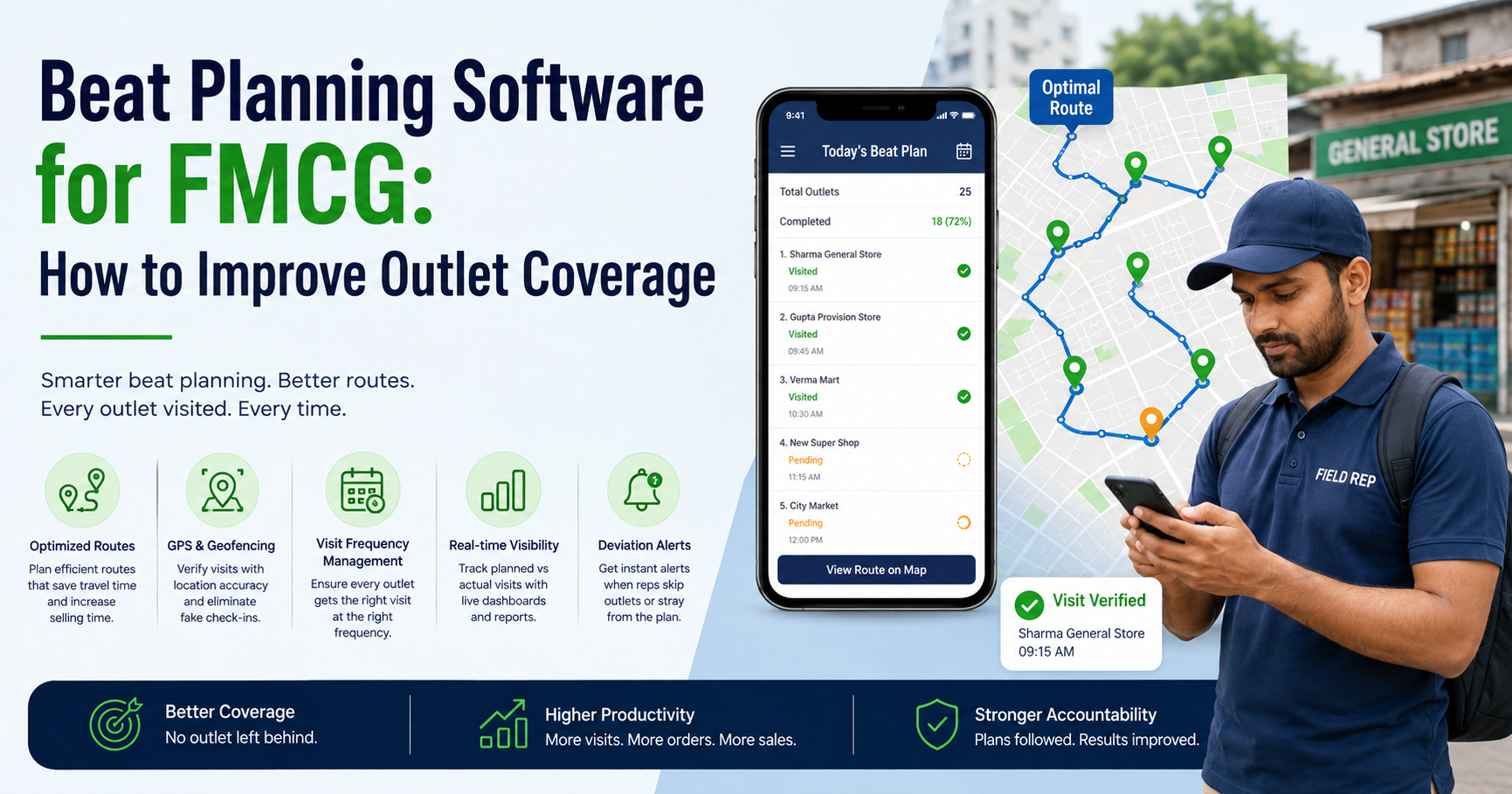
Route planning software matters more in India than almost anywhere else — traffic patterns, city layouts, and outlet density vary enormously between a metro like Bengaluru and a smaller town in Bihar. Automated or AI-assisted beat planning helps reps cover more outlets in less driving time, instead of manually deciding their route each morning.
Visit Verification and Proof of Visit
A “visit” that’s only reported verbally isn’t proof of anything. Photo capture, digital signatures, or OTP verification at the point of the visit give managers evidence that the work actually happened — and give the business a defensible record if a customer disputes it.
Expense and Collection Management
Field expense claims and cash collections are two of the most common sources of leakage in a sales operation. Digitizing both — with receipt photos, approval workflows, and collection-to-settlement tracking — closes gaps that spreadsheets and paper vouchers can’t.
Real-Time Reporting and Dashboards
Reports that arrive at the end of the week are reports that arrive too late to act on. Field sales tracking software should surface visit counts, attendance, SLA breaches, and sales numbers as they happen, not after the fact.
Custom Forms and Workflows
No two field teams work identically — a pharma rep’s visit checklist looks nothing like a distributor’s order form. Software that lets a business build its own forms, job types, and approval chains without needing a developer will fit a wider range of use cases than a rigid, one-size-fits-all tool.
SLA Management
For businesses with service commitments — a repair visit, a claim survey, a delivery window — SLA tracking flags jobs at risk of breaching their deadline before it becomes a customer complaint.
Field Sales Tracking Software vs. a Basic GPS App
A plain GPS tracking app and full field sales tracking software solve different problems. The table below shows where they typically diverge.
| Capability | Basic GPS App | Field Sales Tracking Software |
|---|---|---|
| Live location tracking | Yes | Yes |
| Attendance with geofencing | Rarely | Yes |
| Proof of visit (photo/signature/OTP) | No | Yes |
| Route or beat optimization | No | Often |
| Task and order management | No | Yes |
| Expense and collection tracking | No | Yes |
| Custom workflows and forms | No | Often |
| Reporting beyond location history | Limited | Comprehensive |
If the goal is only “know where my team is,” a GPS app might suffice. If the goal is to actually manage a field sales operation — attendance, visits, money, and performance — a purpose-built platform does more of the job.
How to Choose the Right Field Sales Tracking Software
- List your actual field workflow first. Map out what a rep’s day looks like — visits, orders, collections, expenses — before comparing tools, so you’re evaluating fit, not just feature checklists.
- Check for offline functionality. Field connectivity in India is inconsistent outside major cities. Software that only works online will leave gaps in smaller towns and rural routes.
- Verify attendance integrity features. Ask specifically about server-time punch-ins, geofencing, and spoof detection — this is where manual systems fail most often.
- Look at reporting, not just tracking. A live map is a start; real decisions need visit trends, SLA adherence, and productivity data.
- Confirm it fits your industry’s workflow. FMCG beat plans, pharma doctor visits, and field service SLA jobs are different enough that generic tools often need heavy workarounds.
- Ask about implementation time. A tool that takes months to configure delays the ROI it’s meant to deliver.
- Check integration options. If you already run a CRM or ERP, confirm the software can connect to it rather than becoming another data silo.
Industries That Benefit Most From Field Sales Tracking Software
While any business with a team on the road can use field sales tracking software, a few sectors see it applied most heavily in India:
- FMCG and distribution — beat plans, order booking, and outlet coverage across large territories.
- Pharma and medical representatives — doctor and chemist visit tracking with call reporting.
- Consumer durables — dealer visits and demand generation tracking.
- Field service and repair — SLA-bound installation, AMC, and service jobs.
- Banking, NBFC, and collections — field verification and recovery visit tracking.
Businesses in these sectors typically see the fastest return, since the core problems — coverage, verification, and reporting — sit at the center of daily operations.
Best Practices for Rolling Out Field Sales Tracking Software
- Involve the sales team early. Field reps are more likely to adopt a tool they understand the purpose of, rather than one that feels purely like surveillance.
- Be transparent about what’s tracked and why. Location tracking tied to duty hours, with a clear policy, avoids resistance and builds trust.
- Start with core workflows. Roll out attendance and visit tracking first, then layer in expenses, collections, and custom forms once the basics are adopted.
- Review the data regularly. The value of real-time reporting is lost if dashboards aren’t actually reviewed and acted on weekly.
- Train managers, not just reps. A field tracking system is only as useful as the decisions made from its reports.
How FieldExecutives Helps Indian Field Sales Teams
Businesses looking to bring these pieces together — attendance, tracking, route planning, visits, and money — without stitching together spreadsheets, WhatsApp groups, and separate apps can use field force management software such as FieldExecutives.
FieldExecutives brings the field sales workflow onto one live platform: a real-time map of the whole field team, geofenced attendance with server-time punch-ins and spoof detection, AI-assisted route and beat planning, and proof-of-visit capture through photos, signatures, and OTPs. Expense claims and field collections are tracked end-to-end instead of sitting in a spreadsheet, and managers get real-time KPIs rather than end-of-week summaries.
The platform is also built offline-first, which matters for field operations covering areas with patchy connectivity, and it supports custom forms and workflows so businesses can configure job types, checklists, and approvals to match how their team actually works — whether that’s an FMCG beat plan, a pharma visit log, or a field service job with SLA timers.
You can see the full breakdown on the [Internal Link Opportunity: FieldExecutives Features page], explore how it’s configured for different sectors on the [Internal Link Opportunity: FieldExecutives Industries page — e.g., FMCG & Distribution or Pharma & Medical Reps], or compare plans on the [Internal Link Opportunity: FieldExecutives Pricing page].
Conclusion
Manual tracking — diaries, phone calls, WhatsApp updates — simply doesn’t scale with the size and spread of most Indian field sales teams, and the cost shows up as missed visits, unverifiable attendance, wasted travel time, and money that’s hard to reconcile. The right field sales tracking software fixes this by giving managers real-time visibility into location, attendance, visits, and expenses, instead of finding out about problems days or weeks later.
The practical takeaway: before comparing vendors, map your team’s actual daily workflow, then evaluate software against that — not against a generic feature list. Prioritize attendance integrity, offline functionality, route planning, and reporting depth over flashy extras you won’t use.
Platforms like FieldExecutives bring these pieces — live tracking, geofenced attendance, AI-assisted route planning, proof of visit, and expense and collection management — into one system built for how Indian field teams actually operate. If missed visits, unreliable attendance, or slow reporting are costing your business time and money, it’s worth seeing what a proper field sales tracking software can fix.