

Beat Planning Software for FMCG: How to Improve Outlet Coverage
Ask any FMCG sales manager what keeps them up at night, and outlet coverage usually tops the list. Reps skip outlets, visit the same retailers too often, and lose hours in traffic between stops that a better route could have avoided. As a result, orders go missing, market penetration stays uneven, and revenue slips away.
Beat planning software solves this by replacing manual, paper-based route planning with structured, data-driven beat plans that field teams can actually follow. In this article, we’ll look at why outlet coverage breaks down in the first place, explain what beat planning software actually does, and show how FMCG companies can use it to visit the right outlets, at the right frequency, every single time.
What Is Beat Planning in FMCG?
A beat is a predefined route or cluster of retail outlets that a company assigns to a field sales representative for a specific day or cycle. Beat planning, then, is the process of organizing these outlets into logical, efficient routes based on factors like location, outlet potential, visit frequency, and rep capacity.
In FMCG distribution, beat planning determines:
- Which outlets a rep visits, and in what order
- How often each outlet needs a visit (daily, weekly, or on a fixed cycle)
- How many outlets a rep can realistically cover in a working day
- How the team divides territory among reps
When done well, beat planning ensures no outlet gets left out and no rep wastes the day on inefficient travel. When done poorly — usually on spreadsheets or paper registers — it creates the coverage gaps most FMCG companies struggle with.
Why Outlet Coverage Breaks Down Without the Right Tools
Most FMCG companies don’t lack a beat plan. Instead, they lack a beat plan that reps actually follow and that stays up to date. Here are the common reasons coverage slips:
1. Manual Planning Doesn’t Scale
Spreadsheet-based beat plans work fine for a handful of reps and a few dozen outlets. However, once a distributor manages hundreds of outlets across multiple territories, manual planning quickly becomes error-prone and hard to update.
2. No Real Visibility Into What’s Actually Happening
A paper beat plan can’t tell a manager whether a rep actually visited an outlet, skipped it, or logged a fake visit from outside the store. Without verification, coverage numbers on paper can look very different from coverage on the ground.
3. Static Plans Don’t Adapt to Real Conditions
New outlets open, some close, seasonal demand shifts, and outlet potential changes over time. So when a company creates a beat plan once and never revisits it, the plan quickly goes stale — leading to over-servicing low-potential outlets and under-servicing high-potential ones.
4. Inefficient Routes Waste Field Time
When beats don’t follow a logical geographic sequence, reps end up crisscrossing their territory instead of moving through it efficiently. That wasted travel time directly cuts into selling time and, in turn, order volume.
5. Limited Accountability
Without a system that tracks adherence to the plan, managers struggle to see which reps consistently follow their beats and which ones need coaching or support.
What Beat Planning Software Actually Does
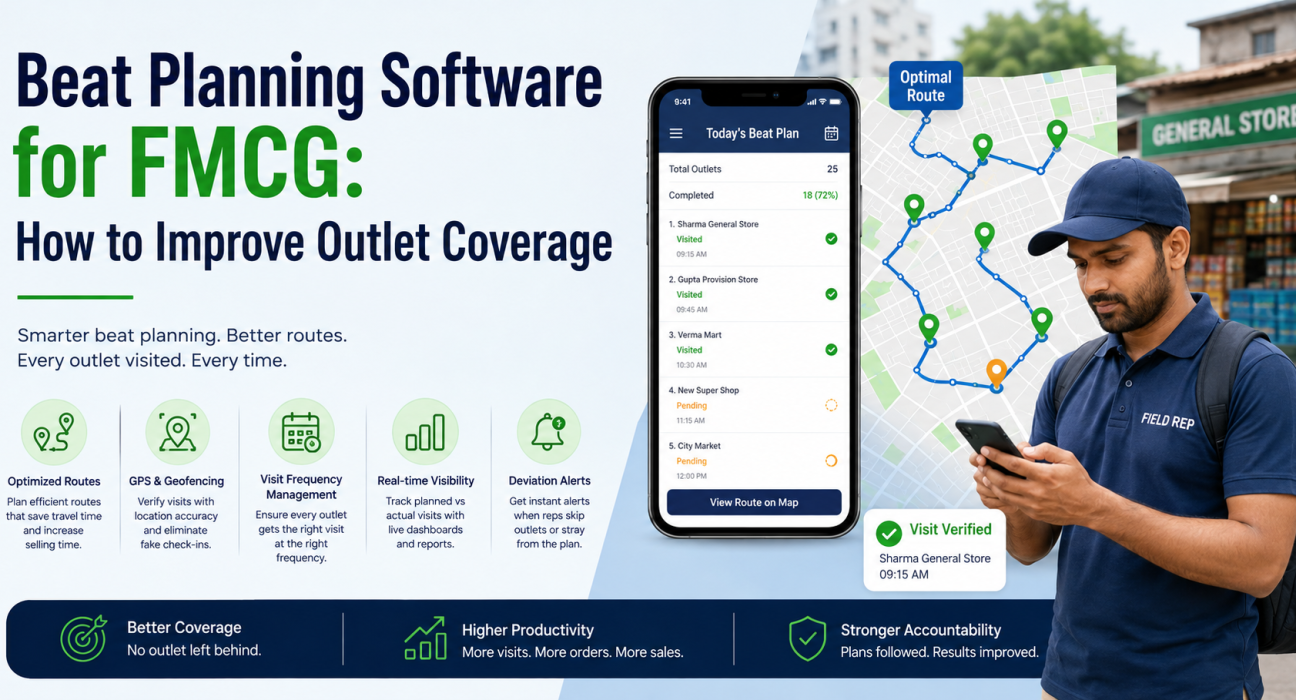
Beat planning software digitizes and automates the entire process — from creating routes to confirming that visits actually happened. Core capabilities typically include:
- Automated route creation based on outlet location, priority, and rep workload
- GPS-based tracking that shows where field reps are in real time
- Geofencing that confirms a rep physically reached an outlet before logging a call
- Visit frequency management so high-potential outlets receive more visits than low-potential ones
- Real-time dashboards that show planned versus actual coverage
- Deviation alerts that flag when a rep skips an outlet or strays from the assigned beat
- Reporting on outlet-level and territory-level coverage performance
Together, these features turn beat planning from a static document into a living system that managers can monitor and adjust continuously.
How Beat Planning Software Improves Outlet Coverage
1. Every Outlet Gets a Defined Visit Schedule
Instead of relying on a rep’s memory or a printed list, the system assigns each outlet a fixed visit frequency — daily, alternate days, weekly, or a custom cycle. This removes guesswork and stops low-visibility outlets from quietly dropping out of the routine.
2. Routes Are Optimized, Not Improvised
Route planning software sequences outlet visits by geography, which cuts unnecessary travel between stops. As a result, reps spend more of the day selling and less of it driving in circles.
3. Visits Are Verified, Not Assumed
With geofencing and GPS tracking, a “completed” visit in the system means the rep genuinely stood at the outlet’s location — not that they logged it from a café down the street. In fact, this verification step is one of the biggest, and most underrated, drivers of real coverage improvement.
4. Managers Get Coverage Visibility in Real Time
Instead of discovering coverage gaps at month-end, managers can check planned-versus-actual visits every day. That way, they can course-correct within the same cycle instead of the next one.
5. Underperforming Beats Can Be Redesigned Quickly
When the data shows that certain outlets or territories stay consistently under-covered, managers can rework those beats directly in the software, without redrawing the entire plan by hand.
6. Field Data Feeds Better Decisions
Since the software records visit history, order data, and outlet performance automatically, sales leaders get the information they need to reclassify outlets, adjust visit frequency, or reassign territory — decisions that are hard to make confidently from paper records.
Manual Beat Planning vs. Beat Planning Software
| Factor | Manual Beat Planning | Beat Planning Software |
|---|---|---|
| Route creation | Time-consuming, done by hand | Automated, based on location and outlet data |
| Visit verification | Self-reported, hard to confirm | GPS and geofencing-based verification |
| Coverage visibility | Available only at month-end | Real-time dashboards |
| Adapting to change | Requires manual re-planning | Can be adjusted quickly in the system |
| Accountability | Difficult to track adherence | Deviation alerts and visit logs |
| Scalability | Breaks down with more outlets/reps | Scales across large territories |
Best Practices for Improving Outlet Coverage with Beat Planning Software
- Classify outlets by potential. Not every outlet needs the same visit frequency, so segment outlets and give high-value stores more attention.
- Set realistic beats. A route that looks efficient on a map but ignores traffic patterns or store hours won’t hold up in practice.
- Review coverage data regularly. Weekly reviews of planned versus actual visits catch gaps before they turn into a pattern.
- Use verification, not trust alone. GPS and geofencing remove any doubt about whether a visit genuinely happened.
- Involve field reps in plan adjustments. Reps often understand local constraints — for instance, a market that’s only reachable in the morning — that pure map-based planning misses.
- Track outlet-level history over time. Instead of relying only on aggregate territory numbers, look at individual outlets to spot which ones keep getting missed.
How Software Like FieldExecutives Supports Beat Planning
Businesses looking to simplify these processes can use field force management software such as FieldExecutives to manage beat plans, track field visits with GPS, and verify outlet coverage through geofencing — all from a single platform. Instead of maintaining separate spreadsheets for routes, attendance, and visit reports, FMCG companies can plan beats, monitor real-time field activity, and generate coverage reports in one system.
For sales teams specifically, this approach connects beat planning with related field sales needs, such as [Internal Link Opportunity: Field Sales Management page on FieldExecutives] and [Internal Link Opportunity: Route Planning feature page on FieldExecutives], so coverage data doesn’t sit in isolation from the rest of the field sales process.
Teams evaluating a platform for the first time can also check [Internal Link Opportunity: GPS Tracking feature page] and [Internal Link Opportunity: Geofencing feature page] to see how visit verification works in practice, or the [Internal Link Opportunity: Pricing page] to compare plans against team size.
Conclusion
Outlet coverage gaps rarely come from a lack of effort. Instead, they come from a lack of visibility. When beat plans live on paper or in spreadsheets, managers have no reliable way to confirm that outlets received their planned visits, and reps have no efficient way to follow an optimized route.
Beat planning software closes that gap. By combining automated route creation, GPS-based verification, and real-time reporting, it helps FMCG companies give every outlet the attention it needs while making the most of every field day. So if your team still plans beats manually, now may be the right time to see how a platform like FieldExecutives can bring structure, visibility, and accountability to your field operations.