

The best AI development companies are not simply the ones with the biggest names or the flashiest demos. Instead, they turn a business problem into a working, secure, and maintainable AI solution. In practice, that means strong data engineering, relevant industry experience, a clear delivery process, and a plan for life after launch.
If you are searching for the best AI development companies, you probably already see how AI could help with customer support, forecasting, document processing, or internal automation. However, you may lack the in-house team to build it, and every vendor claims to be an “AI expert.” As a result, choosing a partner can feel risky.
This guide explains what custom AI development companies actually do. It also shows how to evaluate them, which questions to ask before signing, and how to build a shortlist you can trust.
What Do AI Development Companies Do?
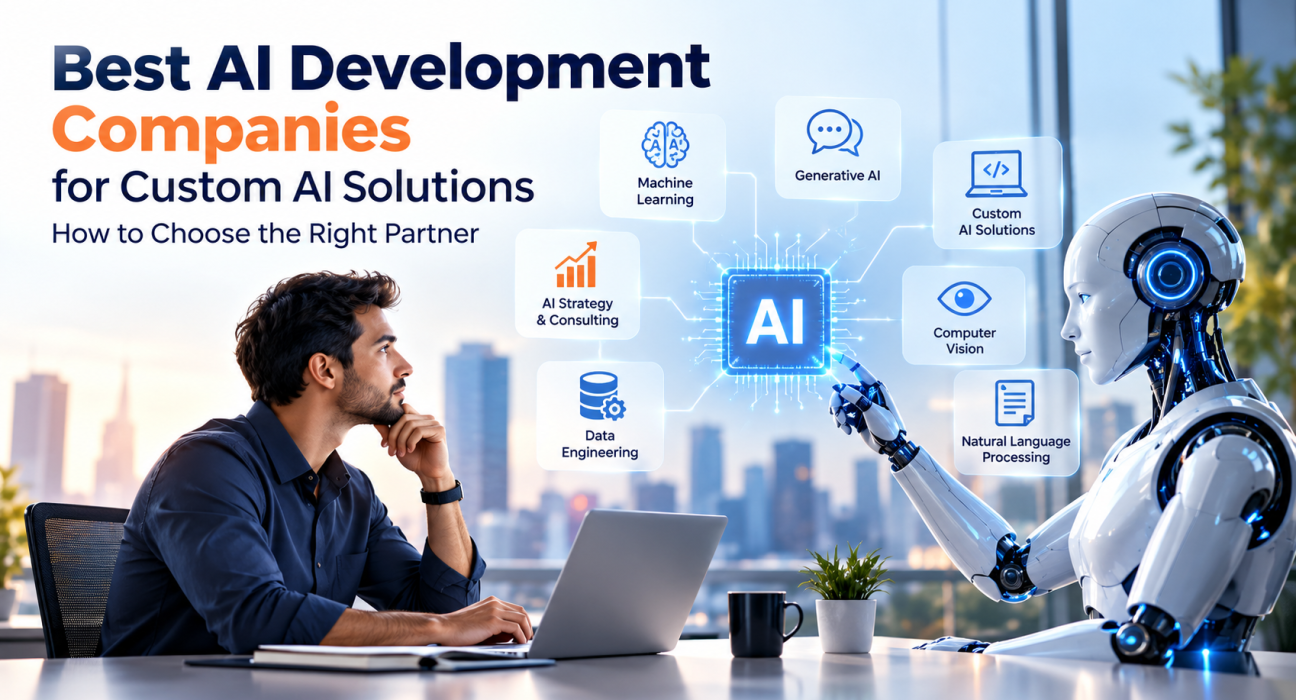
AI development companies design, build, and deploy software that uses machine learning, natural language processing, computer vision, or generative AI to solve a specific business problem. Unlike off-the-shelf tools, a custom solution fits your data, your workflows, and your goals. Most providers offer a mix of the following services:
- AI strategy and consulting: identifying use cases, assessing data readiness, and defining a roadmap
- Machine learning development: building predictive and classification models
- Generative AI and LLM applications: chatbots, copilots, content tools, and retrieval-augmented generation (RAG) systems
- Computer vision: image and video analysis, quality inspection, and document recognition
- NLP solutions: sentiment analysis, text extraction, and smarter search
- Data engineering: pipelines, data cleaning, and storage that make AI possible
- MLOps and maintenance: monitoring, retraining, and scaling models in production
- System integration: connecting AI to your CRM, ERP, website, or mobile app
Custom AI Solutions vs. Off-the-Shelf AI Tools
Choose off-the-shelf AI when your need is common and speed matters. On the other hand, choose custom AI when your data, workflow, or competitive advantage is unique.
| Factor | Off-the-Shelf AI Tools | Custom AI Solutions |
|---|---|---|
| Setup speed | Fast | Slower |
| Upfront cost | Usually lower | Usually higher |
| Fit to your workflow | Limited | High |
| Data control | Depends on the vendor | Can be designed around your policies |
| Differentiation | Low (competitors can use the same tool) | Higher |
| Long-term flexibility | Vendor-dependent | Greater control |
Many businesses start with a pre-built tool to validate the idea. Then, once they hit its limits, they move to a custom build.
What Makes an AI Development Company “the Best” for You?
The best AI development company is the one whose experience, process, and communication style match your project, budget, and risk level. For example, a partner that suits a funded enterprise may be a poor fit for an early-stage startup. Consider these qualities when you compare options:
- Relevant project experience. Ask whether the team has built something similar, ideally in your industry or with comparable data.
- Data and engineering depth. AI projects often fail because of messy data, not weak algorithms.
- A clear delivery process. Discovery, prototyping, testing, deployment, and support should be defined rather than improvised.
- Honest scoping. A good partner will say so when AI is not the right answer.
- Security and compliance awareness. This matters most in healthcare, finance, legal, and other regulated sectors.
- Transparent communication. You should know who works on your project and how progress is reported.
- Post-launch support. Because models drift over time, someone has to monitor and improve them.
How to Choose an AI Development Company: A Step-by-Step Process
Step 1: Define the business problem first
Start with the outcome, not the technology. For instance, “reduce support ticket handling time” is a better brief than “we want a chatbot.” A clear problem statement also helps vendors give realistic proposals.
Step 2: Check your data readiness
Before you contact anyone, review your data honestly:
- Do you have enough relevant data?
- Is it accurate, organized, and easy to access?
- Does the law allow you to use it for this purpose?
If the answer to any of these is “not sure,” a good vendor will offer a data assessment before development begins.
Step 3: Set a realistic budget and timeline
Custom AI costs vary widely because scope, data complexity, integrations, and compliance needs differ from project to project. Therefore, avoid anchoring on a single number you read online. Instead, ask shortlisted vendors for phased estimates, such as discovery, proof of concept, and production rollout.
Step 4: Build a shortlist
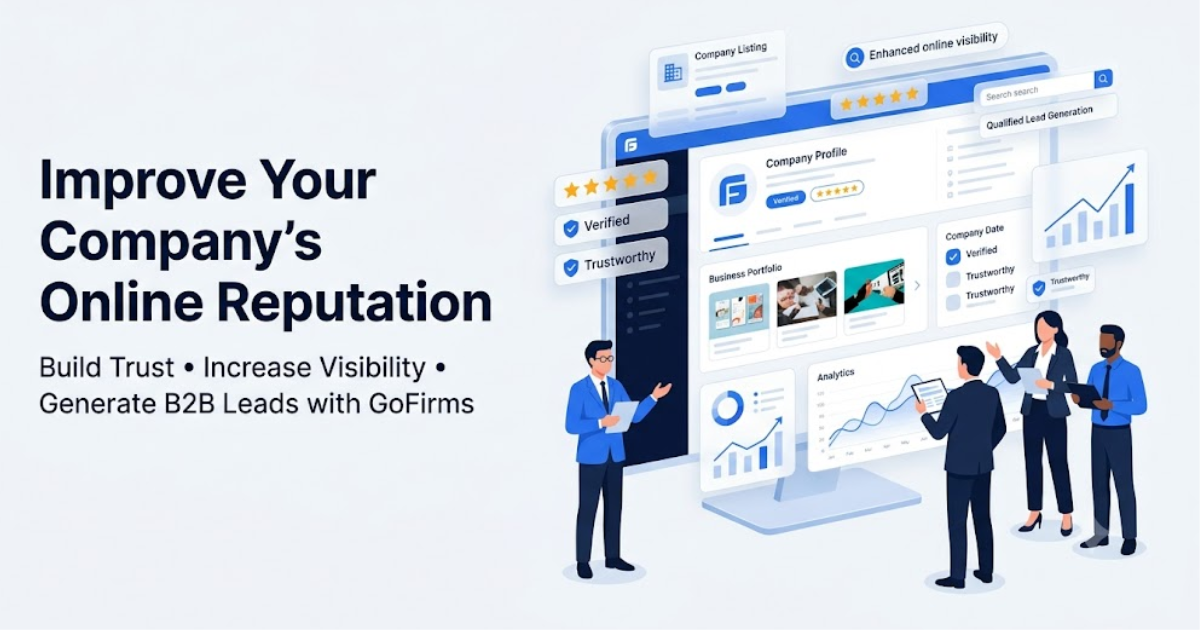
Use a mix of sources, including referrals from peers, industry communities, and company directories. On a platform like GoFirms, for example, you can research and compare technology service providers by service category, review company profiles, and narrow your options before reaching out. Whichever source you use, verify every claim independently.
Step 5: Review portfolios and case studies
Look for evidence of results rather than a wall of logos. In particular, try to answer these questions:
- What problem did the project solve?
- What was the company’s specific role?
- How did the client measure success?
- Does the solution still run in production?
Step 6: Interview the team
Speak with the people who will actually do the work, not only the sales team. Then ask how they would approach your use case, what risks they foresee, and what they need from your side.
Step 7: Start with a pilot
A small proof of concept or paid discovery phase lets you test collaboration, communication, and technical quality. As a result, you can commit to a full build with far more confidence.
Key Questions to Ask Before Hiring an AI Development Company
Strong questions quickly separate experienced teams from those simply following a trend. Use the list below as a starting point.
Experience
- Can you share similar projects, and may we speak with a past client?
- Which AI approaches would you choose for our case, and why?
Data and security
- How do you handle sensitive or proprietary data?
- Where does our data live during processing?
- Might our data train models for other clients?
Ownership
- Who owns the code, trained models, and documentation?
- Could we move to another cloud provider or vendor later?
Delivery
- Which metrics show how well the model performs?
- How does testing work before launch?
- What is your plan for bias, errors, or “hallucinations” in generative AI output?
Support
- What help do we receive after launch?
- Do you monitor and retrain models over time?
Red Flags to Watch For
Be cautious if a company:
- promises guaranteed accuracy or results before seeing your data,
- cannot explain its approach in plain language,
- pushes AI where simpler software would work,
- avoids talking about data privacy or security,
- offers no references, case studies, or verifiable work,
- gives a fixed price for a complex project without a discovery phase, or
- stays vague about who owns the final solution.
Types of AI Development Partners: Which Fits Your Business?
| Partner Type | Best For | Things to Consider |
|---|---|---|
| Specialized AI boutique | Focused, advanced AI projects | May have limited capacity for large rollouts |
| Full-service software development company | AI built into larger products or platforms | Confirm genuine AI depth, not just general development |
| Large IT services firm | Enterprise-scale, multi-system programs | Higher cost, longer timelines |
| Freelancers or small teams | Small prototypes and experiments | Continuity and support can be a risk |
| In-house hiring | Long-term AI as a core capability | Slow to build, competitive talent market |
Common Use Cases for Custom AI Solutions
Understanding typical applications helps you brief vendors more clearly. Here are some of the most common ones:
- Customer support automation: AI assistants answer routine questions and route complex ones to humans.
- Demand forecasting: models predict sales, inventory, or resource needs.
- Document processing: software extracts data from invoices, contracts, and forms.
- Personalization: recommendation engines suit e-commerce and media businesses well.
- Fraud and anomaly detection: systems flag unusual transactions or behavior.
- Quality inspection: computer vision checks products on manufacturing lines.
- Internal knowledge search: employees query company documents in natural language.
How Long Does a Custom AI Project Take?
It depends on scope, but most projects move in phases from discovery to proof of concept to production. A simple prototype may come together quickly. However, an enterprise system with integrations, security reviews, and compliance requirements takes considerably longer. Therefore, ask each vendor for a phased timeline and for what they need from your team at every stage.
Verify before publishing: If you add specific timelines, cost ranges, or market statistics, confirm them against current, reputable sources and cite them.
Frequently Asked Questions
What are the best AI development companies?
The best AI development companies vary by project type, industry, and budget. Rather than relying on a single ranking, compare vendors on relevant experience, data expertise, security practices, client references, and post-launch support. In addition, directories such as GoFirms can help you research and compare providers before you shortlist.
How much does custom AI development cost?
Cost depends on project scope, data quality, model complexity, integrations, and compliance needs. Generally, a proof of concept costs far less than a full production system. Therefore, request phased estimates from several vendors, and make sure each quote covers testing, deployment, and ongoing maintenance.
How do I know if my business needs custom AI?
Custom AI makes sense if off-the-shelf tools cannot handle your workflow, your data is unique or sensitive, or AI would become a competitive advantage. However, if a standard tool already solves the problem well, custom development may be unnecessary and more expensive.
What should I look for in an AI development company?
Look for relevant case studies, strong data engineering skills, a clear delivery process, security awareness, transparent communication, and post-launch support. Also confirm who owns the code and trained models, and whether you can switch providers later.
Can small businesses and startups work with AI development companies?
Yes. Startups and SMBs often begin with a small pilot to limit risk and cost. Because many vendors offer phased engagements, you can validate value first and then expand. Meanwhile, be clear about your budget and goals from the start.
How is an AI development company different from a regular software company?
An AI development company specializes in machine learning, language models, or computer vision, along with the data work behind them. A regular software company, by contrast, may build the application around AI but lack model development and MLOps expertise. Some firms, of course, offer both.
How do I compare AI development companies?
First, create a shortlist. Next, score each company against the same criteria: relevant experience, technical approach, data security, communication, pricing structure, and support. Finally, review case studies, speak with references, and consider a paid pilot before signing a larger contract.
Conclusion
Finding the best AI development companies for custom AI solutions comes down to fit, not hype. To recap, start with a clear business problem, check your data readiness, and shortlist providers with relevant experience. Then ask tough questions about security and ownership, and test the relationship with a small pilot.
Careful selection saves time, money, and frustration later. When you are ready to build your shortlist, you can research and compare technology service providers on GoFirms, and then verify each company’s claims through references and direct conversations.