

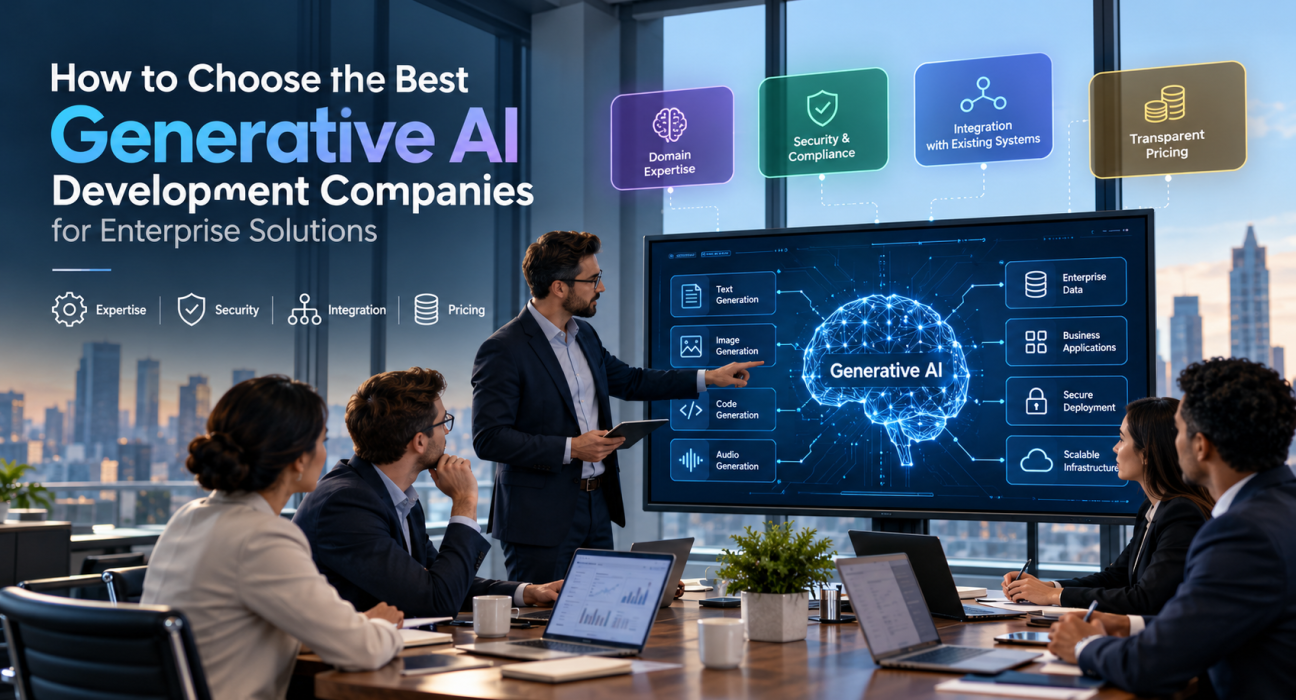
Choosing among generative AI development companies is one of the harder vendor decisions an enterprise faces today. The technology moves quickly. Many providers now claim generative AI expertise, and a polished demo says little about whether a team can deliver a secure, scalable system inside your existing infrastructure.
The short answer: the best generative AI development company for your enterprise is the one that combines proven delivery experience, strong data security and governance practices, the ability to integrate with your existing systems, and a clear plan for measuring business results. Name recognition and the size of the team matter much less than those four things.
This guide explains what enterprise generative AI development involves, which criteria separate strong partners from weak ones, and how to compare providers step by step.
What Do Generative AI Development Companies Actually Do?
Generative AI development companies design, build, and deploy systems that produce new content, such as text, code, images, audio, or structured data, using large language models (LLMs) and related models.
For enterprises, the work usually goes beyond building a chatbot. Typical services include:
- Use case discovery and strategy: identifying where generative AI can create measurable value.
- LLM application development: building assistants, copilots, summarization tools, and content workflows.
- Retrieval-augmented generation (RAG): connecting models to your internal documents and knowledge bases so answers are grounded in your own data.
- Model fine-tuning and customization: adapting models to your domain, terminology, and tone.
- Integration: connecting AI features to CRMs, ERPs, data warehouses, and internal tools.
- MLOps and LLMOps: monitoring, evaluation, versioning, and cost control after launch.
- Governance and compliance support: access controls, audit trails, and responsible AI practices.
A good partner covers the full lifecycle, not just the build.
Why Enterprise Needs Are Different
Enterprise projects face constraints that a startup prototype does not. Knowing them upfront helps you judge whether a provider is ready for your environment.
Data sensitivity. Enterprise data often includes customer records, contracts, financial information, or regulated data. The provider must show how that data is handled, stored, and kept out of public model training.
Integration complexity. Most enterprises run a mix of legacy and modern systems. An AI tool that cannot connect to them will not be adopted.
Scale and reliability. A pilot used by ten people behaves very differently from a system used by ten thousand. Latency, uptime, and cost per request all matter at scale.
Compliance and governance. Depending on your industry and region, you may need audit logs, human review steps, data residency controls, and documented risk management.
Change management. Adoption depends on training, workflows, and trust, not only on technology.
Key Criteria for Evaluating Generative AI Development Companies
1. Proven Enterprise Delivery Experience
Ask for case studies that resemble your situation: similar industry, similar scale, similar complexity. Look for evidence of systems running in production, not only proofs of concept.
Useful questions:
- How many generative AI projects have reached production?
- What business outcome did each deliver, and how was it measured?
- Can we speak with a past client in a similar industry?
2. Technical Depth Across the Stack
A strong team should be comfortable with multiple model families, both proprietary and open-source, and should be able to explain why a given model fits your case. Be cautious of providers who recommend one model or platform for every problem.
Check for experience with:
- Prompt engineering and evaluation frameworks
- RAG architectures and vector databases
- Fine-tuning and model optimization
- Cloud platforms and on-premises or private deployments
- Agentic workflows and tool use, where relevant
3. Security, Privacy, and Compliance Practices
This is often the deciding factor for enterprises. Ask the provider to explain:
- How your data is isolated and encrypted
- Whether your data is used to train any third-party model
- What certifications and audit practices they follow (verify any claims independently)
- How they handle access control, logging, and incident response
- How they address risks such as prompt injection and data leakage
4. Integration and Architecture Skills
Generative AI delivers value when it sits inside real workflows. Ask how the provider would connect the solution to your existing systems, and request an architecture overview early in the conversation.
5. Evaluation and Quality Control
Generative models can produce confident but incorrect answers. A mature provider will describe how they test for accuracy, bias, and consistency, and how they monitor quality after launch. If a vendor cannot explain how they measure output quality, treat that as a warning sign.
6. Transparent Pricing and Engagement Models
Understand how the work is priced, whether fixed-price, time-and-materials, or a dedicated team, and what ongoing costs to expect. Model usage fees, infrastructure, monitoring, and maintenance can add up after launch, so ask for a breakdown of both build and run costs. Treat any specific pricing figures you encounter as estimates to confirm directly with providers.
7. Communication, Culture, and Support
You will work with this team for months. Look at how they communicate during the sales process, how clearly they explain trade-offs, and what support they offer after deployment.
Comparison Table: What to Look For
| Criteria | Strong Signal | Warning Sign |
|---|---|---|
| Experience | Production deployments with measurable outcomes | Only demos and prototypes |
| Model approach | Explains trade-offs across several models | Pushes one tool for everything |
| Security | Clear data handling and governance answers | Vague or defensive answers |
| Integration | Early architecture discussion | “We’ll figure it out later” |
| Evaluation | Defined testing and monitoring process | No method for measuring quality |
| Pricing | Separate build and run cost estimates | Only a single headline number |
| Support | Defined post-launch plan | Handover with no follow-up |
How to Shortlist and Compare Providers: A Step-by-Step Process
Step 1: Define the problem first. Write down the business problem, the users, the data involved, and the outcome you want. Providers can only propose useful solutions when the goal is specific.
Step 2: Set your non-negotiables. List requirements such as data residency, deployment model, compliance obligations, and budget range.
Step 3: Build a long list. Use directories and comparison platforms, referrals, and industry events to identify candidates. Platforms such as GoFirms let businesses research and compare technology and AI service providers by category, services, and other details, which can make the early screening faster. Verify any provider’s claims directly before relying on them.
Step 4: Review portfolios and references. Narrow the list to three to five companies with relevant, verifiable experience.
Step 5: Run a structured evaluation. Send each shortlisted provider the same brief and compare their proposals against the same scorecard.
Step 6: Start with a paid pilot. A small, well-scoped pilot reveals how a team actually works, communicates, and handles problems, before you commit to a large program.
Step 7: Define success metrics. Agree on measurable targets, such as time saved, resolution rates, or accuracy thresholds, before development begins.
Types of Generative AI Development Partners
Enterprises usually choose among a few types of provider. Each has trade-offs.
- Specialized AI consultancies: deep expertise and focus, though sometimes smaller capacity.
- Large IT services and consulting firms: broad capabilities and scale, often with higher cost and slower processes.
- Software development companies with AI practices: strong engineering and integration skills, with varying AI depth.
- Platform and cloud-aligned partners: efficient if you are committed to one ecosystem, but potentially less flexible.
The right choice depends on your project size, internal capabilities, and how much customization you need.
Common Mistakes to Avoid
- Starting with the technology instead of the problem. Pick use cases with clear business value.
- Ignoring data readiness. Poor-quality or scattered data will limit any model’s performance.
- Underestimating ongoing costs. Usage, monitoring, and maintenance continue after launch.
- Skipping governance. Add review processes and usage policies from the start.
- Choosing on price alone. The cheapest proposal often leaves out evaluation, security, or integration work.
- Expecting instant results. Plan for iteration and refinement.
Enterprise Generative AI Vendor Checklist
Before signing, confirm that you have:
- ✓ Reviewed at least two relevant case studies and spoken with a reference
- ✓ Received a written explanation of data handling and security
- ✓ Seen a proposed architecture and integration plan
- ✓ Agreed on how quality will be measured
- ✓ Understood build costs and ongoing run costs
- ✓ Defined ownership of code, models, and outputs
- ✓ Confirmed support and maintenance terms
- ✓ Set pilot goals and success metrics
Frequently Asked Questions
What are generative AI development companies?
Generative AI development companies are service providers that design, build, and deploy AI systems capable of creating text, code, images, or other content. For enterprises, they typically handle strategy, model selection, customization, integration with existing systems, deployment, and ongoing monitoring.
How do I choose the best generative AI development company for my enterprise?
Focus on production experience, security and data governance, integration ability, evaluation methods, and pricing transparency. Review case studies, speak with references, and run a small paid pilot before committing. Compare several providers against the same scorecard rather than relying on a single recommendation.
How much do enterprise generative AI projects cost?
Costs vary widely based on scope, data complexity, model choice, and integration needs. A focused pilot costs far less than a full enterprise rollout. Request detailed proposals from several providers, and ask for separate estimates for development and ongoing operational costs such as model usage and monitoring.
How long does it take to build an enterprise generative AI solution?
Timelines depend on scope and data readiness. A limited pilot can often be completed much faster than a full production system with deep integrations and compliance reviews. Ask providers for a phased roadmap with clear milestones so you can judge progress along the way.
Should we build in-house or hire a generative AI development company?
In-house teams offer control and long-term capability but require scarce talent and time. External providers can speed up delivery and bring experience across projects. Many enterprises combine both, using a partner to launch the first solution while building internal skills over time.
How do we keep company data safe when working with a generative AI provider?
Ask how data is isolated, encrypted, and stored, and confirm in writing that your data will not be used to train third-party models. Review access controls, audit logging, and compliance practices, and consider private or on-premises deployment for highly sensitive data.
Where can I find and compare generative AI development companies?
You can use business directories, industry referrals, and comparison platforms. GoFirms, for example, helps businesses research and compare technology and AI service providers across categories. Whichever source you use, verify credentials, review past work, and speak with references before shortlisting.
Conclusion
Selecting from the many generative AI development companies available comes down to a disciplined process. Define the business problem, set your security and integration requirements, compare a small group of providers against the same criteria, and validate the choice with a pilot before scaling.
The strongest partners are transparent about trade-offs, specific about security, and focused on measurable outcomes rather than hype. If you are ready to build your shortlist, you can research and compare relevant AI and software service providers on GoFirms, then use the checklist above to evaluate each candidate.