

The promise of DevOps has always been simple: deliver software faster, more reliably, and with less drama. But if you’re leading technology in a large enterprise, you know the reality is far messier than the conference presentations suggest.
Your organization probably has DevOps teams. You’ve invested in tools. You’ve sent people for training. Yet releases still take weeks to coordinate. Deployments still require weekend war rooms. And when something breaks in production, it still takes hours to figure out which team owns the fix.
The gap between DevOps theory and enterprise reality isn’t about tools or training. It’s about execution maturity in complex organizational environments where change is hard, stakes are high, and accountability is often unclear.
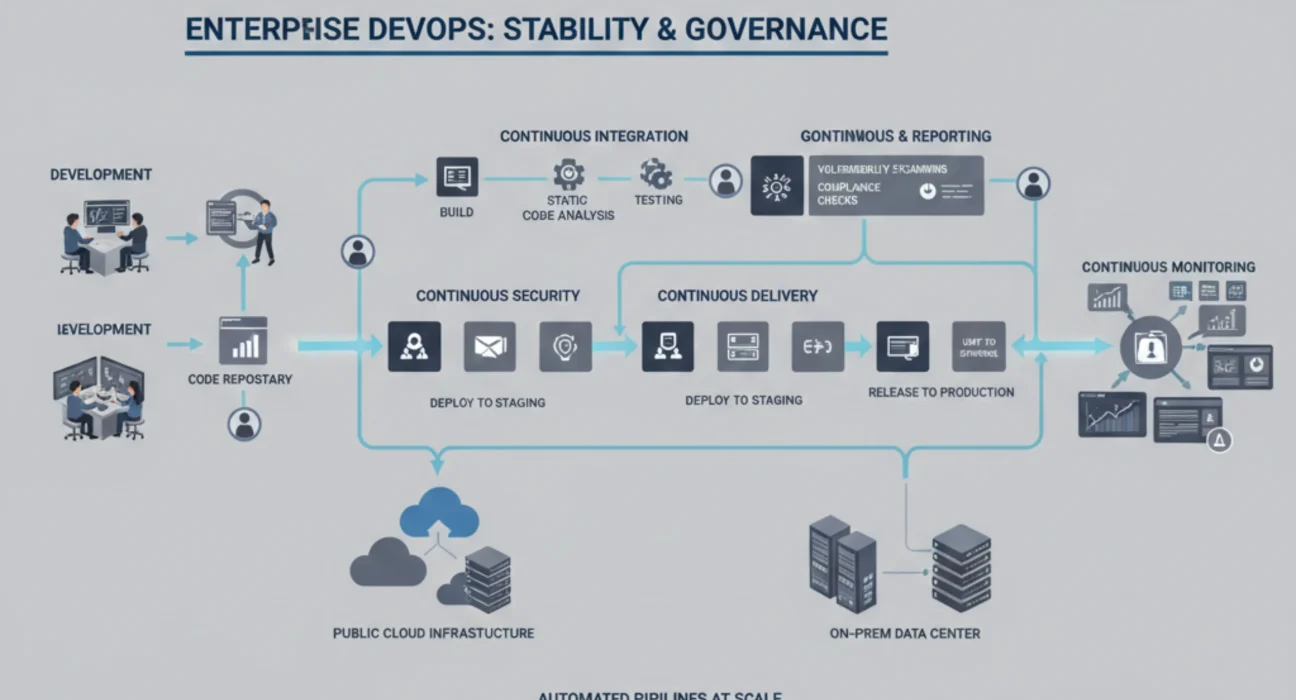
As we move through 2026, the conversation has evolved from “should we do DevOps” to “how do we make DevOps actually work at enterprise scale.” The focus has shifted to what’s being called “continuous everything”—continuous integration, continuous delivery, continuous security, continuous compliance, continuous improvement. But for C-level executives, the real question is simpler: how do we deliver business value continuously without introducing unacceptable risk?
What’s Actually Changed in Enterprise DevOps
Five years ago, DevOps in large enterprises meant adopting some automation and maybe setting up a CI/CD pipeline for one or two applications. Today, the expectations have fundamentally shifted.
Business teams now expect that a feature requested in January should be in production by March, not next year. Customers expect that issues reported today will be fixed within days, not after the next quarterly release. Regulators expect that security vulnerabilities will be patched within hours, not weeks.
This pace of change isn’t compatible with the way most large organizations have traditionally worked. Your change management processes were designed for stability, not speed. Your security reviews assumed quarterly releases, not daily deployments. Your compliance documentation expected that nothing would change for months at a time.
The technology to enable faster delivery exists. What most organizations struggle with is changing the organizational systems around that technology.
The Reality of Continuous Integration in Large Enterprises
Continuous integration sounds straightforward: developers merge code frequently, automated tests run, issues are caught early. In a startup with twenty developers working on one codebase, this is relatively simple.
In an enterprise with two thousand developers working across fifty different applications, some of which are twenty years old, the challenges multiply exponentially.
The shared database problem. You have ten teams all working on different features that touch the same database. One team’s changes break another team’s tests. Do you let them proceed? Do you make them wait? Who decides priorities when conflicts arise?
The test timing dilemma. Your full test suite takes six hours to run. Developers can’t wait six hours to know if their code works. You implement faster smoke tests, but then production bugs slip through. How much testing is enough without becoming a bottleneck?
The breaking change nightmare. A team makes a change to a shared API. Five other teams’ applications break. Nobody realized the dependency existed because it wasn’t documented anywhere. Now you’re spending days coordinating fixes across multiple teams who all have their own priorities and deadlines.
These aren’t theoretical problems. A financial services company we worked with spent nine months trying to implement continuous integration before they addressed the fundamental issue: they had no clear ownership model for shared components. Every team wanted the autonomy to move fast, but nobody wanted the accountability for breaking others.
The solution wasn’t better tools. It was clearer governance. They established architecture review boards, API contracts, version management policies, and escalation paths for breaking changes. Only after these organizational foundations were in place did the technical implementations start working smoothly.
Continuous Delivery When Compliance Is Non-Negotiable
The software industry loves to talk about deploying to production fifty times a day. That’s wonderful for consumer apps. But when you’re a bank, an insurance company, or a healthcare provider, every production deployment is a regulatory event that needs to be documented, approved, and auditable.
This doesn’t mean continuous delivery is impossible in regulated industries. It means you need to build compliance into the pipeline, not treat it as a gate at the end.
A large insurance company recently asked us to help them accelerate their deployment cycles. They were taking four weeks from code complete to production, and the business was frustrated. But when we examined their process, the actual deployment took thirty minutes. The four weeks was all compliance documentation, security reviews, and approval chains.
The instinct might be to say the compliance process is too heavy and needs to be cut. But in regulated industries, that’s not an option. The real question is: how do you automate and parallelize compliance so it happens continuously rather than as a batch process at the end?
The answer involved several changes. Automated security scanning that ran on every commit, not once before release. Compliance checks that happened in the pipeline and produced audit trails automatically. Pre-approved patterns that teams could use without manual review. And clear escalation paths for anything that fell outside standard patterns.
Did this eliminate the four-week cycle? No. But it brought it down to five days, and more importantly, it made the process predictable. Business teams knew that if they wanted a feature in production by month-end, they needed to have it code-complete two weeks prior. That predictability enabled better planning across the organization.
The Security Shift: From Gate to Guardian
Traditional security in enterprises worked like this: development teams built features, security teams reviewed them before release, and hopefully issues were found and fixed before customers were exposed.
This model breaks down completely when you’re deploying continuously. Security can’t be a gate you pass through once. It needs to be woven into every stage of development and operations.
This shift has been difficult for many organizations because it requires security teams to work differently. Instead of being reviewers who say yes or no, they need to become enablers who provide tools, guardrails, and guidance that let development teams move fast safely.
But it also requires development teams to take on more security responsibility. You can’t build a feature, throw it over the wall to security, and consider your job done. You need to understand the security implications of your architectural decisions. You need to fix vulnerabilities in your code, not expect someone else to clean up after you.
This shared responsibility model sounds good in theory but creates accountability challenges in practice. When a security incident occurs, who owns it? The development team that wrote the vulnerable code? The security team that approved the release? The operations team that deployed it to production?
Successful organizations have clear answers to these questions, documented in writing and reinforced through real consequences when things go wrong. Less mature organizations discover their accountability gaps during crisis moments, which is the worst possible time.
The Infrastructure Evolution Nobody Prepared For
When DevOps started becoming mainstream, most enterprises were running applications on physical servers in their own data centers. Infrastructure changes took weeks and required detailed planning.
Today, even conservative enterprises are running significant portions of their infrastructure in the cloud, using container orchestration platforms, and treating infrastructure as code. This is powerful but introduces new complexity that many organizations underestimated.
Your infrastructure is now defined in configuration files that can be changed as easily as application code. This means a misplaced line in a configuration file can take down your entire production environment. And because these changes can happen quickly, they often do happen quickly, before someone realizes the implications.
A retail company learned this lesson expensively during their annual sale. An infrastructure engineer made what seemed like a small change to their Kubernetes cluster configuration. The change worked fine in the test environment. But in production, under heavy load, it caused a cascading failure that took down their entire checkout system for three hours.
The technical issue was fixable. The bigger problem was that nobody had thought to include infrastructure changes in the same review and testing rigor they’d built for application code. Infrastructure was still treated as “operations work” that didn’t need the same governance as “development work.”
This distinction no longer makes sense when infrastructure is defined in code and can be changed via the same pipelines as application features. Successful DevOps implementation means applying the same rigor, testing, and governance to infrastructure changes as you do to application changes.
The Culture Problem That Technology Can’t Solve
Let’s address the uncomfortable truth: most DevOps initiatives fail not because of technology choices but because of organizational culture and politics.
You have development teams measured on delivering features and operations teams measured on system stability. These are inherently conflicting goals. Development wants to deploy fast. Operations wants to prevent change.
You have business teams frustrated that technology is slow and technology teams frustrated that business keeps changing priorities. Neither side fully understands the constraints the other operates under.
You have vendors selling tools that promise to solve all your problems, and consulting firms offering to “transform your organization” in six months, and conference speakers making it all sound easy if you just adopt their framework.
The reality is that changing how a large organization delivers technology is an organizational change program that happens to involve technology. It requires changing incentive structures, breaking down silos, redistributing power, and forcing accountability where it’s been lacking.
This type of change requires executive sponsorship at the highest levels. Not just approval for the initiative, but active involvement in removing barriers, resolving conflicts, and holding people accountable for changing how they work.
A CTO we worked with put it well: “I spent the first year of our DevOps transformation focused on tools and training. Nothing really changed. The second year, I spent my time on organizational design, incentive alignment, and conflict resolution. That’s when we started seeing real progress.”
What Continuous Everything Actually Means for Enterprises
The phrase “continuous everything” has become popular in 2026, but it’s worth being precise about what this means in an enterprise context.
Continuous integration means code from multiple developers is merged and tested frequently, ideally multiple times per day. This requires automated testing, clear branching strategies, and rapid feedback loops. For enterprises, it also requires governance around shared components and clear ownership of integration failures.
Continuous delivery means code is always in a deployable state and can be released to production at any time. This doesn’t mean you deploy constantly, but that you could if business needs required it. For enterprises, this requires automated deployment pipelines, robust rollback mechanisms, and confidence in your testing.
Continuous deployment means code automatically goes to production when it passes all tests and checks. Very few enterprises are comfortable with this level of automation for customer-facing systems, and that’s reasonable. The goal should be capability, not dogma. You should be able to deploy automatically if you choose to, even if you decide to keep human approval in the loop.
Continuous security means security checks happen throughout the development and deployment pipeline, not as a gate at the end. This includes automated scanning for known vulnerabilities, checking for security best practices, and monitoring production systems for security incidents.
Continuous compliance means compliance requirements are built into the development and deployment process and evidence is gathered automatically. This is critical for regulated industries where audit trails and documentation are mandatory.
Continuous monitoring means you have real-time visibility into system health, user experience, and business metrics. When something goes wrong, you detect it immediately and have the context needed to diagnose and fix it quickly.
Continuous improvement means you regularly review what’s working and what’s not, and you make changes to your processes, tools, and practices based on what you learn.
The key word in all of these is “continuous.” You’re not doing these things once or occasionally. You’re building them into how your organization works every day.
The Economics of DevOps at Scale
CFOs need to understand the business case for DevOps investment, which is often presented poorly by technology teams.
The typical pitch focuses on efficiency: we’ll deploy faster, spend less time on manual work, and need fewer people for operations. These benefits are real but often oversold. Implementing good DevOps practices requires significant upfront investment in tools, training, process redesign, and organizational change. The efficiency gains take time to materialize.
The more compelling business case is about risk and opportunity cost.
On the risk side, poor deployment practices lead to costly outages, security breaches, compliance violations, and customer trust issues. A major outage can cost crores per hour in lost revenue, not counting reputation damage and customer churn. Reducing the frequency and severity of these incidents has clear financial value.
On the opportunity side, the ability to deliver and iterate quickly enables the business to respond to market changes, test new ideas, and capture opportunities that would otherwise be missed. When your competitors can launch new features in weeks and you take months, you’re losing market share.
The challenge is quantifying these benefits in a way that financial leadership finds credible. This requires being honest about timelines and realistic about what’s achievable.
A realistic DevOps transformation timeline for a large enterprise is two to three years from initiation to maturity. Year one is largely investment with minimal benefits as you build foundations. Year two is where efficiency gains start appearing. Year three is where the real business value emerges as you can genuinely respond faster to market opportunities.
Organizations that try to compress this timeline usually end up with superficial adoption that doesn’t deliver sustainable benefits. They automate a few deployments, declare victory, and then wonder why they’re not seeing the promised results.
Building the Right Team Structure
The question of how to structure teams for DevOps is surprisingly contentious. Should you have separate development and operations teams? Should you have cross-functional teams that own both? Should you have a central platform team that builds tools for product teams to use?
There’s no single right answer because it depends on your organization’s size, maturity, and existing culture. But there are patterns that work better than others.
The DevOps team anti-pattern. Many organizations create a “DevOps team” that sits between development and operations. This usually just creates a new silo and a new handoff point. The goal of DevOps is to eliminate handoffs, not create new ones.
The “you build it, you run it” model. This approach makes development teams responsible for both building and operating their services. It works well for organizations with mature engineering culture and clear service boundaries. It works poorly when teams lack operational expertise or when you have complex shared infrastructure that no single team can manage alone.
The platform team model. A central platform team builds and maintains the infrastructure, tools, and services that product teams use to deploy and operate their applications. Product teams own their services but delegate infrastructure concerns to the platform team. This works well for large organizations but requires the platform team to be genuinely responsive to product team needs.
At Ozrit, we’ve found that the best model often combines elements of all three approaches. Product teams own their services end-to-end but are supported by a platform team that provides reliable infrastructure and tooling. A central DevOps practice community shares knowledge and standards across teams. And clear escalation paths exist for when issues span multiple teams.
The key is clarity about ownership and accountability. Every service should have a team that owns it. Every incident should have a clear owner responsible for resolution. Every architectural decision should have someone accountable for its consequences.
Ambiguity in ownership is the primary cause of persistent issues in enterprise technology organizations.
Vendor and Partner Selection for DevOps Success
The DevOps tool landscape is overwhelming. There are hundreds of tools for continuous integration, deployment automation, monitoring, security scanning, and every other aspect of the DevOps lifecycle.
Technology teams often approach tool selection as a technical evaluation: which tool has the best features, performance, and cost? But for enterprise deployments, other factors matter more.
Integration with existing systems. Your new DevOps tools need to work with your existing source control, ticketing systems, identity management, and monitoring platforms. A technically superior tool that doesn’t integrate well with your environment will create friction and reduce adoption.
Support for your compliance requirements. If you’re in a regulated industry, your DevOps tools need to provide audit trails, access controls, and documentation that satisfy your compliance needs. Many tools designed for startups don’t have these capabilities.
Vendor stability and support. You’re building critical processes around these tools. If the vendor goes out of business or decides to discontinue the product, you have a serious problem. Enterprise-grade support and clear long-term commitment matter.
Training and expertise availability. Can you hire people who know this tool? Can you train your existing team? Is there good documentation and community support? The best technical solution that nobody knows how to use is worthless.
Beyond tools, many organizations need partners who can help with implementation and ongoing support. This is where selection becomes even more critical.
Look for partners who ask about your business context, not just your technical requirements. Partners who want to understand your organizational structure, your current pain points, your risk tolerance, and your constraints around budget and timeline.
Be skeptical of partners who promise quick transformations or claim they can implement DevOps in a few months. Real transformation takes time and requires changing how people work, not just installing tools.
The best partners bring not just technical expertise but also experience navigating enterprise complexity. They’ve seen what works and what doesn’t across multiple organizations. They can help you avoid common pitfalls and accelerate your learning.
Security and Compliance in a Continuous Delivery World
We touched on this earlier, but it’s worth exploring more deeply because it’s a major concern for enterprise executives.
Traditional security and compliance processes assumed that you could review software thoroughly before release because releases were infrequent. When you’re releasing quarterly, you can afford to spend a week on security review. When you’re releasing daily, that’s impossible.
The solution isn’t to skip security review. It’s to automate the routine checks and focus human security expertise on the novel or high-risk areas.
This requires several capabilities:
Automated security scanning that runs on every code commit and identifies known vulnerabilities, insecure coding patterns, and dependency issues. These tools aren’t perfect, but they catch a large percentage of common issues without human intervention.
Secure defaults and templates that make it easy for developers to do the right thing. If following security best practices requires extra work, they won’t happen consistently. If security is built into your standard patterns, it happens automatically.
Clear risk categorization so that low-risk changes can proceed quickly while high-risk changes get appropriate scrutiny. Not every deployment needs the same level of review. But you need clear, documented criteria for what constitutes high risk.
Comprehensive audit trails that automatically capture who made what changes, when, and why. This satisfies compliance requirements without requiring manual documentation.
Production monitoring that detects security incidents quickly. No matter how good your preventive measures are, issues will occasionally reach production. The faster you detect and respond, the less damage occurs.
The goal is to make security a continuous concern throughout the development lifecycle, not a gate at the end. Developers should think about security when writing code. Automated systems should verify security continuously. And human security experts should focus on the areas that require judgment and expertise.
Managing the Transformation Journey
If you’re an executive leading a DevOps transformation in a large enterprise, here’s what the journey typically looks like:
Phase one: Assessment and planning (2-3 months). Understand where you are today, where you want to go, what the gaps are, and what resources you’ll need. This phase should involve key stakeholders across technology and business. The output is a clear transformation roadmap with realistic timelines and budgets.
Phase two: Foundation building (6-12 months). Set up your core infrastructure, select and implement key tools, establish initial processes and governance, and begin training teams. This phase is mostly investment with minimal visible benefits. It’s also where executive patience is most important because pressure to show results will be intense.
Phase three: Pilot implementations (6-9 months). Choose one or two applications to implement your new DevOps practices end-to-end. Learn what works and what doesn’t. Refine your processes based on real experience. Build confidence and demonstrate value.
Phase four: Scaling (12-18 months). Roll out your DevOps practices to more applications and teams. This is where you encounter organizational change challenges at scale. Different teams will resist in different ways. Issues that weren’t apparent in the pilot will emerge. Executive support in removing barriers is critical.
Phase five: Optimization and maturity (ongoing). Continuously improve your processes, tools, and practices based on experience. This phase never really ends because technology and business needs keep evolving.
Total timeline: Two to three years to reach operational maturity. Organizations that try to compress this into a single year usually end up with superficial adoption that doesn’t deliver sustained results.
The most common mistake is declaring victory too early. You implement some automation, complete a successful pilot, and announce that you’re now doing DevOps. But when you look six months later, most teams have reverted to old practices because the new ways weren’t actually easier or better supported.
Real transformation requires persistent executive attention and patience beyond what most organizations are comfortable with.
What Success Looks Like in 2026
Successful DevOps implementation in large enterprises isn’t about deploying a certain number of times per day or achieving specific automation metrics. It’s about sustainable capability that serves business needs.
Here’s what we see in organizations that have genuinely matured their DevOps practices:
Business and technology teams have productive conversations about what’s possible and what’s not. Technology can commit to delivery timelines with confidence, and business trusts those commitments. When priorities change, everyone understands the implications and makes informed tradeoffs.
Deployments happen without drama. They’re routine events that don’t require weekend work or extensive coordination. When issues occur, they’re detected quickly and fixed with clear accountability.
Security and compliance are integrated into delivery, not obstacles to it. Teams understand the requirements and have tools and processes that make compliance relatively painless. Audits are straightforward because evidence is gathered automatically.
Teams have the autonomy to make decisions within clear guardrails. They don’t need extensive approval chains for routine changes, but they have clear escalation paths for novel or high-risk situations.
The organization learns from failures systematically. When incidents occur, blameless post-mortems identify systemic issues and drive process improvements. The same failure rarely happens twice.
Technology investment is predictable and tied to business value. There aren’t constant surprises in the budget because infrastructure costs are understood and scaling is planned.
Most importantly, the organization has developed the muscle memory for continuous improvement. They regularly assess what’s working and what’s not, and they make changes based on data and experience rather than following trends or vendor marketing.
Moving Forward with Clarity and Purpose
DevOps in 2026 isn’t about adopting the latest tools or following the newest trends. It’s about building sustainable capability to deliver technology that serves your business effectively.
For enterprise leaders, this requires several commitments:
Commit to realistic timelines. Transformation takes years, not months. Trying to rush it usually makes it take longer.
Commit to organizational change, not just technology change. The hardest parts of DevOps are about people, processes, and culture. Technology is the easy part.
Commit to continuous investment. DevOps isn’t a project you complete. It’s an ongoing operating model that requires sustained attention and resources.
Commit to clear accountability. When things go wrong, and they will, having clear ownership makes the difference between rapid resolution and finger-pointing chaos.
Commit to learning from experience. Your first attempts won’t be perfect. That’s expected. What matters is that you learn, adapt, and improve.
The enterprises that thrive in the coming years will be those that can deliver technology continuously, reliably, and safely. The technology to enable this exists. What separates success from failure is the discipline to execute well in complex organizational environments.
That’s not a technology problem. It’s a leadership and execution challenge. And it’s one that requires partners who understand both the technical and organizational dimensions of enterprise transformation.
The opportunity is significant for organizations willing to make the necessary commitments. The risk is equally significant for those who think they can achieve continuous delivery without changing how they fundamentally operate.
The choice, ultimately, is about whether you’re serious about transforming how your organization delivers technology, or whether you’re just implementing tools and hoping for the best.