

Every few years, a new technology wave promises to solve all our problems. Cloud migration. Digital transformation. Platform modernisation. The pitch is always compelling: move your systems to the cloud, gain agility, reduce costs, scale effortlessly.
So enterprises invest. They hire consultants, engage system integrators, allocate budgets. And then, somewhere between planning and production, things start to break down.
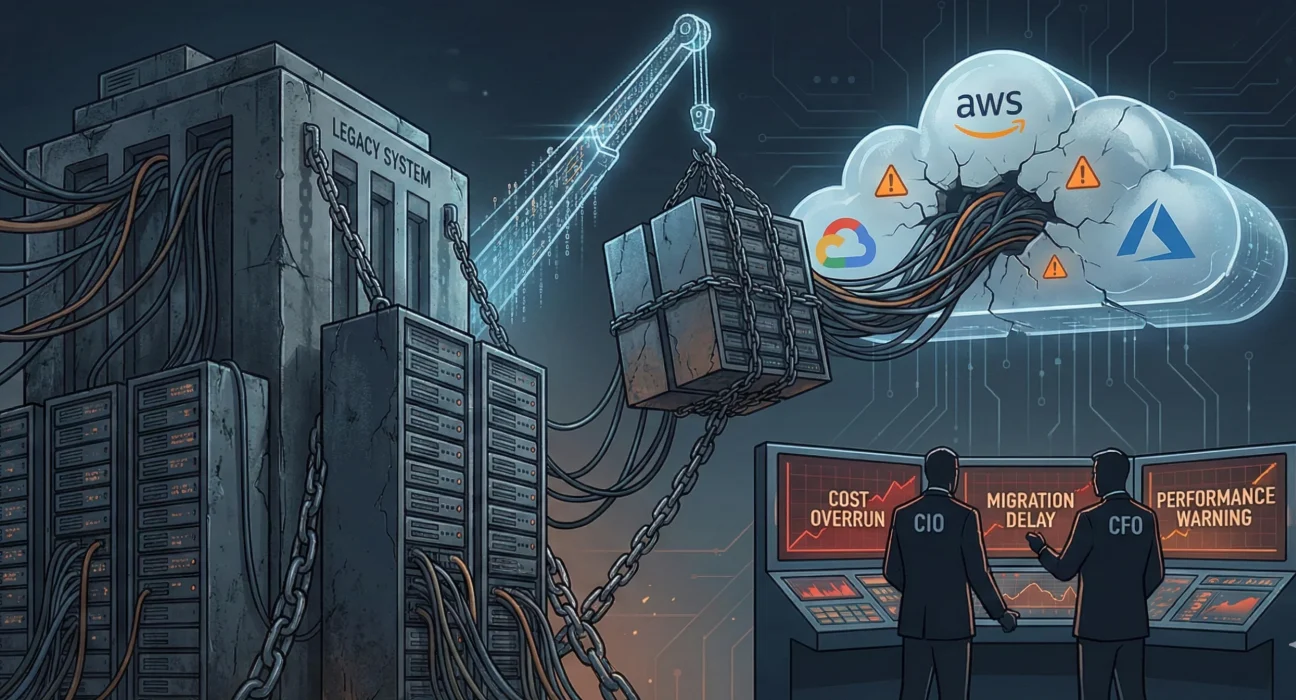
The most common approach lift-and-shift looks simple on paper. Take what you have, move it to the cloud, switch it on. Minimal disruption, quick wins, fast ROI. Except it rarely works that way for large enterprises. What starts as a six-month migration stretches into two years. Costs double. Performance issues emerge. Business stakeholders lose confidence. And eventually, someone asks the uncomfortable question: why did we do this in the first place?
The answer lies not in the technology itself, but in how enterprises approach execution at scale.
The appeal of lift-and-shift is also its trap
Lift-and-shift is attractive because it promises safety. You’re not rebuilding. You’re not re-architecting. You’re just moving. For CFOs and CIOs managing risk, this sounds like the prudent choice.
But enterprise systems didn’t grow in isolation. They evolved over years, sometimes decades. They carry assumptions about infrastructure, latency, storage, integration patterns, and vendor dependencies that no longer hold true in a cloud environment. Moving them intact means moving all those assumptions too.
A monolithic ERP system designed to run on dedicated hardware doesn’t magically become cloud-native when you host it on AWS or Azure. It still behaves the same way. It still scales the same way. It still fails the same way. Except now you’re paying cloud rates for on-premise performance.
The trap is thinking that location equals transformation. It doesn’t.
What actually goes wrong in large-scale migrations
Most enterprises underestimate three things: complexity, dependencies, and governance.
Complexity isn’t just about lines of code. It’s about how systems talk to each other. How data flows across applications. How business processes rely on specific integrations that nobody documented properly. In a large enterprise, you might have hundreds of applications, thousands of integrations, and decades of technical debt. A lift-and-shift doesn’t resolve any of that. It just relocates it.
Dependencies surface late. That legacy system you thought nobody used anymore? Turns out Finance runs month-end close on it. That batch job scheduled at 2 AM? It’s critical for regulatory reporting. These dependencies aren’t always visible in architecture diagrams. They emerge during testing, or worse, during cutover.
Governance breaks down when accountability is unclear. Who owns the migration? IT says they’re executing the plan, but Business says they weren’t consulted properly. The vendor says they delivered what was in the contract. The system integrator says they need more time. Meanwhile, deadlines slip, budgets overrun, and nobody wants to make the hard calls.
This isn’t a technology problem. It’s an execution problem.
Why cloud doesn’t fix what’s broken
Cloud infrastructure offers real advantages: elasticity, global reach, managed services, faster provisioning. But these advantages only materialise if you design for them.
An application that wasn’t built to scale horizontally won’t scale just because you moved it to the cloud. A database that locks during peak transactions will still lock. A monolithic system that takes 30 minutes to restart will still take 30 minutes. The underlying design constraints remain.
Worse, you might introduce new problems. Network latency between on-premise systems and cloud environments. Data transfer costs that weren’t in the original budget. Licensing models that don’t translate well to cloud consumption. Security policies that conflict with cloud-native practices.
Enterprises often discover these issues after migration, when it’s expensive and disruptive to course-correct. At that point, you’re committed. The business has moved on. Budgets are spent. And you’re left managing a system that’s neither modern nor cost-effective.
The hidden costs nobody talks about
Lift-and-shift migrations look cheaper on paper because you’re not changing much. But the real costs show up over time.
Operational complexity increases. You’re now managing hybrid environments—some systems on-premise, some in the cloud, all of them interconnected. Your operations team needs new skills, new tools, new runbooks. Incident response gets harder because failure modes are different.
Technical debt compounds. The issues you didn’t fix before migration are now harder to fix. That tightly coupled architecture? Still tightly coupled. That poorly optimised query? Still slow, and now more expensive because you’re paying for computers.
Opportunity cost grows. While you’re spending time and money keeping a migrated-but-not-modernised system running, your competitors are building cloud-native solutions that actually leverage platform capabilities. The gap widens.
CFOs see this reflected in TCO analyses that don’t match the original business case. CIOs see it in operational incidents and slower delivery cycles. Business leaders see it in delayed innovation and missed market opportunities.
What separates successful programs from failed ones
The enterprises that succeed with large-scale IT transformation don’t start with technology. They start with clarity.
Clear objectives. Why are we doing this? If the answer is “everyone else is moving to the cloud,” that’s not enough. What specific business outcomes are we trying to achieve? Faster time-to-market? Better customer experience? Regulatory compliance? Cost optimization? The technology strategy should follow from business strategy, not the other way around.
Clear ownership. Who is accountable for delivery? Not just sponsorship actual delivery. In successful programs, there’s a single throat to choke. Someone who has authority, resources, and accountability. Someone who can make decisions when trade-offs are required. Someone who stays through implementation, not just planning.
Clear governance. How do we make decisions? How do we manage risk? How do we handle scope changes, vendor escalations, and timeline pressures? Governance isn’t bureaucracy. It’s the mechanism that keeps large programs from drifting or collapsing under their own weight.
These aren’t new ideas. They’re basic program management principles. But in the rush to modernise, enterprises often skip them. They assume technology vendors or system integrators will figure it out. They don’t.
The role of partnership in enterprise execution
No large enterprise executes complex programs alone. You need partners. The question is: what kind of partners?
Traditional system integrators bring resources and methodologies. They’re good at delivering what’s specified. But enterprise transformation isn’t just about following a spec. It’s about navigating uncertainty, making pragmatic trade-offs, and keeping business outcomes front and centre even when technical challenges arise.
This is where execution maturity matters. A partner who has delivered large-scale enterprise programs understands that success isn’t measured by lines of code or features shipped. It’s measured by whether the business can operate better after the program than before.
This requires a different mindset. It requires people who understand both technology and business context. Who can translate between technical teams and C-suite executives. Who knows when to push back and when to adapt. Who stay engaged through the messy middle of implementation, not just the clean planning phase and the final cutover.
At Ozrit, this is the kind of partnership we’ve built with enterprises across India and globally. We don’t just deliver projects. We take ownership of execution, align with business goals, and stay accountable through implementation and beyond. Because we’ve seen what happens when programs lack that level of maturity.
What actually works: pragmatic modernisation
If lift-and-shift isn’t the answer, what is?
Modernisation, done right, is incremental. You don’t rip everything out and rebuild. You identify the components that matter most the ones that directly impact business value and you modernise those first. You decouple systems gradually. You retire what’s truly obsolete. You refactor what’s worth keeping.
This approach takes longer upfront. It requires more planning, more architecture work, more alignment across stakeholders. But it reduces risk. It delivers value sooner. And it creates a foundation you can build on, rather than technical debt you’ll be managing for years.
It also requires honest conversations. What can we realistically achieve with current budgets and timelines? What trade-offs are we willing to make? Where do we need to invest more, and where can we defer?
These conversations are uncomfortable. Nobody wants to tell the board that the transformation will take three years instead of 18 months. But honesty upfront prevents much bigger problems later.
Risk, governance, and the long view
Enterprise IT leaders operate in a world of constraints. Budget constraints. Timeline constraints. Regulatory constraints. Stakeholder expectations. Legacy systems that can’t be turned off overnight.
Managing these constraints requires governance frameworks that actually work. Not 200-page documents that nobody reads. Practical mechanisms: weekly checkpoints with clear decision rights, risk registers that get reviewed and acted upon, escalation paths that function when needed, transparency about progress and problems.
Good governance doesn’t slow programs down. It prevents the chaos that slows them down. It ensures that when issues arise and they always do there’s a process to address them quickly.
It also requires long-term thinking. A successful transformation doesn’t end when the system goes live. It continues through stabilisation, optimisation, and continuous improvement. The vendors who disappear after cutover leave you holding the bag. The partners who stay engaged help you realise the business value you invested in.
The real question for enterprise leaders
Technology decisions are ultimately business decisions. The question isn’t whether to move to the cloud or modernise legacy systems. The question is: how do we execute transformation at enterprise scale without disrupting operations, blowing budgets, or losing stakeholder confidence?
The answer lies in execution maturity. In clear objectives, strong governance, pragmatic planning, and partners who take ownership. In being honest about complexity and realistic about timelines. In measuring success by business outcomes, not technology checkboxes.
Lift-and-shift fails because it treats transformation as a technical exercise rather than a business program. It prioritises speed over sustainability. It underestimates complexity and overestimates simplicity.
Enterprises that succeed take a different approach. They invest in understanding what they’re really trying to achieve. They plan for complexity. They govern actively. And they work with partners who share accountability for delivery, not just contracts.
That’s not a technology strategy. That’s an execution strategy. And in enterprise transformation, execution is everything.