

When you’re running a digital transformation program with 200 engineers, twelve vendor teams, and eighteen different stakeholders across three continents, Agile starts to feel less like a methodology and more like a prayer.
The truth is, most enterprises don’t fail at technology. They fail at execution. They fail at coordination. They fail at making hundreds of people work as one coherent unit while dealing with legacy systems that were never meant to talk to each other, compliance requirements that change mid-flight, and timelines that were optimistic to begin with.
If you’re a CXO overseeing a large-scale IT transformation or enterprise software delivery program, you already know this. The question isn’t whether Agile works, it’s whether it can work at the scale and complexity your organisation demands.
Why Enterprise Programs Are Different
A startup with twenty engineers can run Agile beautifully. Stand-ups are quick. Decisions are fast. Everyone knows what everyone else is doing.
But enterprise programs operate in a different reality altogether.
You have multiple business units with competing priorities. You have procurement cycles that take months. You have audit and compliance teams who need documentation that two-week sprints don’t naturally produce. You have legacy core systems that can’t be touched without a change advisory board meeting. You have vendors in different time zones who interpret requirements differently. You have budgets that were approved eighteen months ago based on assumptions that no longer hold.
And you have a board that wants to see progress, ROI, and risk mitigation, not burndown charts.
This is where most Agile implementations at scale break down. Not because the principles are wrong, but because the scaffolding around them wasn’t built for enterprise complexity.
What Actually Goes Wrong
Let’s be honest about what happens in large programs.
Coordination overhead kills velocity. When you have fifteen scrum teams, each running their own sprints, the dependencies between them become unmanageable. Team A is waiting for an API from Team B, which is blocked by a database change from Team C, which needs sign-off from an enterprise architect who’s in back-to-back meetings. Suddenly, your two-week sprint has three weeks of waiting time built in.
Governance becomes theatre. You set up all the ceremonies, sprint reviews, retrospectives, PI planning sessions. But when senior leadership joins these meetings, they don’t want to hear about story points. They want to know if the customer onboarding system will be ready for the product launch in Q3. The mismatch between Agile language and business language creates a translation layer that slows everything down and breeds mistrust.
Quality suffers under pressure. When timelines slip and they will, the first thing that gets compromised is testing. Technical debt piles up. Integration issues surface late. The program lurches from one firefighting exercise to another. By the time you’re six months in, you’re spending more time fixing things than building new features.
Vendor management becomes a nightmare. If you’re working with multiple SI partners or offshore teams, aligning them to a single Agile cadence is nearly impossible. Each vendor has their own project managers, their own tooling, their own idea of what “done” means. Contracts were written with fixed milestones and deliverables, not iterative sprints. The financial and legal reality of vendor engagement often conflicts directly with Agile principles.
Stakeholder expectations diverge. Marketing wants features for a campaign. Finance wants cost predictability. Compliance wants audit trails. Operations want stability. The CIO wants innovation. Agile’s promise of flexibility sounds great until you realise that flexibility in a 300-person program means different things to different people, and reconciling those differences takes political capital and time.
What Separates Success from Failure
The enterprises that succeed at scaling Agile don’t do it by following a framework to the letter. They do it by solving the underlying problems that frameworks alone can’t address.
They invest in program-level architecture early. Before you scale teams, you need to scale the system design. This means defining clear service boundaries, API contracts, and integration patterns upfront. It means making hard decisions about what gets built as microservices and what stays monolithic. It means having a strong enterprise architecture function that can guide teams without bottlenecking them.
Without this, you’ll have teams building in silos, and integration will become a six-month death march at the end.
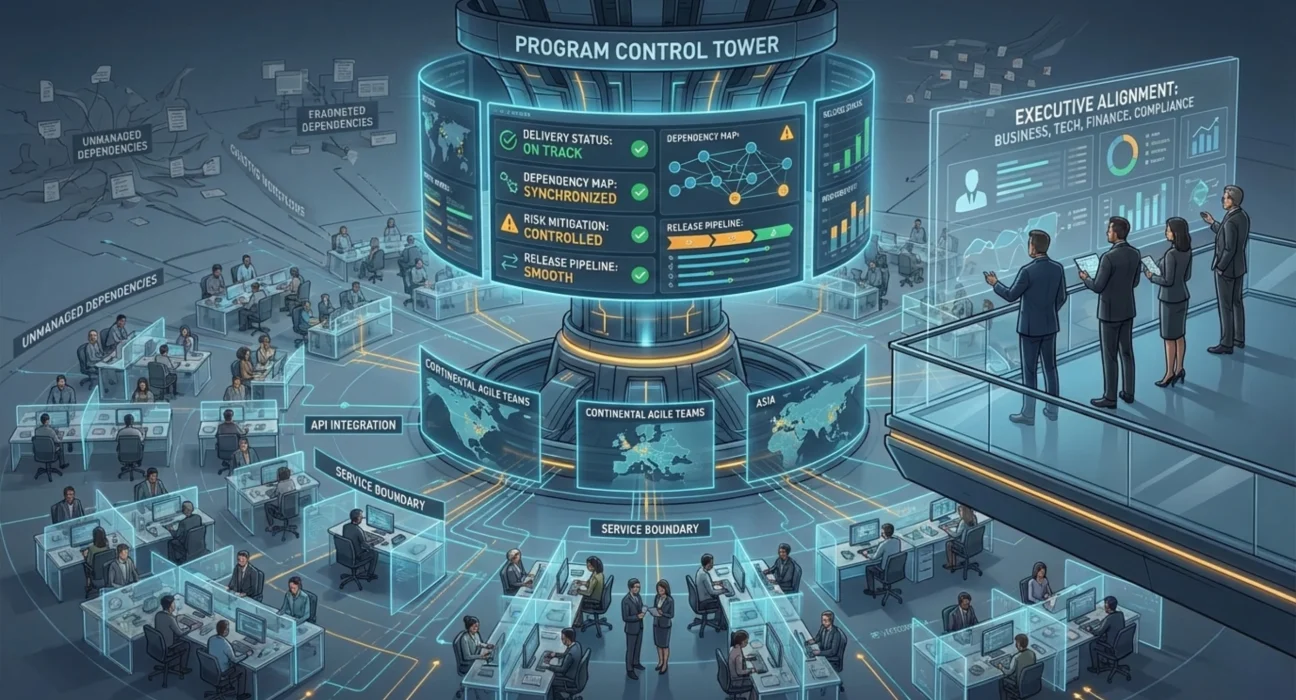
They create a single source of truth for delivery. Jira is fine for individual teams. But at the program level, you need visibility across all teams, all vendors, all dependencies, all risks. You need a delivery control tower not as a bureaucratic layer, but as an operational necessity. Someone needs to know, in real time, what’s on track, what’s slipping, and what decisions need to be escalated.
This is where experienced execution partners make a tangible difference. Firms like Ozrit, for instance, bring program execution discipline that goes beyond development helping enterprises establish governance structures that actually enable speed rather than slow it down.
They staff for delivery, not just development. The ratio of developers to delivery managers, architects, test leads, and DevOps engineers matters enormously. A lot of programs under-invest in these enabling roles because they’re expensive and don’t write code. But without them, developers spend half their time in meetings trying to figure out what to build, how to deploy it, and whose approval they need.
Mature programs recognise that delivery is a discipline, not an afterthought.
They align financial governance with Agile execution. This is uncomfortable but essential. If your finance function is still operating on a waterfall budgeting and milestone-based payment model, you’ll create constant friction with Agile delivery. You need to move toward outcome-based funding, rolling wave planning, and adaptive budgeting. This requires CFOs and CIOs to work together in ways they traditionally haven’t.
They treat vendors as extended teams, not outsourced risk. If you’re working with an SI partner or offshore development centre, the relationship can’t be transactional. You need shared metrics, shared ceremonies, and shared accountability. The best enterprise programs embed vendor teams into the same Agile rituals, give them access to the same tools, and treat them as part of one delivery organisation.
When this works, it’s powerful. When it doesn’t, you end up with finger-pointing and blame games that destroy momentum.
The Role of Leadership
Scaling Agile is not a PMO problem. It’s a leadership problem.
If the CIO is asking for Agile but the CFO is demanding fixed-price contracts, you have a leadership misalignment. If the COO wants speed but the CTO insists on zero risk, you have a leadership misalignment. If business sponsors change priorities every month but expect engineering to stay on schedule, you have a leadership misalignment.
Agile at scale only works when the executive team is aligned on what trade-offs they’re willing to make. Speed versus cost. Flexibility versus predictability. Innovation versus stability.
These are not easy conversations. But avoiding them is worse.
Leaders also need to shield the program from organisational churn. Enterprise reorgs, budget cuts, strategy pivots these are facts of life. But if the delivery teams are constantly reacting to changes in direction, velocity collapses. Strong program sponsors create a buffer. They absorb uncertainty at the top so the teams below can focus on execution.
Execution Maturity Is the Real Differentiator
Here’s what enterprises often get wrong: they think scaling Agile is about scaling the ceremonies. More stand-ups. Bigger PI planning events. Longer backlogs.
But what actually scales execution is maturity in a few critical areas.
Clarity of ownership. Every feature, every service, every integration point needs a clear owner. Not a team. Not a committee. A person. Someone who wakes up thinking about it and is accountable for its success. In large programs, ambiguity is the enemy.
Ruthless prioritisation. You cannot build everything. You need a prioritisation framework that is transparent, consistently applied, and tied to business outcomes. Whether it’s WSJF, MoSCoW, or something custom, it has to be respected. When stakeholders try to bypass it , leadership has to hold the line.
Automated everything. At scale, manual processes don’t work. You need CI/CD pipelines that are rock solid. You need automated testing at every layer. You need infrastructure as code. You need observability and monitoring built in from day one. The cost of automation is high upfront, but the cost of not automating is catastrophic at scale.
Transparent risk management. Risks in large programs are not edge cases. They’re the main event. Dependency risks. Integration risks. Security risks. Compliance risks. Vendor performance risks. Budget risks. The organisations that handle this well have a risk register that’s updated weekly, reviewed at every steering committee, and actively managed not just documented.
Choosing the Right Partner
Many enterprises try to scale Agile with their existing teams and existing vendors. Sometimes that works. Often, it doesn’t.
The gap is execution capability. Building software is one thing. Delivering a large-scale enterprise program is another. You need partners who understand not just technology, but governance, stakeholder management, risk, compliance, and the messy realities of enterprise IT.
This is where working with a partner who has deep program execution experience becomes invaluable. Ozrit, for example, brings a delivery-first mindset to enterprise engagements focusing not just on building features, but on building the operating model, the governance structure, and the delivery discipline that makes those features actually reach production on time and within budget.
The right partner doesn’t just give you engineers. They give you delivery leadership. They bring patterns that have worked in other large enterprises. They help you avoid mistakes that cost months and millions.
But partnership only works if there’s trust and alignment. If you’re treating your technology partner as a vendor to be managed at arm’s length, you’ll get arm’s length results.
What Good Looks Like
When scaling Agile works in an enterprise setting, you see a few consistent patterns.
Teams have clarity. They know what they’re building, why it matters, and who it’s for. Dependencies are visible and managed. Blockers are escalated and resolved quickly, not left to fester.
Releases happen regularly. Not once a year. Not after nine months of integration testing. Every few weeks, real functionality goes to production. It might be behind a feature flag. It might be in a limited pilot. But it’s real progress.
Stakeholders have confidence. They see working software. They see metrics improving. They see risks being managed. They might not love every trade-off decision, but they understand why it was made and trust the process.
The program adapts without collapsing. When requirements change and they will, the teams can absorb the change because they’re working in short cycles with clear priorities. The architecture is modular enough to accommodate change. The governance is light enough to allow flexibility but strong enough to maintain coherence.
And perhaps most importantly, people stay. Engineers don’t burn out. Delivery leads don’t quit halfway through. The organisation learns and improves with every sprint, every release, every retrospective.
This doesn’t happen by accident. It happens when leadership is committed, when the operating model is sound, when the right capabilities are in place, and when execution is treated with the same seriousness as strategy.
Final Thoughts
Scaling Agile for programs with hundreds of engineers is not a framework problem. It’s a systems problem. It’s about aligning people, process, technology, governance, and culture in a way that enables delivery at speed without sacrificing quality or control.
Most enterprises under-invest in the hard, unglamorous work of building delivery capability. They focus on tools and methodologies and hope that’s enough. It never is.
The enterprises that win are the ones that treat execution as a core competence. They build strong program leadership. They invest in the right scaffolding. They choose partners who understand enterprise realities. And they recognise that in large-scale transformation, maturity matters more than methodology.
If you’re leading one of these programs, you already know it’s difficult. The question is whether you’re set up to succeed or just set up to try.