

Enterprise Resource Planning systems have become standard infrastructure for large organizations. But understanding what ERP actually delivers in practical terms is more important than knowing the technical definition. For C-suite leaders evaluating ERP investments or trying to get more value from existing systems, the question is not what ERP is. The question is what it does for your business.
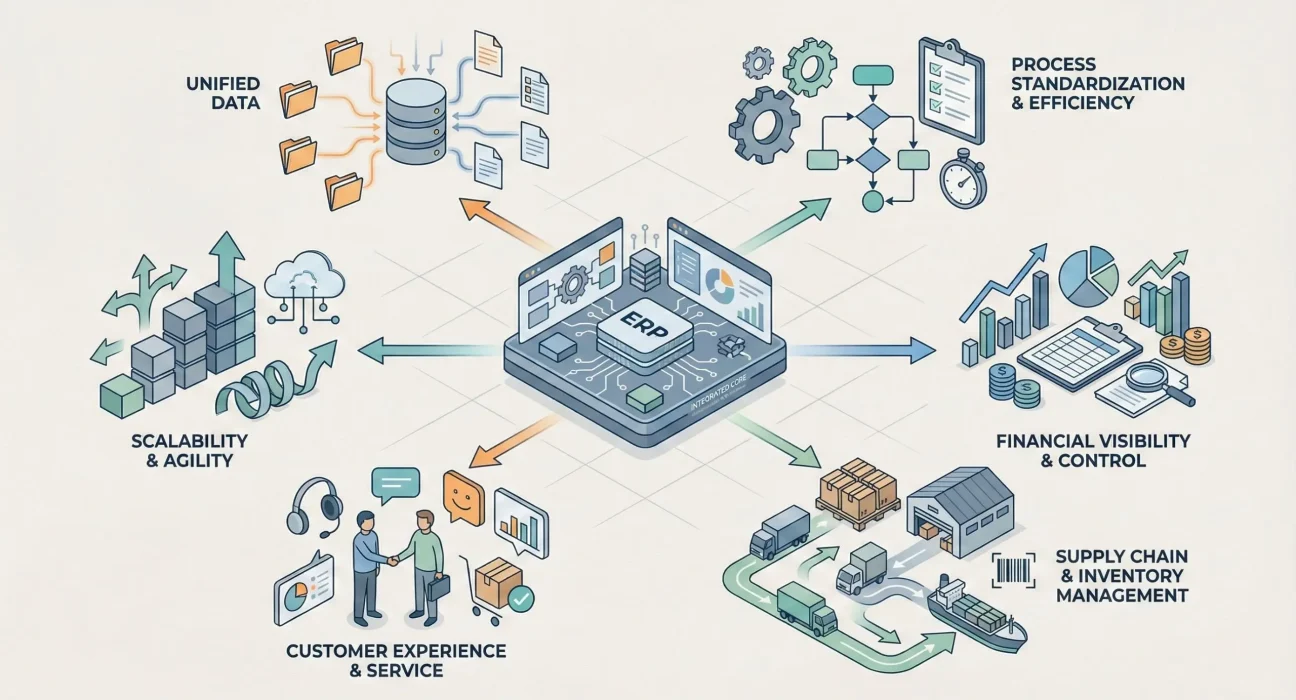
ERP delivers six core benefits that matter at enterprise scale. These are not abstract advantages or vendor marketing claims. They are tangible operational improvements that show up in financial performance, execution speed, and competitive capability.
Unified Data Across the Organization
The first and most fundamental benefit of ERP is a single source of truth for business data. In organizations without ERP, different departments maintain their own records. Sales has one version of customer information. Finance has another. Operations works from a third. These discrepancies create constant friction and bad decisions.
When a customer calls about an order, the service rep needs to check multiple systems to piece together what is actually happening. When leadership asks for revenue projections, finance and sales present different numbers because they are working from different data. When operations plans production, they might be using outdated demand forecasts because information has not propagated from the sales systems.
ERP solves this by creating one database that all functions access. A customer record exists once. An order flows through the system from initial quote through delivery and payment, with every department seeing the same information at the same time. Inventory positions update in real time across all locations.
This unified data environment eliminates entire categories of problems. Teams stop wasting time reconciling conflicting reports. Decisions get made faster because people are not debating whose numbers are correct. Issues get identified earlier because anomalies become visible across the entire operation instead of staying hidden in departmental silos.
The value compounds in large organizations. A company with 50 locations and 5,000 employees creates millions of data points daily. Without ERP, keeping this information consistent is essentially impossible. With ERP, it happens automatically as part of normal operations.
Process Standardization and Efficiency
The second major benefit is standardized processes that run consistently across the organization. Large enterprises struggle with process variation. Each region or business unit develops its own way of handling orders, managing inventory, processing invoices, and dozens of other routine tasks.
This variation creates multiple problems. Training becomes difficult because procedures differ by location. Quality suffers because some sites follow better practices than others. Costs stay high because you cannot achieve economies of scale when everyone operates differently. Reporting is complicated because data does not align across divisions.
ERP enforces standard processes through the system design. When someone enters an order, the system guides them through the same steps regardless of location. Approvals route to the right people based on defined business rules. Exception handling follows consistent procedures. Compliance controls apply uniformly across the organization.
This standardization drives significant efficiency gains. Employees become more productive because they follow clear, proven workflows instead of figuring things out ad hoc. Errors decrease because the system prevents common mistakes. Throughput increases because bottlenecks get eliminated through process optimization that applies everywhere.
The automation embedded in these processes also matters. Tasks that used to require manual intervention now happen automatically. Purchase orders generate based on inventory levels. Invoices match against receipts and route for payment. Commission calculations run automatically from sales data. This frees people to focus on judgment-based work that actually requires human expertise.
For large organizations, these efficiency improvements create substantial cost advantages. Even modest gains per transaction multiply across millions of transactions annually. Companies that implement ERP effectively can typically handle significantly higher volumes without proportional increases in headcount.
Improved Financial Visibility and Control
The third benefit is much stronger financial management capability. ERP gives finance teams real-time visibility into what is happening across the business. Revenue, costs, cash flow, and profitability become visible at granular levels instead of waiting for month-end close processes.
This visibility enables better control. Finance can monitor spending patterns, identify cost overruns early, and enforce budget discipline more effectively. Month-end close cycles that used to take weeks can be compressed to days because data does not need to be gathered and reconciled from multiple systems. Audit trails are built into the system, making compliance and internal controls more manageable.
The planning capabilities also improve. When finance has accurate, current data about operations, forecasting becomes more reliable. Budget versus actual analysis happens in real time rather than retrospectively. Scenario planning can incorporate actual operational constraints instead of relying on simplified assumptions.
For public companies and regulated industries, this financial control is not optional. The ability to close books quickly, produce accurate reports, and demonstrate proper controls has become a regulatory requirement. ERP provides the foundation that makes this achievable at enterprise scale.
Beyond compliance, better financial visibility enables faster strategic decision-making. When leadership considers an acquisition, expansion, or major investment, they need accurate data about current performance and capacity. ERP makes this information accessible instead of requiring weeks of manual analysis to answer basic questions.
Enhanced Supply Chain and Inventory Management
The fourth benefit applies primarily to companies that manufacture products or manage complex supply chains. ERP provides integrated visibility and control across procurement, production, warehousing, and distribution.
Without ERP, supply chain management relies on disconnected systems and manual coordination. Procurement does not have real-time visibility into production schedules. Manufacturing operates from demand forecasts that may be outdated. Warehouses manage inventory based on local information without understanding company-wide needs. The result is excess inventory in some locations, stockouts in others, and constant expediting to fix problems.
ERP connects these functions through shared data and coordinated processes. Demand from customers flows back to production planning and procurement automatically. Inventory is visible across all locations, enabling better allocation decisions. Production schedules consider material availability, capacity constraints, and delivery commitments. Procurement can consolidate purchases to negotiate better pricing and optimize logistics.
The working capital impact can be substantial. Companies typically reduce inventory levels by 15 to 25 percent after implementing ERP effectively while simultaneously improving service levels. This happens because visibility and coordination reduce the safety stock needed to buffer against uncertainty.
Lead times also improve. When the supply chain operates as an integrated system rather than a series of handoffs between departments, products move faster from raw materials to delivered goods. This speed advantage matters in industries where responsiveness is a competitive differentiator.
Better Customer Experience and Service
The fifth benefit is improved customer-facing capability. ERP gives customer service teams complete visibility into order status, delivery schedules, product availability, and customer history. This enables better service without the customer having to wait while someone searches through multiple systems.
When a customer asks about an order, the service rep can see exactly where it is in the fulfillment process. If there is a problem, they can identify it immediately and take action instead of promising to investigate and call back later. If the customer wants to place a new order, the system shows accurate inventory positions and realistic delivery dates.
This responsiveness improves customer satisfaction and loyalty. In competitive markets, service quality often matters as much as product features or pricing. Companies with ERP can deliver better service without hiring more people because the system makes each service interaction faster and more productive.
The sales function also benefits. Sales teams get accurate information about product availability, pricing, and delivery lead times. They can configure complex orders using guided selling tools built into the ERP system. Quote-to-order processes happen faster because information does not need to be manually transferred between systems.
For B2B companies, customer portals connected to ERP enable self-service capabilities that both improve customer experience and reduce service costs. Customers can check order status, review invoices, and track shipments without contacting support. This transparency builds trust while freeing service teams to handle more complex issues.
Scalability and Business Agility
The sixth benefit is the ability to scale operations and adapt to changing business needs more effectively. Companies without ERP hit operational limits as they grow. Processes that worked at smaller scale break down. Manual coordination becomes impossible. Costs increase faster than revenue because inefficiency compounds.
ERP removes many of these scaling constraints. The system can handle much higher transaction volumes without requiring major redesign. Adding new locations or business units means deploying the existing ERP configuration rather than building new processes from scratch. Acquisitions can be integrated more smoothly because you have a target system architecture to migrate them into.
The agility advantage may be even more valuable than pure scalability. Markets change, regulations evolve, and strategic priorities shift. Organizations need to adapt quickly. With ERP, process changes can be implemented through system configuration and deployed across the entire company rapidly. Without ERP, changing how the business operates requires updating countless spreadsheets, retraining thousands of people on new procedures, and hoping everyone actually follows the new approach.
Modern ERP systems also provide platforms for innovation. Companies can add analytics capabilities, automate processes using workflow engines, or build customer-facing applications on top of the ERP foundation. This is much harder when core operations run on fragmented legacy systems that do not integrate well.
The Implementation Reality
These six benefits are real and substantial. But achieving them requires strong implementation execution. Most ERP failures are not technology failures. The software usually has the necessary capabilities. What goes wrong is how the project gets planned, resourced, and delivered.
Organizations underestimate the change management challenge. ERP changes how people work across every function. Without proper training, communication, and support, adoption will be low and benefits will not materialize. Data quality issues also derail many implementations. ERP requires clean, consistent master data. Fixing data problems during implementation adds months to timelines and significant cost.
Integration complexity catches companies by surprise. ERP rarely operates in isolation. Connections to e-commerce platforms, logistics systems, manufacturing equipment, and specialized applications all need to work reliably. Each integration point requires careful design, testing, and ongoing maintenance.
These challenges explain why ERP implementations demand experienced execution partners who understand enterprise complexity and can navigate it successfully.
How Ozrit Approaches ERP Delivery
Ozrit specializes in large-scale ERP implementations where delivery certainty matters more than promises. The company’s approach addresses common failure points through senior leadership involvement, realistic planning, and sufficient capacity to staff complex programs properly.
When you work with Ozrit, you engage directly with delivery leaders who have implemented ERP at major enterprises before. These are experienced professionals who can anticipate problems based on pattern recognition from previous programs. This judgment matters because ERP projects involve countless decisions where the wrong choice creates expensive consequences down the road.
Ozrit’s structured onboarding process reduces the ramp-up period where new teams are learning your environment. The company has developed methods for quickly understanding client operations, existing systems, and organizational dynamics. This means the team adds value in weeks rather than spending months on discovery before actual implementation work begins.
Team capacity is another important factor. Ozrit maintains over 200 experienced engineers and architects who can be deployed to enterprise programs. ERP implementations often need to scale up quickly or require specialists in specific modules or integration technologies. Ozrit can staff projects appropriately from the start rather than forcing compromises on team composition.
The delivery model emphasizes phased implementation with clear milestones and regular reviews. Ozrit does not promise aggressive timelines that cannot be met. They plan realistic schedules that allow for proper testing, training, and data migration. This transparency helps leadership manage expectations and maintain confidence throughout the program.
Support continues after go-live with 24/7 coverage for production systems. ERP runs critical business processes that cannot afford extended downtime. When issues occur, you need immediate access to people who understand your specific implementation and can resolve problems quickly.
Making ERP Deliver Value
ERP provides substantial benefits when implemented and operated effectively. Unified data, standardized processes, financial control, supply chain optimization, better customer service, and business agility are all achievable outcomes that justify significant investment.
But technology alone does not deliver these benefits. Success requires strong execution from initial planning through go-live and ongoing operations. This means realistic timelines, experienced leadership, thorough implementation work, and sustained support after deployment.
For senior leaders evaluating ERP initiatives, the critical assessment is not about software selection. It is about implementation capability and long-term partnership quality. The benefits of ERP are real, but they only materialize when the program is delivered successfully by teams who understand enterprise complexity and can navigate it without compromising on quality or control.