

Regulated enterprises face a dilemma with AI. The technology promises significant operational improvements through automation and intelligent decision-making. But regulations require human accountability, explainable decisions, and audit trails that show how outcomes were reached. Fully automated AI systems that operate as black boxes cannot satisfy these requirements.
The answer for most regulated operations is human-in-the-loop AI. The technology handles routine work, identifies patterns, and recommends actions. Humans make final decisions on matters that carry regulatory risk, review AI outputs for correctness, and intervene when situations fall outside normal parameters. This approach captures AI efficiency while maintaining the oversight and accountability that regulations demand.
Implementing this model successfully requires more than just adding a review step to automated processes. It requires thoughtful design about when humans must be involved, how AI presents information to support good decisions, and how the combined system performs reliably under operational pressure. Most enterprises underestimate this complexity and end up with implementations that satisfy neither efficiency goals nor regulatory requirements.
Why Regulated Enterprises Cannot Fully Automate
Financial services must comply with regulations around lending decisions, trading activities, and customer communications. Healthcare organisations must follow treatment protocols and patient privacy rules. Government contractors must demonstrate fairness and transparency in decision-making. Pharmaceutical companies must maintain extensive documentation for regulatory approval and compliance.
These regulations share common themes. Decisions that affect people or significant financial outcomes must be explainable. Someone must be accountable when things go wrong. Audit trails must show who decided what and based on what information. Algorithms cannot discriminate based on protected characteristics.
Fully automated AI struggles with all of these requirements. Modern AI often works through complex patterns that are difficult to explain in simple terms. When the AI makes a decision, tracing exactly why can be challenging. If that decision causes harm or violates regulations, determining accountability becomes ambiguous. And detecting whether AI has developed biased patterns requires active monitoring that many organisations lack.
The practical result is that regulators and compliance teams will not approve full automation for decisions that carry significant risk. A loan approval, a treatment recommendation, a benefits determination, or a trading decision cannot be fully automated in most regulated contexts. Human judgment must be part of the process in a documented and meaningful way.
What Human-in-the-Loop Actually Means
The concept sounds straightforward. AI does work and humans review or approve the results. But effective implementation requires careful thinking about several dimensions.
The first question is when human involvement is required. For every decision? Only for decisions above certain thresholds? When AI confidence is below a certain level? When the situation matches certain risk criteria? The answer affects both operational efficiency and regulatory compliance. Too much human involvement eliminates efficiency gains. Too little creates compliance risk.
The second question is what humans actually do when they are in the loop. Are they rubber-stamping AI recommendations or making genuine assessments? Do they have the information needed to make good decisions, or just summary outputs from the AI? Can they override the AI when they disagree, or is the technology determinative? The quality of human decisions depends on how these questions are answered.
The third question is how the system behaves when humans and AI disagree. Does the human decision always prevail? Does disagreement trigger additional review? Is there a mechanism to learn from disagreements to improve the AI? These situations reveal whether the system truly supports human judgment or just creates the appearance of human involvement to satisfy regulations.
The fourth question is how the combined human and AI system scales. If AI handles 80 percent of routine decisions automatically and routes 20 percent to humans, the workload is manageable. If uncertainty thresholds are set too conservatively and 60 percent requires human review, the system creates more work than the manual process it replaced. Finding the right balance requires both good AI design and operational experience.
The Design Patterns That Work
Effective human-in-the-loop AI follows certain patterns that have proven successful in regulated environments.
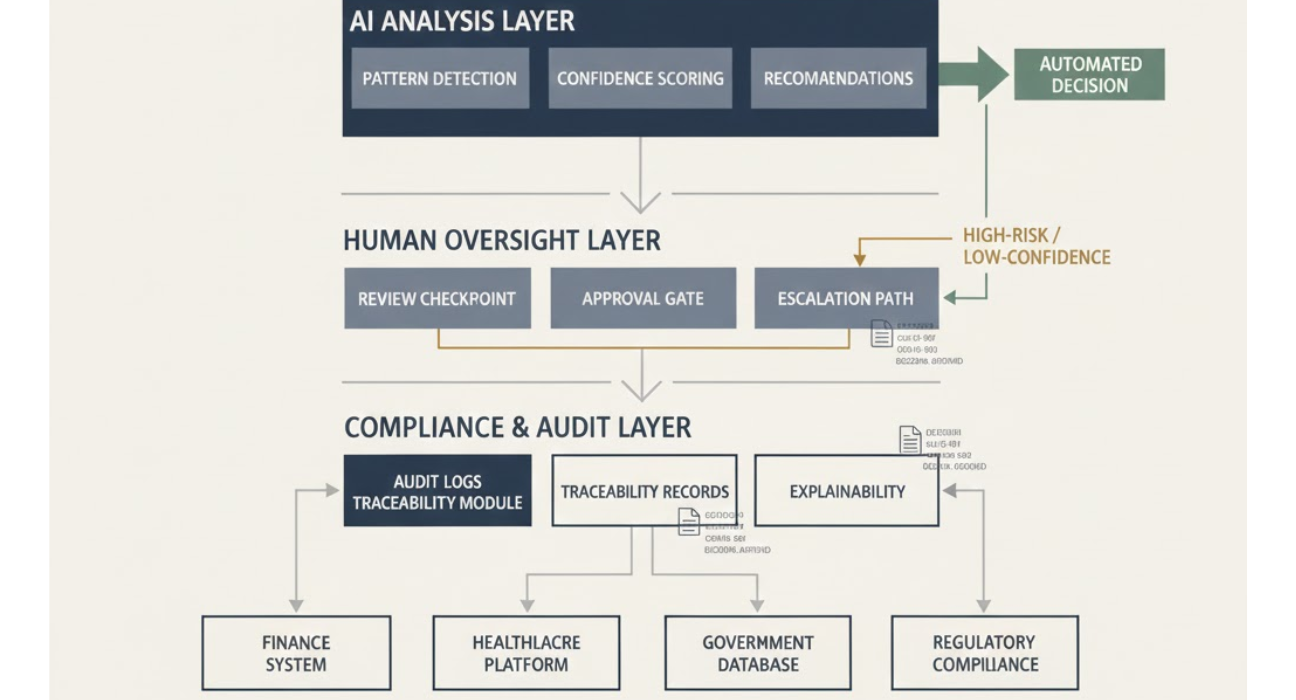
Confidence-based routing is one common approach. The AI evaluates its confidence in each decision based on how similar the current situation is to patterns in training data. High-confidence routine cases get automated. Lower-confidence cases get routed to humans with context about why the AI was uncertain. This focuses human attention where it adds most value.
Risk-based escalation is another pattern. The AI can handle routine, low-risk decisions automatically. Decisions that exceed risk thresholds, whether based on dollar amounts, customer characteristics, or situation complexity, get escalated to humans. The thresholds get calibrated based on regulatory requirements and organisational risk tolerance.
Exception handling with human oversight allows the AI to process normal cases while routing exceptions to specialists. The AI identifies when a situation falls outside standard parameters and provides humans with relevant context and suggested approaches based on similar historical cases. Humans make final decisions but with better information than they would have through purely manual processes.
Augmented decision-making keeps humans fully in control but provides AI-generated insights to inform their decisions. The human reviews the situation and makes a judgment. The AI provides analysis, relevant precedents, risk factors, and recommendations. The human can accept, modify, or reject the AI input. This pattern works well when regulations require human decision-making, but AI can improve decision quality.
How Ozrit Implements Human-in-the-Loop AI
Ozrit designs operations platforms for regulated enterprises with human-in-the-loop AI as a core architectural principle. The company was founded by people who understood that regulated operations cannot fully automate and that effective AI must augment human capability rather than replace it.
The platform architecture treats human decision-making as a first-class component of operational workflows, not an afterthought. Routing logic determines which cases need human involvement based on configurable rules around risk, confidence, complexity, and regulatory requirements. Cases that need human review get directed to appropriate specialists with full context.
The user interfaces provide humans with the information they need to make good decisions quickly. This includes AI recommendations with confidence levels, relevant historical precedents, risk factors the AI identified, and a clear presentation of data that informs the decision. Humans can drill into details when needed, but are not overwhelmed with information that does not help.
The system maintains complete audit trails showing both AI processing and human decisions. For each case, the audit trail captures what data the AI used, what recommendation it made, why it escalated to a human if applicable, what the human decided, and what information informed that decision. This satisfies regulatory requirements for explainability and accountability.
The platform learns from human decisions to improve AI recommendations over time. When humans consistently override AI recommendations in certain types of situations, the system identifies these patterns and adjusts its approach. This creates a feedback loop where human expertise continuously refines AI behaviour without requiring data scientists to manually retrain models.
For regulated operations like financial approvals, the AI can evaluate applications against established criteria and automatically approve clearly qualified cases. Applications that fall into grey areas or trigger risk flags get routed to underwriters with AI analysis of strengths, concerns, and comparable past decisions. The underwriter makes the final decision with better information than they would have through manual review alone.
For compliance monitoring, the AI can flag transactions or activities that deviate from normal patterns and might indicate issues. Compliance specialists review flagged items to determine whether they represent actual problems or benign anomalies. The AI handles the tedious work of monitoring high volumes while humans apply judgment to ambiguous situations.
Implementation for Regulated Environments
Ozrit structures human-in-the-loop AI implementations to address the specific requirements of regulated enterprises. The approach begins with a regulatory assessment, typically four to six weeks, that identifies which decisions require human involvement, what documentation regulators expect, and what compliance risks must be managed. This assessment involves both technical teams and compliance officers to ensure the implementation satisfies operational and regulatory needs.
The implementation follows a phased approach that validates regulatory compliance at each stage. The first phase typically implements AI for a specific operational area with conservative escalation thresholds. This allows the organisation and regulators to gain confidence that the system operates appropriately before expanding the scope or reducing human involvement.
Each phase includes extensive compliance testing that goes beyond technical functionality. Testing validates that audit trails contain required information, that human decisions are properly documented, that escalation logic works correctly, and that the system behaves appropriately in edge cases. Compliance teams actively participate in testing rather than reviewing after implementation.
A realistic timeline for human-in-the-loop AI in regulated operations is 8 to 14 months for focused implementations in specific operational areas, or 14 to 20 months for comprehensive AI across major regulated processes. These timelines are longer than unregulated AI implementations because regulatory validation and compliance testing add necessary rigor. Delays typically come from regulatory approval processes rather than technical delivery.
Ozrit assigns senior AI architects who have experience with regulated enterprises to these programs. They understand how to design systems that satisfy both operational efficiency goals and regulatory requirements. They have worked with regulators before and know how to present AI capabilities in ways that build confidence rather than triggering concerns. They remain involved through regulatory discussions and approval processes, not just during technical implementation.
Managing Regulatory Relationships
Implementing AI in regulated environments requires active engagement with regulators and compliance teams. Surprises create problems. Early involvement builds trust and surfaces concerns when they are easier to address.
Ozrit helps clients develop communication strategies for regulators that explain how human-in-the-loop AI works, what safeguards ensure appropriate human involvement, how audit trails support oversight, and how the system prevents algorithmic bias. These communications focus on regulatory objectives rather than technical details, helping regulators understand how AI supports rather than undermines their goals.
Some regulators want to review AI systems before deployment. This requires documentation that explains decision logic, training data sources, testing procedures, and operational controls. Ozrit supports these reviews with materials designed for non-technical audiences and responds to regulator questions in ways that build confidence.
Ongoing regulatory reporting often requires additional capabilities beyond normal operations. The system must be able to generate reports showing decision patterns, human override rates, demographic distributions to demonstrate fairness, and other metrics regulators use for oversight. These capabilities are designed into the platform rather than retrofitted later.
Operating Under Regulatory Scrutiny
Human-in-the-loop AI in regulated environments requires operational discipline that goes beyond normal AI systems. Monitoring must track not just technical performance but also compliance with human involvement requirements. When problems occur, the response must address both operational and regulatory dimensions.
Ozrit platforms include monitoring that validates human involvement is happening as required. If escalation rates drop too low, it might indicate the AI is making decisions that should involve humans. If override rates spike, it might indicate the AI has degraded and is making poor recommendations. These patterns trigger investigation before they become compliance issues.
The 24/7 support includes compliance-aware engineers who understand the regulatory context and can respond to issues without creating compliance risk. When problems occur, they consider both operational impact and regulatory implications in developing solutions. This prevents fixes that solve technical problems but create compliance exposure.
Regular compliance reviews assess whether the system continues operating within regulatory parameters. These reviews examine audit trails, escalation patterns, decision outcomes, and demographic distributions to ensure the AI is not developing biased patterns. Issues get addressed proactively rather than discovered during regulatory audits.
The Business Case in Regulated Environments
Human-in-the-loop AI in regulated enterprises delivers efficiency gains while maintaining compliance. The AI handles routine work that previously required human attention. Humans focus on complex cases where their expertise matters most. Overall throughput increases without adding headcount or creating regulatory risk.
The investment required is higher than for unregulated AI because of additional compliance requirements, more extensive testing, and ongoing regulatory management. For meaningful human-in-the-loop AI across significant regulated operations, total investment typically reaches millions over the implementation period.
The return comes from increased operational capacity, improved decision quality, and reduced compliance risk. Faster processing improves customer experience. Better decisions reduce errors and their consequences. Strong audit trails and compliance controls reduce regulatory penalties and reputational risk. These benefits justify the investment while meeting the organisation’s obligation to operate responsibly in regulated domains.
The timeline to value is longer than unregulated implementations because regulatory approval and compliance validation cannot be rushed. Most organisations see meaningful operational improvement within 18 to 24 months after starting implementation, with benefits increasing as the system matures and human-AI collaboration improves.
What Success Requires
Human-in-the-loop AI succeeds in regulated enterprises when organisations design for both efficiency and compliance from the beginning. The system must genuinely involve humans in meaningful ways, not create the appearance of involvement to satisfy regulations. Audit trails must be complete and accessible. Compliance monitoring must be continuous and rigorous.
This requires partnership between technical teams, operational teams, and compliance functions throughout design and implementation. It requires patient engagement with regulators to build confidence. And it requires operational discipline to maintain compliance as the system evolves. Organisations that approach human-in-the-loop AI this way capture efficiency benefits while managing regulatory risk appropriately. The result is operations that work better while remaining fully compliant with the rules that govern regulated enterprises.