

If you’re planning a website, web app, or online platform, you’ve probably run into a familiar problem: one vendor for design, another for backend, a third for hosting, and nobody owning the whole result. Full stack web development companies solve this by handling the front end, back end, database, integrations, and deployment under one roof.
In short, full-stack development companies offer end-to-end web development: user interface, server-side logic, databases, APIs, testing, deployment, and ongoing support. Below, we explain what that includes, who benefits most, how it compares to other hiring models, and how to choose the right partner.
What Is a Full-Stack Web Development Company?
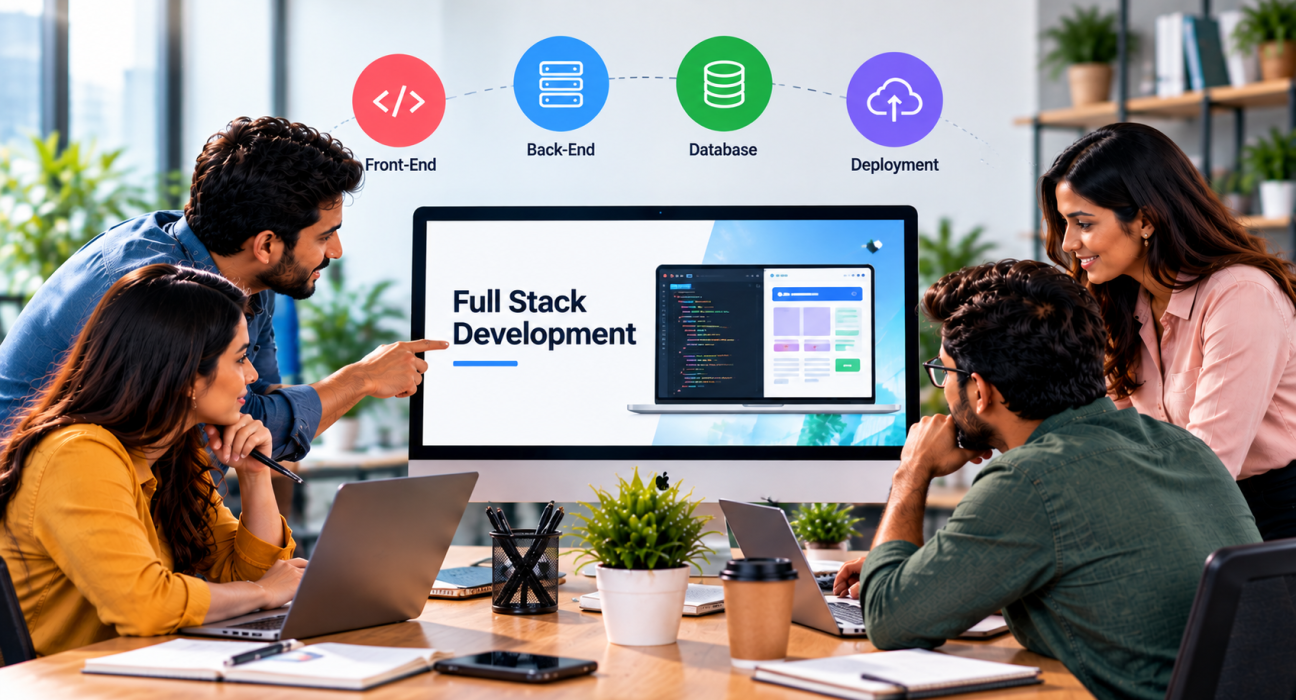
A full-stack web development company builds and maintains every layer of a web application. “Stack” refers to the technologies that make a web product work:
- Front end: what users see and interact with (layouts, forms, dashboards, navigation)
- Back end: the server-side logic, business rules, and authentication that power the product
- Database: where data such as user accounts, orders, and content is stored
- Infrastructure: hosting, deployment pipelines, security, and monitoring
Some companies have individual developers who work across all layers. Others have specialized front-end, back-end, and DevOps teams that work together under one project manager. Both approaches count as full-stack, as long as the company takes responsibility for the whole product.
What Services Do Full-Stack Web Development Companies Offer?
Exact services vary by company, but most cover the following.
1. Discovery and Product Planning
Good agencies start by understanding your business goals, users, and constraints. This usually includes requirements gathering, feature prioritization, technical scoping, and a project roadmap. Skipping this step is one of the most common reasons web projects run over budget.
2. UI/UX Design
Many full-stack companies include wireframing, prototyping, and interface design. Others partner with design specialists. Either way, ask how design and development teams collaborate, since handoff problems can slow a project significantly.
3. Front-End Development
This covers building responsive, accessible interfaces that work across devices and browsers. Common tools include React, Angular, and Vue.js, though the right choice depends on your project.
4. Back-End Development
Back-end work covers server logic, user authentication, business workflows, and data processing. Typical technologies include Node.js, Python, Java, PHP, and .NET.
5. Database Design and Management
Developers choose and structure databases (SQL or NoSQL) based on how your data is used, how much of it there is, and how quickly it needs to grow.
6. API Development and Third-Party Integrations
Most business websites need to connect with other tools: payment gateways, CRMs, ERPs, email platforms, analytics, or shipping services. A full-stack team builds and maintains these connections.
7. E-Commerce and CMS Development
Companies often build online stores, custom content management systems, marketplaces, and membership platforms, either from scratch or on top of established platforms.
8. Cloud Deployment and DevOps
This includes setting up hosting, continuous integration and deployment (CI/CD), environments for testing, and performance monitoring.
9. Quality Assurance and Security
Testing (functional, performance, and cross-browser) and security practices such as secure authentication and data protection should be part of the process, not an afterthought.
10. Maintenance and Support
After launch, many companies offer bug fixes, updates, performance tuning, and feature additions under a support agreement.
Why Do Businesses Hire Full-Stack Web Development Companies?
Here are the main benefits companies typically look for.
Single point of accountability. When something breaks, you don’t have to figure out whether it’s a front-end, back-end, or hosting issue. One team owns it.
Better coordination. Front-end and back-end developers working together can design data flows and interfaces that fit, reducing rework.
Faster time to market. Fewer handoffs between vendors usually means fewer delays, especially for MVPs and early-stage products.
Simpler management. One contract, one project manager, and one communication channel are easier than juggling several vendors.
Scalable architecture. An experienced team can plan for growth from the start, rather than rebuilding when traffic or features increase.
Who Benefits Most From Full-Stack Development Services?
- Startups and founders building an MVP without an in-house engineering team
- SMBs that need a custom website, portal, or internal tool but can’t justify a full development department
- E-commerce businesses needing custom checkout flows, inventory integrations, or marketplace features
- Enterprises modernizing legacy systems or launching new digital products
- Marketing and product teams that need dashboards, landing platforms, or customer-facing apps built quickly
Full-Stack Company vs. Freelancers vs. In-House Team
| Factor | Full-Stack Company | Freelancers | In-House Team |
|---|---|---|---|
| Skill coverage | Broad, multi-role team | Limited to individual skills | Depends on hires |
| Accountability | Single vendor | Split across individuals | Internal management |
| Scalability | Easy to add resources | Harder to scale | Slow (hiring takes time) |
| Management effort | Moderate | High | High |
| Long-term cost | Project or retainer based | Variable | Salaries and overhead |
| Best for | Complete builds, MVPs, growing products | Small tasks, short projects | Core, long-term products |
There’s no universally right answer. Many businesses start with an agency to launch a product, then build an in-house team later.
How to Choose the Right Full-Stack Web Development Company
Follow these steps to narrow your options.
- Define your goals and scope. Write down what the product must do, who will use it, and what success looks like. Even a rough brief helps you compare proposals fairly.
- Set a realistic budget and timeline. Costs depend heavily on complexity, features, integrations, and team location, so treat any quote as an estimate to discuss rather than a fixed figure.
- Shortlist relevant companies. Look for experience in your industry or with similar products. Directories like GoFirms let you research and compare technology service providers by category, so you can build a shortlist before reaching out.
- Review portfolios and case studies. Look for projects similar in complexity to yours, and ask what the company’s role in each was.
- Ask about their process. How do they handle requirements, sprints, testing, and communication? A clear process is often a better sign than a long list of technologies.
- Check technical fit. The team should be able to explain why they recommend a certain technology, not just name-drop frameworks.
- Talk to past clients when possible. References tell you what a portfolio can’t, such as how the team handles problems and deadlines.
- Review the contract carefully. Confirm ownership of the code, payment milestones, support terms, and what happens if the scope changes.
Checklist: Questions to Ask Before You Hire
- Have you built products similar to ours?
- Who will actually work on our project, and how experienced are they?
- How do you manage scope changes?
- What testing and security practices do you follow?
- Who owns the source code after delivery?
- What does post-launch support include?
- How will we communicate, and how often?
Red Flags to Watch For
- Vague proposals with no breakdown of scope or milestones
- Promises of unrealistic timelines or unusually low prices
- No clear answer on who owns the code
- Reluctance to share relevant work samples or client references
- Pushing a specific technology without explaining why it suits your needs
- Little interest in understanding your business goals
What Affects the Cost of Full-Stack Web Development?
Rather than quoting numbers, it’s more useful to understand the drivers. Pricing typically depends on:
- Project complexity: a marketing site is very different from a multi-role SaaS platform
- Number of features and integrations
- Design requirements: custom design costs more than templates
- Team size and seniority
- Location and engagement model: fixed price, time-and-materials, or dedicated team
- Timeline: faster delivery may require a larger team
- Ongoing needs: hosting, maintenance, and future updates
Ask several companies for detailed estimates based on the same brief, and compare what’s included, not just the total.
Common Mistakes Businesses Make
Choosing on price alone. The cheapest proposal often leaves out testing, documentation, or support, which show up as costs later.
Skipping discovery. Without clear requirements, projects drift and budgets grow.
Assuming “full-stack” means “does everything well.” Confirm the team’s depth in the areas that matter most for your product, such as payments, security, or performance.
Ignoring post-launch needs. Web products need updates, monitoring, and fixes. Plan for them from day one.
Frequently Asked Questions
What do full-stack web development companies do?
Full-stack web development companies design, build, test, deploy, and maintain complete web applications. They handle the front end (user interface), back end (server logic), databases, integrations, and hosting. This lets businesses work with one team instead of coordinating separate vendors for each part of the project.
How is a full-stack company different from a regular web design agency?
A web design agency typically focuses on how a site looks and feels. A full-stack company also builds the functionality behind the scenes, such as user accounts, payments, databases, and integrations. Some agencies offer both, so it’s worth asking what’s included before you sign.
When should a business hire a full-stack development company instead of freelancers?
Consider a company when your project needs multiple skills, such as design, back-end development, and DevOps, or when you need reliable timelines and ongoing support. Freelancers can work well for small, well-defined tasks. Complex products usually benefit from a team with clear accountability and a structured process.
How long does a full-stack web development project take?
It depends on scope. A simple business website may take a few weeks, while a custom platform with multiple user roles and integrations can take several months. A good company will give you a timeline after a discovery phase, and will break the work into milestones so you can track progress.
What technologies do full-stack web development companies use?
Common technologies include React, Angular, or Vue.js on the front end; Node.js, Python, Java, PHP, or .NET on the back end; and databases such as PostgreSQL, MySQL, or MongoDB. The right stack depends on your requirements, so a good partner should explain their recommendation rather than default to one toolset.
How do I compare full-stack web development companies?
Compare portfolios, relevant industry experience, process, communication, technical approach, and post-launch support. Ask each company for a proposal based on the same brief. Platforms like GoFirms can help you research and shortlist service providers before you begin conversations, which saves time in the early stages.
Do full-stack companies provide support after launch?
Many do, usually through a maintenance or support agreement covering bug fixes, security updates, performance monitoring, and new features. Always confirm what’s included, response times, and pricing before the project starts, so there are no surprises once the product is live.
Conclusion
Full-stack web development companies give businesses a complete path from idea to launch and beyond: planning, design, front-end and back-end development, integrations, testing, deployment, and support. For startups, SMBs, and enterprises alike, that means fewer handoffs, clearer accountability, and a product designed to work as a whole.
The key to a good outcome is choosing carefully. Define your goals, compare several providers, ask detailed questions, and look closely at process and communication, not just price. If you’re ready to build a shortlist, you can research and compare relevant web development companies on GoFirms and reach out to the ones that best match your project.