


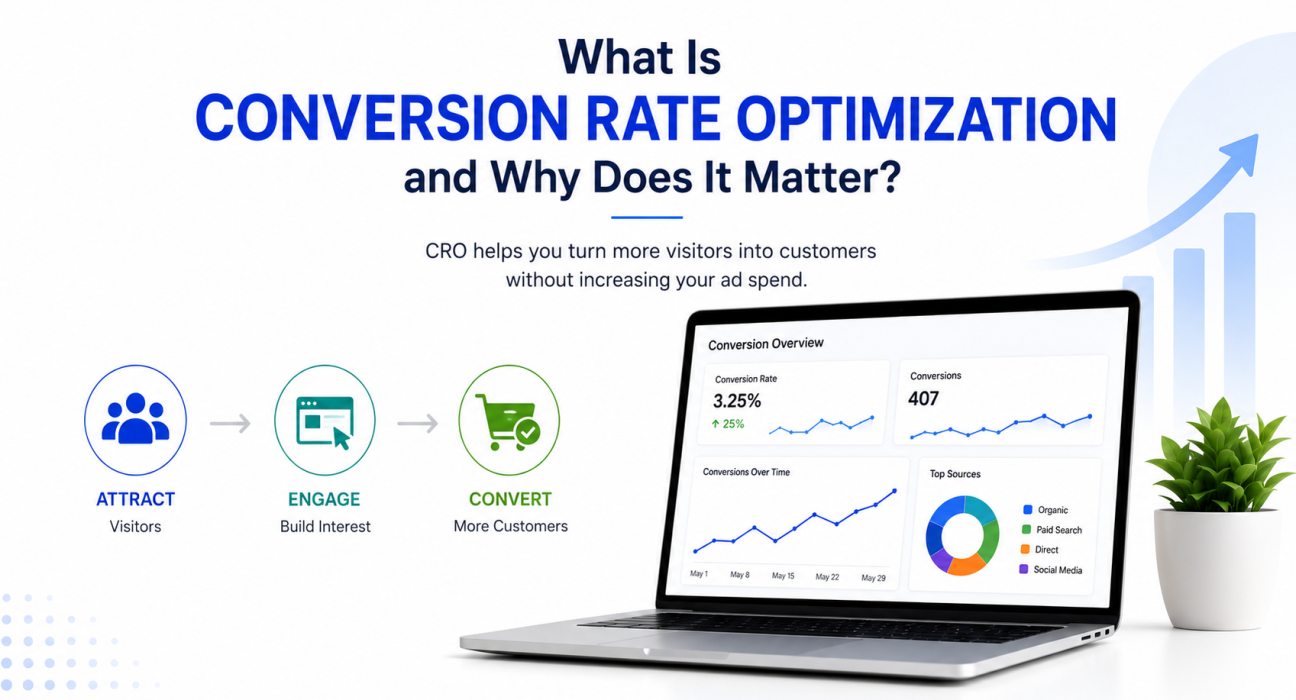
If your website gets a steady stream of visitors but very few of them turn into leads, sign-ups, or paying customers, the problem usually isn’t traffic. It’s conversion. Conversion Rate Optimization (CRO) is the practice of improving your website, app, or landing pages so that more of your existing visitors take the action you want them to take – without spending more on ads or SEO to attract new ones.
For startups, SMBs, and enterprise teams alike, CRO is one of the fastest ways to grow revenue without growing marketing spend. This article breaks down what Conversion Rate Optimization actually means, how it’s measured, why it matters for businesses of every size, and how to build a CRO strategy that works.
What Is Conversion Rate Optimization?
Conversion Rate Optimization is the systematic process of increasing the percentage of website or app visitors who complete a desired action – such as making a purchase, filling out a form, booking a demo, or subscribing to a newsletter.
CRO combines data analysis, user research, design changes, and controlled testing (like A/B testing) to identify friction points in the user journey and remove them. Instead of guessing what might work, CRO relies on real user behavior and measurable results to guide decisions.
In short: CRO helps you get more value out of the traffic you already have.
How Is Conversion Rate Calculated?
The formula for conversion rate is simple:
Conversion Rate = (Number of Conversions ÷ Total Visitors) × 100
For example, if your landing page receives 5,000 visitors in a month and 150 of them complete a purchase, your conversion rate is:
(150 ÷ 5,000) × 100 = 3%
What counts as a “conversion” depends on your business goals. Common conversion types include:
- Completed purchases (e-commerce)
- Form submissions or lead captures (B2B/SaaS)
- Free trial or demo sign-ups
- Newsletter subscriptions
- App downloads or account creations
- Add-to-cart or checkout initiations
There’s no single “good” conversion rate – it varies widely by industry, traffic source, and business model. That’s why CRO focuses on improving your own baseline over time rather than chasing an arbitrary benchmark.
Why Does Conversion Rate Optimization Matter?
CRO matters because it directly affects revenue, marketing efficiency, and customer experience. Here’s why businesses invest in it:
1. It Maximizes Existing Traffic
Acquiring new visitors through SEO, paid ads, or social media costs time and money. CRO helps you convert more of the traffic you’re already paying to attract, which improves your return on marketing investment without increasing spend.
2. It Lowers Customer Acquisition Cost (CAC)
When more visitors convert, your cost per acquisition drops. A small increase in conversion rate can significantly reduce how much you spend to win each new customer.
3. It Improves User Experience
Many CRO improvements – clearer navigation, faster load times, simpler forms – also make the site easier and more pleasant to use. Better UX tends to increase trust, reduce bounce rates, and improve long-term customer satisfaction.
4. It Supports Data-Driven Decision-Making
CRO replaces guesswork with testing. Instead of redesigning a page based on opinion, teams use real user data to validate what actually improves performance.
5. It Creates a Compounding Advantage
Unlike a one-time redesign, CRO is an ongoing process. Each successful test builds on the last, creating steady, compounding improvements in performance over time.
Key Elements of a Successful CRO Strategy
Effective CRO isn’t about changing button colors. It requires a structured look at multiple parts of the user journey.
Website UX and Navigation
Visitors should be able to find what they need with minimal effort. Confusing menus, unclear paths to key pages, or too many steps to complete an action all hurt conversions.
Page Load Speed
Slow-loading pages are one of the most common causes of drop-off, especially on mobile. Even a one- or two-second delay can noticeably reduce conversions.
Copy and Calls-to-Action (CTAs)
Clear, benefit-focused messaging and CTAs that tell visitors exactly what will happen next (“Start Free Trial,” “Get a Quote”) tend to outperform vague or generic language.
Forms and Checkout Flows
Long or complicated forms are a major conversion killer. Reducing the number of required fields and simplifying multi-step checkouts often leads to immediate improvements.
Trust Signals
Testimonials, case studies, security badges, and clear pricing help reduce hesitation, particularly for first-time visitors who aren’t yet familiar with your brand.
Mobile Optimization
With a large share of traffic coming from mobile devices, a site that isn’t fully optimized for smaller screens will consistently underperform.
The CRO Process: Step-by-Step
A disciplined CRO process typically follows these stages:
- Collect Data – Use analytics tools, heatmaps, and session recordings to understand how visitors currently interact with your site.
- Identify Friction Points – Look for pages with high bounce rates, drop-off points in the funnel, or forms with low completion rates.
- Form a Hypothesis – Based on the data, define a specific, testable change (e.g., “Reducing the checkout form from 8 fields to 4 will increase completions”).
- Run a Test – Use A/B testing or multivariate testing to compare the original version against the new one with real traffic.
- Analyze Results – Measure whether the change had a statistically significant impact on conversions.
- Implement and Repeat – Roll out successful changes and move on to the next hypothesis. CRO is an ongoing cycle, not a one-time project.
Common CRO Mistakes to Avoid
- Testing without enough traffic to reach statistically significant results
- Changing too many elements at once, making it impossible to know what caused the improvement
- Relying on assumptions instead of actual user data
- Ignoring mobile users while optimizing primarily for desktop
- Stopping after one successful test instead of treating CRO as continuous
- Focusing only on the homepage while neglecting high-traffic landing pages or checkout flows
Tools and Techniques Commonly Used in CRO
Businesses typically use a mix of tools to support their CRO efforts, including:
- Web analytics platforms to track visitor behavior
- Heatmap and session recording tools to visualize how users interact with pages
- A/B testing platforms to compare page variations
- User feedback tools like on-site surveys or usability testing
- Funnel analysis to pinpoint where visitors drop off
The right combination depends on your traffic volume, budget, and the complexity of your website or app.
When to Bring in a CRO or Digital Marketing Agency
Some businesses run CRO in-house using their marketing or product teams. Others – particularly those without dedicated analytics or UX resources – choose to work with an agency that specializes in conversion optimization, UX design, or digital marketing.
An experienced agency can bring structured testing frameworks, design expertise, and cross-industry benchmarks that are harder to build internally, especially for smaller teams. If you’re evaluating outside help, it’s worth comparing multiple providers based on their experience, process, and past work rather than choosing the first agency you find.
Platforms like GoFirms allow businesses to research and compare digital marketing agencies, UX/UI design firms, and technology service providers side by side, which can make the selection process faster and more informed.
Frequently Asked Questions
What is a good conversion rate? There’s no universal benchmark – a “good” conversion rate depends on your industry, traffic source, and conversion goal. Instead of comparing to industry averages, it’s more useful to track your own rate over time and aim for consistent improvement through testing.
How long does it take to see results from CRO? It depends on your traffic volume and the size of the change being tested. High-traffic pages can show statistically significant results within a few weeks, while lower-traffic sites may need longer testing periods to reach reliable conclusions.
Is CRO only relevant for e-commerce websites? No. CRO applies to any website or app with a defined goal, including SaaS sign-ups, B2B lead generation forms, service inquiries, app downloads, and content subscriptions.
What’s the difference between CRO and SEO? SEO focuses on attracting more visitors to your site through organic search. CRO focuses on converting the visitors you already have into leads or customers. The two work best together, since better SEO traffic paired with strong conversion rates compounds overall growth.
Do I need a large budget to start CRO? Not necessarily. Many CRO improvements – clearer CTAs, simplified forms, faster page speed – require design or development effort rather than large budgets. Larger, more complex testing programs typically require more investment in tools and expertise.
Can small businesses do CRO without hiring an agency? Yes. Many small businesses start with basic analytics and simple A/B tests using in-house resources. As the website’s complexity and traffic grow, some choose to bring in specialized agencies to scale their efforts.
What metrics should I track besides conversion rate? Bounce rate, average session duration, cart abandonment rate, funnel drop-off points, and customer acquisition cost all provide useful context alongside your overall conversion rate.
Conclusion
Conversion Rate Optimization is about making the most of the traffic you already have by removing friction, testing changes, and continuously improving the user experience. Rather than a one-time fix, CRO is an ongoing process built on data, testing, and iteration – and even small improvements can lead to meaningful gains in revenue and marketing efficiency over time.
Whether you handle CRO in-house or decide to bring in outside expertise, the goal stays the same: turn more of your existing visitors into customers. If you’re exploring outside help, GoFirms can be a useful starting point for researching and comparing digital marketing and UX/UI agencies that specialize in conversion optimization.