

Every enterprise software initiative starts with a fundamental choice that shapes everything that follows: Are we building a product or executing a project?
Most leadership teams don’t recognise this as a decision. They assume the answer is obvious. Build a new customer portal? That’s a project. Launch a SaaS platform? That’s a product. But reality is rarely this clean.
Indian enterprises, in particular, struggle with this distinction. They apply project mindsets to initiatives that need product thinking. They fund products like projects and wonder why innovation stalls after go-live. They structure teams, budgets, and governance around the wrong model, then blame execution when outcomes disappoint.
The choice between product and project-based development isn’t about semantics. It’s about how you staff, fund, measure, and sustain software initiatives. Getting it wrong costs time, money, and strategic opportunity.
What Actually Defines Product vs Project Development
The difference isn’t about what you’re building. It’s about how you approach building it.
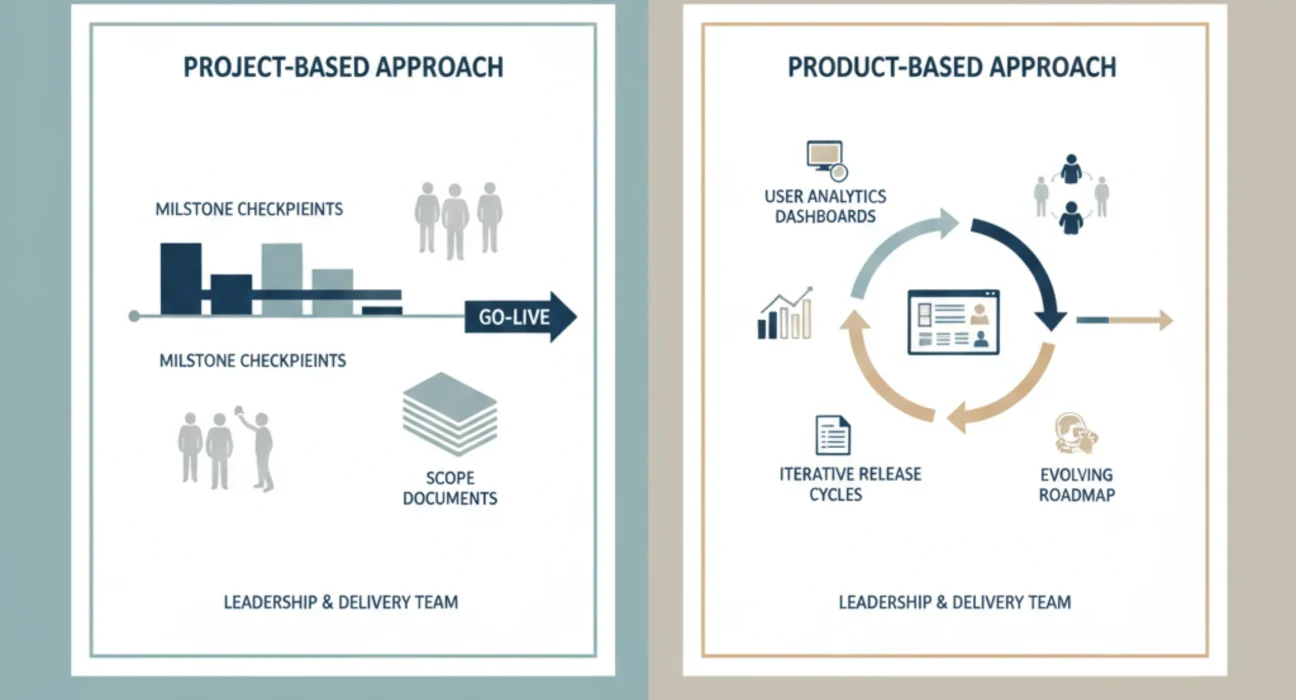
Projects have defined end dates. Products don’t. A project succeeds when it delivers agreed scope on time and on budget. A product succeeds when it continuously delivers value to users and evolves based on feedback and market conditions.
Projects optimise for delivery. Products optimize for outcomes. Project teams measure progress in milestones completed. Product teams measure progress in user adoption, engagement, and business impact.
Projects are funded as capital expenditure. Products are funded as ongoing investment. Projects get budget approval once, with clear ROI calculations. Products require continuous funding justified by sustained value creation.
Project teams disband at go-live. Product teams persist and evolve. Once a project deploys, responsibility transfers to maintenance teams. Product teams own their creation from conception through years of iteration and improvement.
Projects have requirements. Products have hypotheses. Projects succeed by building what’s specified. Products succeed by learning what works, killing what doesn’t, and continuously improving based on data.
The model you choose determines organisational structure, funding mechanisms, success metrics, and vendor relationships. Choose wrong, and you create structural barriers to success that no amount of execution discipline can overcome.
Why Enterprises Default to Project Thinking
Project-based development dominates enterprise software because it aligns with how organisations already work.
Finance teams understand project budgets. Capital expenditure, ROI calculations, and fixed budgets fit established processes. Ongoing product investment requires different financial frameworks that many enterprises haven’t built.
Governance structures are built for projects. Steering committees, stage gates, go/no-go decisions these mechanisms exist to manage projects. Governing products requires different rituals: sprint reviews, usage analytics, A/B test results, customer feedback loops.
Leadership wants predictability. A project with a defined scope, timeline, and budget creates the illusion of control. Products require accepting uncertainty, iterating based on learning, and adjusting course when assumptions prove wrong.
Procurement processes favour projects. RFPs with detailed requirements, fixed-price contracts, and delivery milestones make sense for projects. Products need flexible partnerships where scope evolves and success metrics adapt.
Risk management frameworks assume project constraints. Audit and compliance teams know how to evaluate project risks, scope, timeline, budget. They struggle with product risks, market adoption, user behaviour, and competitive dynamics.
None of this means project thinking is wrong. For certain initiatives, it’s exactly right. The problem is applying project frameworks to work that fundamentally requires product approaches.
When Project-Based Development Actually Works
Projects succeed when requirements are stable, scope is clear, and the goal is defined system delivery within known constraints.
Replacing legacy systems with modern equivalents. Migrating from an old ERP to a new one is a project. The functionality is known. The timeline matters. The budget is fixed. Success means deploying a working system that maintains business continuity.
Regulatory compliance initiatives. Building systems to meet new compliance requirements GST compliance, data privacy regulations, audit reporting—are projects. The requirements are external and non-negotiable. The deadline is set by regulators. Delivery is binary: compliant or non-compliant.
Infrastructure modernisation. Moving from on-premise to cloud, upgrading databases, or replacing networking infrastructure are projects. The technical specifications are clear. The migration path is definable. Success is measured by technical completion and operational stability.
Integration works with defined systems. Connecting your warehouse management system to your e-commerce platform is a project. Both systems exist. The integration requirements are specifiable. The outcome is measurable: data flows correctly between systems.
Time-bound business initiatives. Building systems for one-time events IPO readiness, merger integration, product launch campaigns are projects. They have clear end dates. Once complete, the system serves its purpose and requires only maintenance.
For these scenarios, project-based development delivers exactly what enterprises need: predictable execution against defined requirements within agreed constraints.
When Product Thinking Is Non-Negotiable
Products are the right model when success depends on user adoption, continuous learning, and iterative improvement.
Customer-facing applications. Mobile apps, web portals, self-service platforms—anything customers interact with directly must be products. User needs evolve. Competition changes behaviour. Technology capabilities advance. Static solutions become obsolete quickly.
Internal platforms serving multiple business units. An enterprise data platform, API gateway, or employee experience system serves diverse stakeholders with changing needs. Building it once and walking away guarantees it won’t meet evolving requirements.
Innovation and new market initiatives. Launching new digital services, exploring new business models, or entering unfamiliar markets requires product thinking. You’re testing assumptions, learning from users, and pivoting based on evidence.
SaaS platforms and recurring revenue models. If your business model depends on ongoing customer relationships and recurring revenue, the software powering it must evolve continuously. Projects deliver version 1.0. Products deliver sustainable competitive advantage.
Workflow automation in dynamic environments. Sales processes, customer service workflows, or operational systems in fast-changing businesses need constant refinement. User feedback should drive weekly improvements, not annual upgrade projects.
Trying to build these as projects with fixed scope, fixed timeline, handoff to maintenance creates systems that launch outdated and deteriorate from day one.
The Hybrid Trap: Where Most Enterprises Get Stuck
Many organisations attempt to split the difference, applying project governance to product work or expecting products to behave like projects. This creates the worst of both worlds.
Funding products with project budgets. Leadership approves a large upfront investment to “build the platform,” expects go-live in 12 months, then acts surprised when the product needs ongoing investment for iterations, feature development, and market adaptation.
Applying project success metrics to products. Measuring product success by on-time, on-budget delivery ignores whether anyone uses it, whether it solves real problems, or whether it creates business value. Teams optimise for deployment, not outcomes.
Expecting product teams to work in project phases. Requiring quarterly release cycles, waterfall planning, and upfront requirements documentation kills the rapid iteration and user feedback loops that make products successful.
Disbanding product teams after launch. Treating go-live as the end point, transitioning to “maintenance mode,” and losing the team that understands the vision guarantees the product will stagnate.
Using project vendors for product work. Engaging SI partners on fixed-scope, fixed-price contracts for product development creates misaligned incentives. Vendors optimise for contract delivery, not long-term product success.
Enterprises that get stuck in hybrid traps waste money building things users don’t adopt, lose competitive advantage to more agile competitors, and burn leadership credibility on failed digital initiatives.
What Product Development Actually Requires
Product development isn’t just different process ceremonies. It requires fundamentally different organisational capabilities.
Stable, dedicated teams. Product teams need to stay together long enough to build shared understanding, develop domain expertise, and own outcomes. Rotating developers through quarterly project assignments destroys institutional knowledge.
Outcome-based funding models. Instead of approving ₹5 crore budgets for 18-month projects, CFOs need to fund products with quarterly or annual allocations tied to usage metrics, business impact, and strategic value.
Continuous user research and feedback. Product teams need direct access to users—not requirements documents filtered through layers of business analysts. They need to watch people use their software, understand pain points, and validate assumptions weekly, not annually.
Autonomous decision-making authority. Product teams should decide which features to build, what to defer, and how to sequence work based on user data and business priorities. Requiring steering committee approval for every sprint backlog kills agility.
Technical infrastructure for continuous deployment. Products need automated testing, CI/CD pipelines, feature flags, and monitoring that enable daily or weekly releases. Annual release cycles are project thinking applied to product work.
Metrics that measure value, not activity. Track daily active users, feature adoption, customer satisfaction, and business outcomes. Stop measuring story points completed or percentage of backlog delivered.
Building these capabilities requires investment, cultural change, and leadership commitment. This is why many enterprises default to familiar project approaches even when product thinking would serve them better.
The Role of Vendors and Partners in Each Model
Project and product models require different vendor relationships.
Project vendors optimise for scope completion. System integrators, outsourcing partners, and traditional IT services firms excel at defined-scope, fixed-timeline delivery. They bring execution discipline, project management maturity, and the ability to scale teams quickly.
Product partners optimise for sustained value delivery. Product-focused partners embed with your teams, share accountability for outcomes, and invest in understanding your business context. They bring product thinking, user research capabilities, and commitment beyond initial deployment.
Project contracts specify deliverables and timelines. Fixed-price or time-and-materials contracts with detailed scopes of work, milestone payments, and acceptance criteria work for projects. They create misaligned incentives for products.
Product partnerships require flexible engagement models. Dedicated team augmentation, outcome-based pricing, or shared risk-reward structures align vendor success with product success. Partners like Ozrit structure engagements around long-term product thinking not just delivering version 1.0, but building sustainable capability within client organisations.
Project relationships end at deployment. Once the system goes live and acceptance testing passes, project vendors hand over documentation and exit. Product relationships persist through iterations, improvements, and evolution.
Enterprises often engage project vendors for product work because procurement processes, contract templates, and governance frameworks are built for projects. This structural mismatch undermines product success before development even begins.
Making the Right Choice: A Decision Framework
How should leadership decide which model fits a given initiative?
Ask: When is this “done”? If there’s a clear end state system migrated, compliance requirement met, integration complete it’s a project. If “done” means ongoing improvement and evolution, it’s a product.
Ask: Who defines success? If success is defined by delivered scope matching requirements, it’s a project. If success requires user adoption, engagement, and value realisation, it’s a product.
Ask: What happens after go-live? If the initiative ends at deployment with only support and bug fixes afterward, it’s a project. If go-live is just the beginning of continuous improvement, it’s a product.
Ask: How stable are the requirements? If requirements are well-understood, documented, and unlikely to change significantly, project approaches work. If requirements will evolve based on user feedback and market learning, product thinking is essential.
Ask: What’s the strategic importance? If this is infrastructure supporting existing business, project delivery is appropriate. If this creates competitive advantage or enables new business models, product investment is justified.
Ask: How quickly does value decay? If what you build today will remain valuable for years with minimal change, project delivery makes sense. If six-month-old features feel outdated, product thinking is non-negotiable.
Honest answers to these questions clarify which model fits. The trap is answering based on what’s comfortable rather than what’s true.
Transitioning from Project to Product Mindsets
Many enterprises realise mid-initiative that they’ve applied project thinking to work that needs product approaches. Transitioning is possible but requires deliberate change.
Shift from feature delivery to outcome achievement. Stop measuring progress by requirements completed. Start measuring adoption rates, user satisfaction, and business impact. Reorient teams toward outcomes, not outputs.
Move from fixed roadmaps to adaptive planning. Replace 18-month roadmaps with quarterly themes and monthly sprint planning based on user feedback and data. Embrace uncertainty rather than pretending to eliminate it.
Change funding from project approvals to product budgets. Secure ongoing operational budgets for product teams rather than requiring fresh business cases for every iteration. Tie funding to continue strategic value, not project completion.
Evolve governance from stage gates to continuous review. Replace quarterly steering committees reviewing milestone completion with monthly product reviews examining usage data, customer feedback, and business metrics.
Build product management capabilities. Hire or develop product managers who can prioritise based on user research, balance stakeholder needs, and drive continuous improvement. Project managers optimize for delivery; product managers optimize for value.
This transition doesn’t happen overnight. It requires organisational commitment, capability building, and tolerance for the messiness that comes with iterative learning.
What CFOs Need to Understand About Product Funding
For CFOs, product thinking requires rethinking how software initiatives are funded and measured.
Product investment is operational, not capital. Trying to capitalize product development creates accounting gymnastics. Treat product teams as operational investment similar to sales or marketing ongoing spend justified by ongoing value.
ROI calculations should reflect sustained value, not one-time returns. Project ROI compares implementation cost against benefit over defined periods. Product ROI should consider long-term competitive advantage, customer lifetime value, and strategic optionality.
Budget certainty decreases; value certainty increases. With projects, you know what you’ll spend but might not get value. With products, you invest iteratively but validate value continuously. Uncertainty shifts from outcomes to exact spend.
Success metrics should track business outcomes, not project completion. Stop asking “did we deliver on time and on budget?” Start asking “did we increase customer retention, reduce processing costs, or enable new revenue streams?”
Funding models should enable learning, not just building. Product budgets should include user research, experimentation, and iteration. Cheap failures that inform better decisions create more value than expensive projects that deliver the wrong solution perfectly.
CFOs who grasp product economics become strategic enablers. Those who insist on project-based ROI calculations become barriers to digital transformation.
The Governance Challenge: Managing Products at Scale
Governing product development at enterprise scale requires different rituals than project oversight.
Replace milestone reviews with continuous metrics. Instead of quarterly steering committees reviewing deliverable status, establish dashboards tracking user engagement, business impact, and product health that leadership monitors continuously.
Shift from approving scope to approving hypotheses. Governance shouldn’t approve detailed feature lists. It should approve strategic bets, validate assumptions through pilots, and kill initiatives when evidence shows they won’t deliver value.
Focus on portfolio balance, not individual initiatives. Leadership should ensure balanced investment across core products, growth initiatives, and experimental bets not micromanage individual product backlogs.
Create decision rights frameworks. Define what product teams can decide autonomously versus what requires leadership approval. Speed matters in product development; decision bottlenecks kill momentum.
Institute regular product reviews with users present. Governance meetings should include actual users demonstrating the product, sharing feedback, and surfacing adoption barriers. This grounds decisions in reality, not PowerPoint.
Enterprises skilled at project governance often struggle here. Product governance requires trusting teams, tolerating ambiguity, and making decisions with incomplete information capabilities that risk-averse organisations resist.
When to Use Partners for Product Development
Product development can be done with internal teams, external partners, or hybrid models. Each has trade-offs.
Internal teams provide domain knowledge and long-term ownership. Employees understand the business context, maintain institutional knowledge, and stay invested in long-term success. But they may lack specific technical skills or capacity to move quickly.
External partners bring specialised capabilities and execution speed. Organisations like Ozrit can scale teams rapidly, bring expertise in specific technologies or product domains, and accelerate delivery without lengthy hiring cycles. But they require active collaboration to build necessary business context.
Hybrid models combine strengths when structured properly. Internal product managers and domain experts set direction and priorities. External development partners execute with speed and technical depth. This works when roles are clear and collaboration is genuine.
The wrong partner model is worse than pure internal teams. Treating product partners like project vendors handing them requirements, expecting delivery, and limiting their input combines the worst of both approaches. You pay premium rates for external help while limiting their ability to contribute product thinking.
Choose partners who understand product development. Evaluate vendors not just on technical skills but on product experience, user research capabilities, iterative development practices, willingness to challenge assumptions, and commitment beyond initial deployment.
For complex products requiring sustained investment, the right partner becomes an extension of your team, not a vendor executing contracts, but a collaborator invested in long-term success.
Final Thoughts: Models Matter as Much as Execution
Enterprise software failures often trace back to model mismatch, not execution failure.
Teams working hard, vendors delivering on time, governance processes running smoothly all can still produce disappointing outcomes if the fundamental approach doesn’t match the work’s true nature.
Projects work beautifully for defined, stable initiatives with clear end states. Products succeed when embracing uncertainty, learning from users, and evolving continuously.
The enterprises that consistently deliver successful software outcomes are those that honestly assess each initiative, choose the appropriate model, and structure organisation, funding, and partnerships accordingly.
They don’t force product work into project constraints or expect projects to behave like products. They accept that different problems require different approaches.
Most importantly, they build organisational capabilities for both models project discipline for infrastructure and compliance work, product thinking for innovation and customer-facing systems.
This isn’t about following the latest methodology trends. It’s about matching an organisational approach to actual work requirements. That pragmatism, more than any framework or vendor partnership, determines whether enterprises build software that delivers lasting value or just checks deployment boxes.
In enterprise software delivery, choosing the right development model is the first decision. Everything else flows from there.