


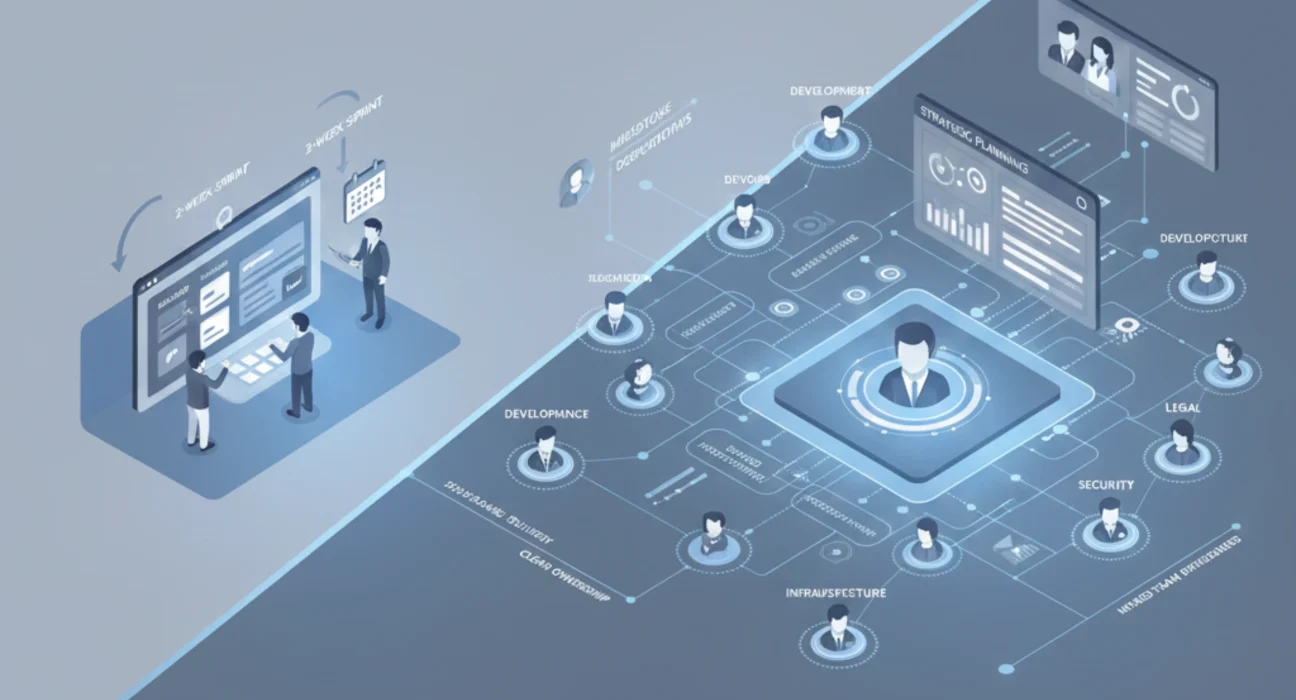
Agile transformed software development at startups and small product teams. The principles made sense. Work in short cycles. Respond to change quickly. Collaborate closely. Deliver working software frequently. For small teams building single products, this approach worked well. But when enterprises tried to adopt Agile at scale, most implementations failed to deliver the promised benefits.
The failure was not because Agile principles are wrong. The failure happened because enterprises tried to apply frameworks designed for small teams to organizations with hundreds of teams, complex dependencies, regulatory requirements, and governance structures that cannot simply be discarded. What works for a 10-person startup does not work for a 10,000-person enterprise. The contexts are fundamentally different.
Why Agile Breaks at Enterprise Scale
Agile assumes small, autonomous teams can make decisions independently and adjust direction based on feedback. In startups, this works because there are few dependencies. One team owns the entire product. They control the technology stack. They can change direction without coordinating with other teams. If they make a mistake, the impact is contained.
Enterprises operate differently. Systems are interconnected. Multiple teams depend on shared infrastructure. Changes in one area affect others. A product team cannot simply decide to adopt a new technology or change an API without coordinating with dozens of other teams who depend on stability. The autonomy that makes Agile effective in small settings creates chaos at scale.
Governance and compliance add another layer of complexity. Enterprises must meet regulatory requirements, maintain audit trails, and demonstrate control over their systems. Agile frameworks rarely address these needs explicitly. Teams are told to move fast and adapt, but they still need approval processes, documentation standards, and review gates that slow down delivery. The result is Agile theater where teams go through the motions of sprints and standups while still following traditional approval processes behind the scenes.
Dependencies between teams create coordination overhead that Agile does not solve. When a feature requires work from five different teams across three business units, short sprints and daily standups do not help. The real constraint is getting everyone aligned, prioritizing the work across competing demands, and coordinating delivery so that all the pieces come together at the right time. Most Agile frameworks assume away these coordination challenges or delegate them to roles like Scrum Masters who lack the authority to actually resolve conflicts.
Resource allocation becomes a problem at scale. Small teams can dedicate people full-time to a single product. Enterprises often have shared service teams, subject matter experts who support multiple initiatives, and infrastructure teams that serve the entire organization. These people cannot be fully dedicated to any single Agile team. They split their time across many efforts, which means they become bottlenecks and make sprint planning unreliable.
The biggest issue is that Agile optimizes for team-level speed at the expense of organizational alignment. Teams can move fast on their own work, but enterprise value comes from coordinating work across many teams. A product launch might require engineering, legal, compliance, marketing, sales, and operations to all deliver on time. If each team is Agile and adjusting priorities independently, coordinating a unified outcome becomes nearly impossible.
What Enterprises Actually Need
Enterprises need delivery frameworks that acknowledge their complexity rather than pretending it does not exist. This means accepting that large organizations require structure, governance, and coordination mechanisms that small teams do not need. The goal is not to eliminate these elements but to make them effective.
Clear ownership and accountability matter more than process flexibility. In enterprises, initiatives fail most often because no one has clear authority to make decisions and resolve conflicts. Multiple stakeholders believe they have a say in direction. Teams wait for approval from committees. When problems arise, responsibility is diffuse. Enterprises need single points of accountability with real authority to make trade-offs and drive execution.
Structured planning with realistic timelines beats continuous adaptation. Agile advocates for adapting to change over following a plan, but enterprises operate in contexts where many things cannot change easily. Regulatory deadlines are fixed. Budget cycles are annual. Infrastructure dependencies take months to resolve. Pretending these constraints do not exist does not make them go away. Better to build realistic plans that account for constraints upfront than to constantly replan when reality intrudes.
Integration and dependency management must be first-class concerns, not afterthoughts. Enterprises should spend as much time planning how work across teams integrates as they spend planning the work itself. This means identifying dependencies early, sequencing work appropriately, and building buffers for coordination overhead. Teams that ignore dependencies until integration time consistently miss deadlines and deliver poor quality.
Governance should enable delivery, not prevent it. The problem with most enterprise governance is not that it exists but that it operates independently from delivery work. Approvals happen in isolation without understanding delivery constraints. Reviews focus on documentation compliance rather than actual risk. Effective governance integrates with delivery so that necessary controls happen at the right time without becoming bottlenecks.
Enterprises also need to differentiate between types of work. Some initiatives are exploratory and benefit from flexible approaches. Others are execution-focused with clear requirements and fixed deadlines. Applying the same methodology to both creates problems. Exploratory work gets bogged down in governance. Execution work lacks the structure needed to deliver predictably. Different work requires different approaches.
The Execution Model That Works at Scale
Successful enterprise delivery combines structured planning with disciplined execution. It acknowledges that enterprises need coordination, governance, and predictability while still enabling teams to work effectively.
It starts with defining clear outcomes and constraints before work begins. This means understanding what success looks like, what the fixed constraints are (budget, timeline, regulatory requirements), and what trade-offs are acceptable. Too many enterprise initiatives begin with vague objectives and unrealistic expectations. Teams waste months discovering that the original goals were impossible or that key stakeholders had different expectations.
Work is organized around deliverables, not iterations. Instead of arbitrary two-week sprints, enterprises should structure work around meaningful milestones that demonstrate progress and enable integration. These milestones account for dependencies, include integration time, and have clear acceptance criteria. Teams know what they are building toward and can see how their work fits into the larger effort.
Senior leadership must be involved in execution, not just strategy. In successful enterprise programs, senior leaders do not just approve plans and then disappear until the final review. They participate in resolving conflicts, removing blockers, and making trade-offs when priorities compete. This does not mean micromanaging. It means being accessible and decisive when teams need direction.
Communication happens through structured touchpoints, not constant meetings. Enterprises cannot operate with everyone in constant communication. That does not scale. Instead, communication needs clear rhythms and purposes. Weekly status reviews focus on risks and blockers. Monthly steering meetings address priority changes and resource needs. Ad-hoc communication happens when escalation is needed, not as the default mode of operation.
Integration is planned and tested continuously. Rather than waiting until the end to integrate work from multiple teams, integration happens throughout delivery. This requires investment in integration environments, automated testing, and time allocated specifically for integration work. Teams that cut corners on integration always pay the price later in delays and quality issues.
How Ozrit Delivers Enterprise Programs
Ozrit works with enterprises that need to deliver complex programs involving multiple teams, vendors, and business units. These organizations have tried various Agile implementations and found them insufficient for their scale and complexity. What they need is structured execution with clear ownership and realistic timelines.
The approach starts with senior team involvement from the beginning. Enterprise programs require experienced leadership who can navigate organizational complexity, make difficult trade-offs, and maintain momentum across long delivery cycles. Ozrit’s senior team takes direct ownership of program delivery, not just advisory roles. They are accountable for outcomes and have the authority to make decisions.
Onboarding focuses on realistic planning before execution starts. Ozrit does not begin delivery until they understand the organizational landscape, technical dependencies, and governance requirements. This discovery phase builds a delivery plan that accounts for actual constraints rather than optimistic assumptions. It identifies risks, establishes clear milestones, and defines how coordination will happen across teams. Enterprises know what to expect and when.
Delivery follows structured phases with built-in integration points. Work is organized around meaningful deliverables that can be demonstrated to stakeholders and tested in realistic conditions. Each phase includes time for integration, testing, and addressing issues that emerge when components come together. This prevents the common enterprise pattern of teams claiming they are done while integration remains incomplete.
Governance is embedded in delivery rather than operating separately. Necessary approvals, reviews, and documentation happen as part of planned milestones, not as surprise requirements that delay work. Ozrit works with enterprise governance teams to ensure controls are satisfied without creating bottlenecks. This requires understanding both delivery needs and governance requirements well enough to satisfy both.
Support is available 24/7 because enterprise programs encounter issues that need immediate resolution. When technical problems emerge, when stakeholders raise concerns, or when external dependencies change, programs need access to senior expertise who can assess the situation and adjust plans accordingly. Delayed responses to issues compound into major delays in large programs.
The result is predictable delivery of complex enterprise programs. Timelines are realistic and generally met. Quality is maintained because integration happens continuously. Stakeholders stay aligned because communication is structured and consistent. And governance requirements are satisfied because they are built into the delivery process from the start.
Choosing Approaches That Match Reality
The conversation about Agile in enterprises has become polarized. Advocates insist that failures are due to poor implementation rather than fundamental mismatches between the approach and the context. Critics reject anything associated with Agile and revert to traditional waterfall methods that have their own problems at scale.
The productive path forward is recognizing that methodology matters less than execution quality. Enterprises need clear ownership, realistic planning, structured coordination, and disciplined delivery. Whether these elements are wrapped in Agile terminology or traditional project management language is less important than whether they actually exist and function effectively.
Leaders who focus on outcomes rather than process labels make better decisions. The question is not whether your organization is Agile. The question is whether your delivery approach matches your organizational reality and enables teams to deliver complex programs predictably. Organizations that answer this question honestly and adjust their approaches accordingly will deliver better results than those still searching for the perfect methodology.