


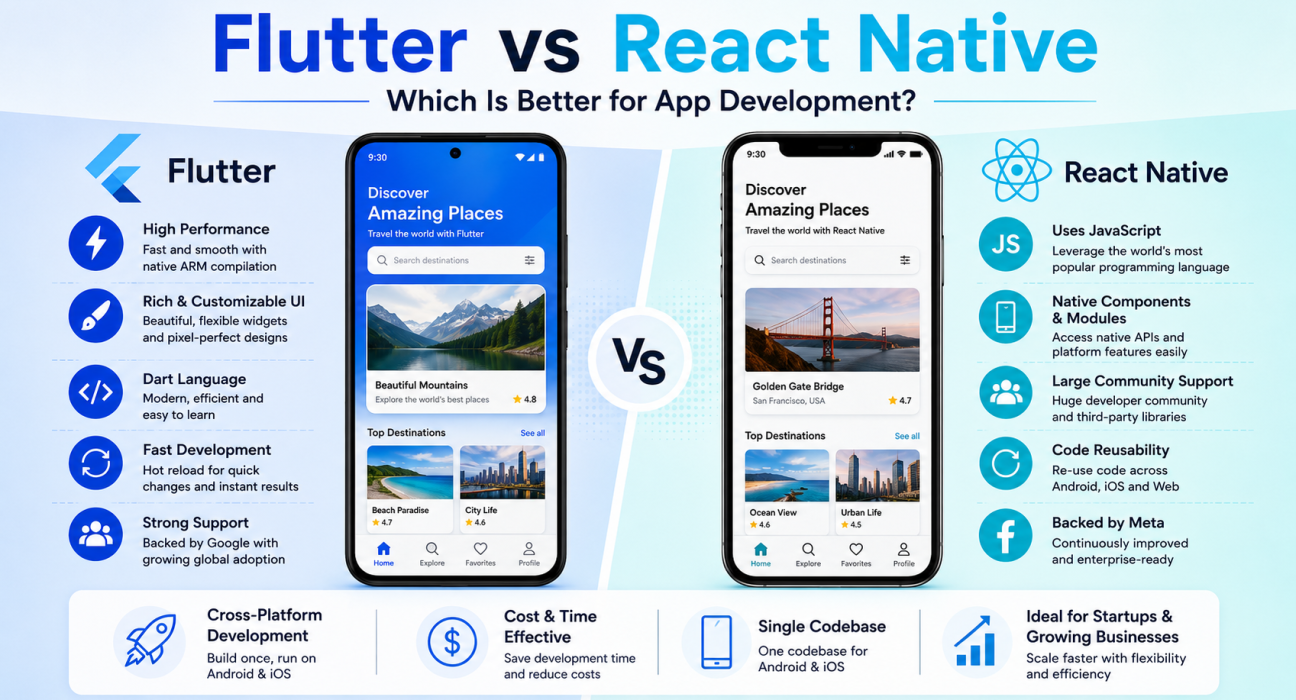
If you have ever sat in a client meeting in Chennai’s OMR IT corridor or a startup hub in Bengaluru’s Koramangala and heard the question, “Bhai, should we go with Flutter or React Native?”, you are not alone. This is easily one of the most common dilemmas among Indian app development teams today, whether you are a solo founder bootstrapping your first MVP or a CTO scaling a fintech platform to lakhs of users.
Both Flutter and React Native are cross-platform app development frameworks, meaning they let you write one codebase and deploy it on both Android and iOS, saving significant time and money compared to building two separate native apps. But beyond that basic similarity, the two frameworks take fairly different roads. In this article, we will break down Flutter vs React Native in plain, simple language, covering performance, cost, developer availability, and real-world suitability, so that by the end you have a clear-headed view of which one fits your project like a well-tailored Pochampally silk saree fits an occasion.
A Quick Introduction: What Are Flutter and React Native?
Flutter is an open-source UI toolkit developed by Google, first released in 2017. It uses the Dart programming language and works by rendering its own widgets directly on a canvas, rather than relying on native platform components. Think of it as an artist who paints every single pixel themselves rather than borrowing brushes from someone else’s toolbox.
React Native, developed by Meta (formerly Facebook), came out a bit earlier, in 2015. It uses JavaScript, one of the most widely known programming languages in the world, and works by bridging JavaScript code to native platform components. In simple terms, React Native borrows the native building blocks of Android and iOS and assembles them using JavaScript logic.
Both frameworks have matured significantly over the years and are backed by tech giants, so neither can be dismissed as a fly-by-night option. The real question is which one suits your specific business needs, team skill set, and long-term goals.
Performance: Who Wins the Race?
When it comes to raw performance, Flutter generally has a slight edge, and here is why. Since Flutter does not rely on a JavaScript bridge to communicate with native components, and instead compiles directly to native ARM code, apps built with it tend to run smoother, particularly for animation-heavy or graphics-intensive applications like gaming apps or apps with complex custom UI, such as a rangoli-pattern design tool or an interactive festival greeting card app.
React Native, on the other hand, has historically faced some friction because of its reliance on the JavaScript bridge for communication between JavaScript and native modules. However, it is worth mentioning that React Native’s newer architecture, called the “New Architecture” with Fabric and Turbo Modules, has significantly reduced this bottleneck, making performance gaps much smaller than they used to be a few years back.
In simple words: For extremely performance-critical apps, Flutter often has a slight upper hand. But for most business apps, e-commerce platforms, or content-based apps, React Native’s performance is more than sufficient and the difference is barely noticeable to the end user.
Development Speed and Ease of Learning
Here is where things get interesting for teams based in India, where there is no shortage of coding talent but plenty of competition to find the right specialized skill set.
React Native uses JavaScript, arguably the most popular programming language globally and one that most computer science graduates from colleges across Tamil Nadu, Karnataka, and other states are already familiar with, either through web development courses or bootcamps. This makes it relatively easier to find developers and get a team up and running quickly. If your existing team already knows web development with React.js, the transition to React Native is fairly smooth, almost like moving from Tamil to Malayalam, similar roots but a slightly different flavour.
Flutter uses Dart, a language developed by Google specifically for UI development. While Dart is not particularly difficult to pick up, especially for developers already familiar with object-oriented programming, it is still a newer and less widespread language compared to JavaScript. This means the hiring pool for experienced Flutter developers, while growing steadily, is comparatively smaller.
That said, many developers who have worked with Flutter often mention that its documentation and tooling, including the excellent hot-reload feature, make the actual coding experience quite pleasant and beginner-friendly once the initial learning curve is crossed.
Cost of App Development: Which One Is Lighter on the Pocket?
For most Indian businesses, especially startups and small-to-medium enterprises, budget is often the deciding factor, not just a footnote.
Since React Native developers are more widely available across India, from Chennai to Pune to Hyderabad, the average development cost tends to be slightly lower simply due to the larger talent pool and competitive market rates. Flutter developers, being a bit more specialized, may sometimes command marginally higher rates, though this gap has been narrowing steadily as more developers upskill in Dart and Flutter.
It is also worth noting that both frameworks significantly reduce cost compared to native development (building separate apps for Android using Kotlin/Java and iOS using Swift), since you are essentially paying for one codebase instead of two. This alone can bring down development costs by a substantial margin, sometimes as much as 30-40%, which matters a lot when every rupee counts for a growing business.
User Interface and Design Flexibility
If your app needs a highly customized, brand-specific look and feel, something as visually distinctive as a Kanjeevaram pattern rather than a generic off-the-rack design, Flutter tends to shine here. Because it renders its own widgets rather than relying on native components, Flutter gives designers and developers extremely granular control over every visual element, ensuring pixel-perfect consistency across both Android and iOS.
React Native, by using native UI components, naturally inherits the platform’s look and feel, meaning apps automatically feel more “native” to the platform they are running on. This can be an advantage if you want your app to blend seamlessly with the rest of the user’s Android or iOS experience, but it can require more custom work if you want identical branding across both platforms.
Community Support and Long-Term Stability
Both frameworks enjoy strong backing and healthy community support, which matters a great deal when you are relying on third-party libraries, troubleshooting bugs, or planning for long-term maintenance.
React Native has been around slightly longer and, thanks to its use of JavaScript, benefits from an enormous existing ecosystem of libraries and tools originally built for the web. Flutter, while younger, has grown its own package ecosystem (called pub.dev) rapidly and is increasingly seen as a framework with strong long-term momentum, given Google’s continued investment in it, including its use in Google Pay and other prominent apps.
Neither framework shows any signs of losing steam, so long-term stability is not really a major differentiator anymore; it mostly comes down to which ecosystem better matches your specific technical requirements.
App Size and Resource Usage
One practical, often overlooked factor is app size, especially relevant in a country like India where many users still have budget smartphones with limited storage and are conscious of data usage.
Flutter apps have historically tended to be slightly larger in size compared to React Native apps, because Flutter bundles its own rendering engine within the app package. React Native apps, by leveraging native components, are sometimes marginally lighter. However, both frameworks have made continuous improvements in this area, and the difference today is often not significant enough to be a dealbreaker on its own.
Which One Should You Choose? A Practical, No-Nonsense Guide
There is no universal “better” framework here; it genuinely depends on your specific project requirements, existing team skills, and business priorities. Here is a simple, practical breakdown to help you decide:
Choose Flutter if:
- Your app requires highly custom, brand-heavy UI with pixel-perfect design consistency across platforms
- Performance for animation-heavy or graphics-intensive features is a top priority
- You are building a fresh product without legacy JavaScript code to reuse
- You want a single, cohesive rendering approach without worrying about native bridge overhead
Choose React Native if:
- Your existing team already has strong JavaScript or React.js expertise
- You need to move fast with a larger, more readily available developer talent pool
- Your app benefits from feeling truly native to each platform (Android or iOS)
- You want to potentially share code logic between your web app and mobile app
Beyond the Framework: Other Factors That Matter
While the Flutter vs React Native debate often dominates the conversation, it is worth remembering that the framework alone does not make or break an app’s success. Factors such as the quality of your development team, the clarity of your project requirements, thoughtful UX design, and post-launch support and maintenance often matter just as much, if not more, than the underlying technology stack.
Many successful apps used by millions of Indians every day, whether for grocery delivery, ride booking, or digital payments, have been built on both frameworks, proving that skilled execution matters more than the tool itself. A skilled craftsman can create a beautiful piece of furniture with either teak or rosewood; the wood matters, but the craftsmanship matters more.
Hybrid and Future-Proofing Considerations
It is also worth mentioning that some businesses choose to start with one framework and later realise their needs have evolved, perhaps requiring more native-level customization or perhaps needing faster iteration speed. Fortunately, both Flutter and React Native support gradual migration strategies and can even coexist with native modules where required, giving businesses some flexibility to future-proof their app as it scales.
Additionally, keep an eye on your app’s roadmap for at least the next two to three years when making this decision. If you are planning to add features like AR/VR integration, advanced animations, or IoT connectivity, Flutter’s rendering approach may offer smoother long-term scalability. If your roadmap leans more towards rapid iteration, web-mobile code sharing, or integration with an existing JavaScript-based backend team, React Native may serve you better.
Conclusion: There Is No One-Size-Fits-All Answer
At the end of the day, asking “Flutter vs React Native, which is better?” is a bit like asking whether idli or dosa is better, both are excellent choices made from the same core ingredients, but suited to slightly different tastes and occasions. Flutter offers superior rendering control, consistent cross-platform design, and strong performance for visually rich apps. React Native offers a larger developer talent pool, faster onboarding for JavaScript-savvy teams, and a more mature native-feel integration.
Rather than chasing trends or going purely by what a colleague or LinkedIn post recommends, take the time to evaluate your specific project needs, your team’s existing skill set, your budget, and your long-term product roadmap. Both frameworks are battle-tested, widely adopted, and fully capable of powering world-class mobile applications used by millions of people every single day, including right here in India’s booming app economy.
Whichever path you choose, what matters most in the end is partnering with a development team that understands your business goals deeply and can translate them into a smooth, reliable, and delightful app experience for your users. Choose wisely, plan carefully, and your app development journey, whether built with Flutter or React Native, is bound to be a rewarding one.