


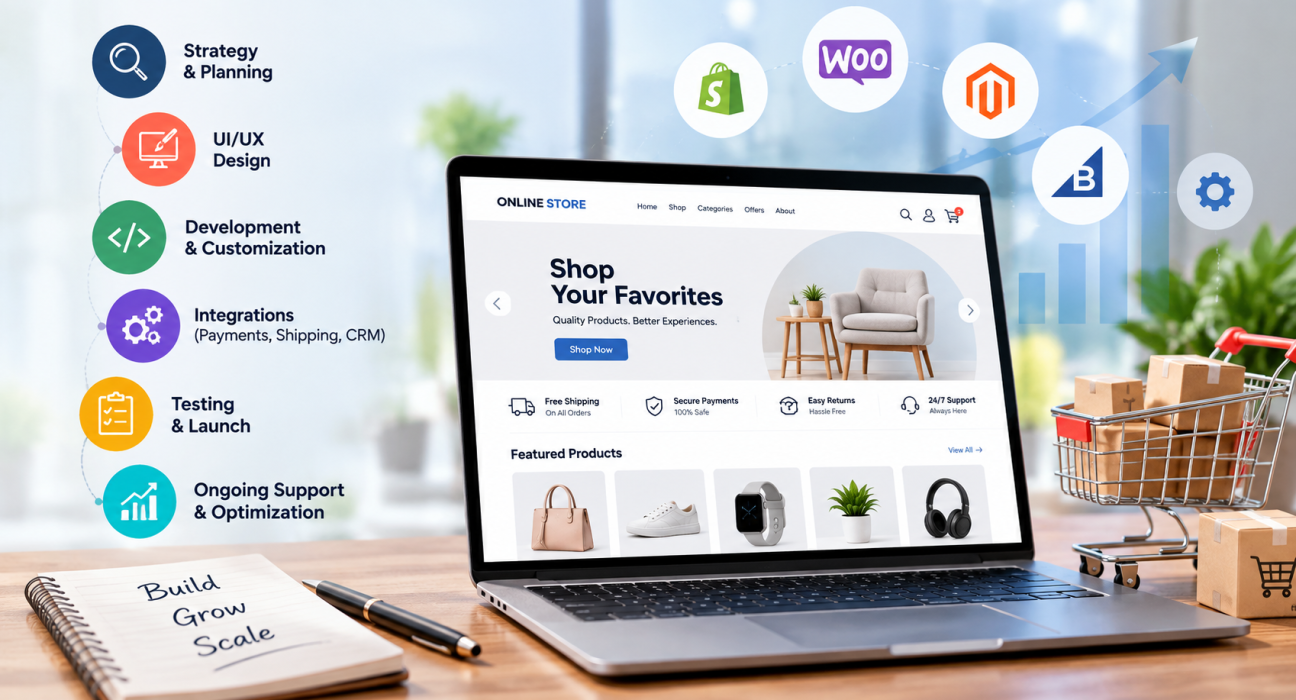
Ecommerce web development companies build successful online stores by combining strategy, design, engineering, and ongoing optimization. They start with your business goals and customers, choose the right platform, design a smooth shopping experience, connect the store to payments, inventory, and shipping systems, test it thoroughly, and keep improving it after launch.
If you’re planning a store, or replacing one that isn’t performing, knowing how this process works helps you ask better questions and compare vendors more confidently. This guide walks through what ecommerce web development companies actually do, the steps they follow, the features that matter, and how to choose the right partner.
What Do Ecommerce Web Development Companies Do?
Ecommerce web development companies design, build, and maintain online stores for businesses that sell products or services online. Depending on the agency, the work can include:
- Store planning and requirements analysis
- Platform selection and setup (Shopify, WooCommerce, Magento, BigCommerce, or custom builds)
- UI/UX design for product pages, carts, and checkout
- Custom feature development and theme customization
- Integrations with payment gateways, ERPs, CRMs, shipping tools, and marketing platforms
- Migration from an existing store
- Performance, security, and SEO setup
- Ongoing support, maintenance, and optimization
Some firms are full-service and cover strategy through post-launch support. Others specialize in one platform or one type of work, such as headless commerce or store migrations.
How Ecommerce Web Development Companies Build an Online Store: Step by Step
Every agency has its own methodology, but most successful projects follow a similar sequence.
1. Discovery and Goal Setting
Good ecommerce web development companies don’t start with code. They start with questions:
- Who are your customers and how do they shop?
- What are you selling, and how many products or variants?
- Which sales channels do you use (website, marketplaces, social, physical stores)?
- What systems must the store connect to?
- What does success look like: revenue, conversion rate, repeat purchases, or expansion into new markets?
The output is usually a scope document or requirements list that defines features, timelines, and priorities. Skipping this step is one of the most common reasons projects go over budget.
2. Choosing the Right Ecommerce Platform
Platform choice affects cost, flexibility, and how easily the store can grow. A capable agency recommends a platform based on your needs, not on what it happens to prefer.
| Platform Type | Best Suited For | Key Consideration |
|---|---|---|
| Hosted SaaS (e.g., Shopify, BigCommerce) | Startups and SMBs that want fast setup and lower maintenance | Less control over the underlying code; monthly fees and app costs apply |
| Open-source (e.g., WooCommerce, Magento/Adobe Commerce) | Businesses needing deep customization or ownership of the stack | Requires hosting, security, and updates to be managed |
| Headless commerce | Brands wanting custom front-end experiences across web, app, and other channels | More complex build and a higher technical skill requirement |
| Fully custom build | Unusual business models or complex workflows | Highest development and maintenance effort |
Pricing and features change often, so verify current plans and capabilities on each platform’s official site before committing.
3. UX and UI Design
Design is where many stores win or lose. Ecommerce designers focus on reducing friction between a visitor landing on the site and completing a purchase. That typically includes:
- Clear navigation and search so shoppers find products quickly
- Product pages with strong images, concise descriptions, pricing, availability, and reviews
- Mobile-first layouts, since many shoppers browse and buy on phones
- Simple cart and checkout flows with few steps and clear costs
- Trust signals such as return policies, secure payment badges, and contact details
A good agency will usually create wireframes and prototypes first, so you can react to the structure before visual design and development begin.
4. Development and Integrations
This is the core build phase. Developers configure the platform, build or customize the theme, and add the functionality your business needs. Common integrations include:
- Payment gateways and local payment methods
- Inventory and order management systems
- ERP and accounting software
- CRM and email marketing tools
- Shipping carriers and fulfillment providers
- Analytics and tag management
Integrations deserve extra attention. A store can look perfect and still fail operationally if orders, stock levels, and customer data don’t sync reliably.
5. Performance, Security, and SEO Foundations
Experienced ecommerce web development companies build these in from the start rather than adding them later:
- Performance: optimized images, efficient code, caching, and a content delivery network to keep pages loading quickly
- Security: HTTPS, secure payment handling, access controls, and regular updates
- Technical SEO: clean URL structures, structured data for products, XML sitemaps, canonical tags, and crawlable category pages
- Accessibility: keyboard navigation, readable contrast, and image alt text
Payment security and data privacy requirements vary by region, so confirm the compliance obligations for your markets with a qualified professional.
6. Quality Assurance Testing
Before launch, the team tests the store across devices, browsers, and scenarios. Typical checks include:
- Full purchase flows with different payment methods
- Discount codes, taxes, and shipping rules
- Mobile and tablet behavior
- Load handling during expected traffic peaks
- Email notifications and order confirmations
- Integration accuracy between systems
7. Launch and Migration
A launch plan covers domain setup, data migration, redirects from old URLs, and a rollback plan in case something goes wrong. For stores replacing an existing site, redirect mapping is especially important to protect search visibility and avoid broken links.
8. Post-Launch Support and Optimization
The launch is the beginning, not the end. After going live, strong agencies help with:
- Monitoring performance and fixing bugs
- Analyzing customer behavior and drop-off points
- A/B testing product pages and checkout steps
- Adding features based on real usage
- Security patches and platform updates
What Features Make an Online Store Successful?
Successful stores tend to share a set of practical fundamentals. Use this as a checklist when reviewing a proposal:
- Fast, mobile-friendly pages
- Clear product information and quality visuals
- Straightforward search and filtering
- Guest checkout and multiple payment options
- Transparent shipping costs and return policies
- Customer accounts and order tracking
- Product reviews or other social proof
- Reliable inventory and order synchronization
- Analytics that show where customers drop off
- A scalable architecture that can handle growth
Not every business needs every feature on day one. A sensible agency will help you prioritize a first release and plan later phases.
How to Choose Among Ecommerce Web Development Companies
Choosing a partner is often harder than choosing a platform. Here is a practical approach.
Define Your Requirements First
Write down your product range, target markets, must-have integrations, timeline, and budget range. Vendors can only give useful proposals when the brief is clear.
Build a Shortlist
Start by researching providers that match your platform, industry, and project size. Directories such as GoFirms let businesses browse and compare web development and ecommerce service providers, which can make early shortlisting faster. Whichever source you use, verify each company’s details independently.
Evaluate Relevant Experience
Look beyond general web design credentials. Ask for:
- Ecommerce projects similar to yours in size and complexity
- Experience with your chosen platform
- Examples of integrations they have built
- Client references you can contact directly
Assess Process and Communication
Ask how they handle discovery, scope changes, testing, and handover. Clear documentation, defined milestones, and a named project contact are good signs.
Compare Proposals Carefully
Look at what each proposal includes, not just the total price. Check whether design, integrations, testing, migration, training, and post-launch support are covered, and what could trigger extra charges.
Questions Worth Asking
- Who will actually work on my project, and where are they based?
- How do you handle changes in scope?
- What happens after launch, and what support options exist?
- Who owns the code, design files, and store data?
- How do you approach performance and security?
Common Mistakes When Building an Online Store
Understanding what goes wrong helps you avoid it:
- Picking a platform based on trends rather than business needs
- Overbuilding the first version with features customers don’t use yet
- Neglecting mobile users during design and testing
- Underestimating integrations, which often take longer than expected
- Ignoring SEO until after launch, which can require costly rework
- Having no plan for maintenance, leaving the store vulnerable and outdated
- Choosing solely on price, which can lead to hidden costs later
Example: Choosing Between Shopify and a Custom Build
Consider a small apparel brand with a few hundred products, standard shipping rules, and a small team. A hosted platform is often a reasonable fit: setup is quicker, maintenance is lighter, and the brand can focus on merchandising and marketing.
Now consider a wholesaler with complex pricing tiers, contract-specific catalogs, and a legacy ERP. Off-the-shelf features may not cover those needs, so a more customized or headless approach may be worth the added investment. The right ecommerce web development companies will help you weigh these trade-offs honestly rather than pushing one solution.
Frequently Asked Questions
What do ecommerce web development companies do?
They plan, design, build, and maintain online stores. Their work typically covers platform selection, UX design, development, payment and system integrations, testing, launch, and ongoing support. Some also provide SEO, digital marketing, and conversion optimization services to help the store attract and convert customers after it goes live.
How long does it take to build an ecommerce website?
Timelines depend on scope. A simple store on a hosted platform can be launched relatively quickly, while a store with custom features, complex integrations, or large-scale data migration takes considerably longer. Ask each agency for a phased timeline with milestones so you can see how different requirements affect the schedule.
How much does ecommerce web development cost?
Costs vary widely based on platform, design complexity, integrations, custom features, and the agency’s location and experience. Instead of relying on generic averages, request detailed proposals from several providers and compare what each includes, such as design, testing, migration, and support.
Which ecommerce platform is best for my business?
There’s no single best option. Hosted platforms suit many startups and SMBs that want speed and simplicity. Open-source or headless approaches suit businesses needing more control or unique experiences. Choose based on your product catalog, budget, technical resources, integrations, and growth plans, and ask your development partner to justify their recommendation.
How do I choose the right ecommerce development company?
Define your requirements, shortlist providers with relevant platform and industry experience, review their past ecommerce work, speak with references, and compare proposals in detail. Also evaluate communication, project management, and post-launch support. Platforms like GoFirms can help you research and compare providers during the shortlisting stage.
Do ecommerce web development companies provide support after launch?
Many do, but it isn’t automatic. Support may include bug fixes, security updates, performance monitoring, and feature enhancements, often under a separate maintenance agreement. Confirm what’s included, response times, and costs before signing, so you aren’t left without help once the store is live.
Can an ecommerce agency migrate my existing store?
Most can. Migration usually involves moving products, customers, and order history, then setting up redirects so existing URLs continue to work. Ask how they handle data accuracy, SEO preservation, and downtime, and request a clear migration plan before the project starts.
Conclusion
Successful online stores are rarely the result of a single decision. Ecommerce web development companies build them through a sequence of informed choices: understanding business goals, selecting the right platform, designing for the customer, integrating operations, testing thoroughly, and improving continuously after launch.
For businesses, the takeaway is to focus on fit rather than hype. Define your needs, evaluate relevant experience, compare proposals in detail, and plan for life after launch. If you’re ready to start comparing providers, you can research and shortlist ecommerce and web development companies through GoFirms to find a partner that matches your requirements.