

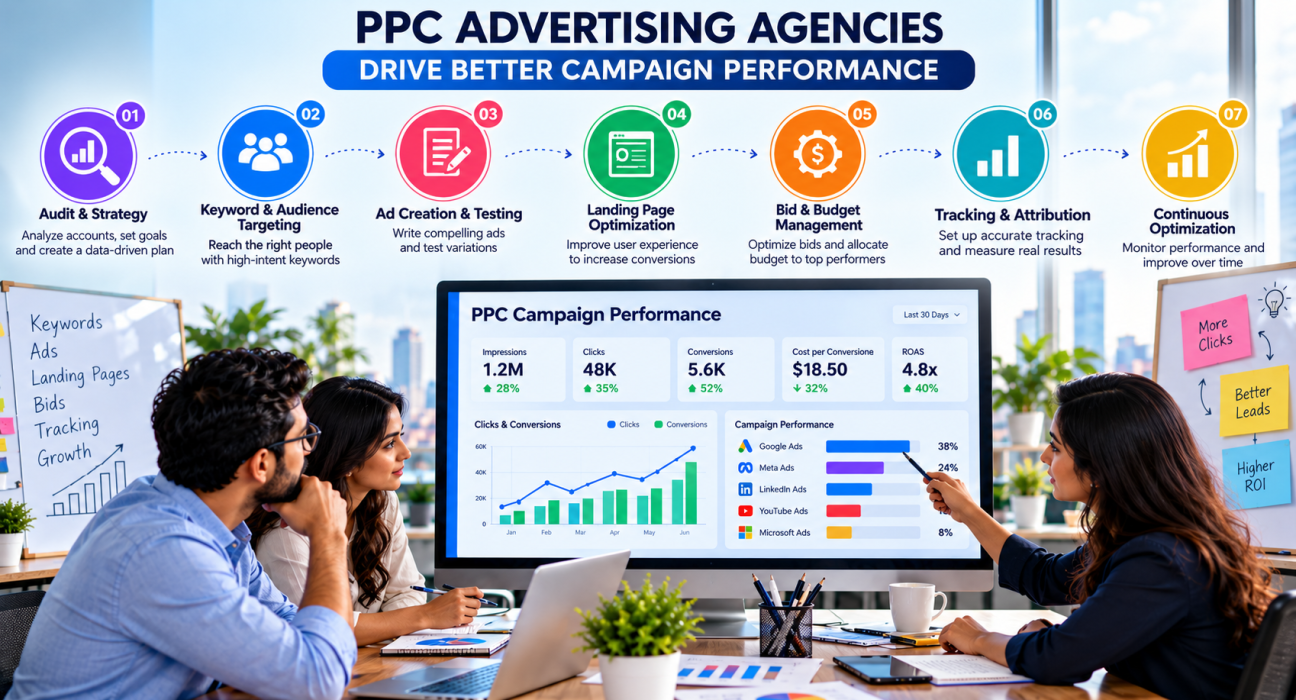
PPC advertising agencies improve campaign performance by combining specialist expertise, structured testing, and ongoing optimization. They tighten keyword targeting, write stronger ads, fix landing page issues, manage bids, and use conversion data to move budget toward what works. The goal is not just more clicks but more qualified leads and sales for each dollar spent.
If your paid campaigns feel stuck, with rising costs, low conversions, or reports that don’t explain much, you’re probably wondering whether outside help would change anything. This guide explains what PPC advertising agencies actually do, where they add the most value, and how to choose one that fits your business.
What Do PPC Advertising Agencies Do?
A PPC (pay-per-click) advertising agency plans, launches, manages, and optimizes paid campaigns on platforms such as Google Ads, Microsoft Advertising, Meta, LinkedIn, and Amazon. You pay the platform for clicks or impressions, and the agency manages how that budget is spent.
Most agencies cover these areas:
- Strategy and planning: setting goals, choosing platforms, and allocating budget
- Keyword and audience research: deciding who to reach and with what intent
- Ad creation: writing copy, selecting creatives, and building ad extensions
- Bid and budget management: controlling cost and pacing spend
- Conversion tracking: making sure results are measured accurately
- Testing and optimization: improving ads, audiences, and landing pages over time
- Reporting: explaining what happened and what to do next
How PPC Advertising Agencies Improve Campaign Performance
1. They Start With a Proper Audit and Clear Goals
Good agencies begin by understanding what you want: leads, sales, app installs, demo bookings, or something else. They then audit your existing account, looking at structure, wasted spend, keyword overlap, ad quality, and tracking.
Many underperforming accounts have basic problems: broad keywords bringing irrelevant traffic, missing negative keywords, or conversion tracking that counts the wrong actions. Fixing these often delivers the quickest gains.
2. They Improve Keyword and Audience Targeting
Not all clicks are equal. Someone searching “buy project management software for a 20-person team” is further along than someone searching “what is project management.”
Agencies improve targeting by:
- Grouping keywords by intent (research, comparison, purchase)
- Adding negative keywords to block irrelevant searches
- Choosing suitable match types
- Building audiences from customer lists, site visitors, and similar segments
- Separating brand and non-brand campaigns so budget is not misread
Better targeting lowers wasted spend and raises the share of clicks from people likely to convert.
3. They Write and Test Better Ads
Ad copy affects both click-through rate and the quality of visitors. Agencies run structured tests, changing one element at a time, such as the headline, offer, or call to action, and keep what performs better.
A good test might compare “Free 14-Day Trial” against “Book a Live Demo” for the same audience. Over months, small improvements add up.
4. They Fix the Landing Page Experience
A great ad sending traffic to a weak page wastes money. Many PPC advertising agencies also advise on, or directly improve, landing pages. Common fixes include:
- Matching the page message to the ad promise
- Simplifying forms
- Improving page speed on mobile
- Placing clear calls to action above the fold
- Adding proof such as testimonials or case studies
Even strong ad management has limits if the page does not convert, so ask any agency how they handle this.
5. They Manage Bids and Budgets Actively
Platforms offer automated bidding strategies, but automation needs good inputs. Agencies decide when to use manual control, target CPA, target ROAS, or other strategies, and they watch for problems such as overspending on low-value terms or limited budget on top performers.
They also adjust by device, location, time of day, and audience when data supports it.
6. They Set Up Accurate Tracking and Attribution
You cannot improve what you cannot measure. Agencies configure conversion tracking, analytics goals, call tracking, and CRM connections so results reflect real business outcomes, not just form fills or clicks.
For longer sales cycles, they look beyond last-click results to understand how different campaigns contribute to leads and revenue.
7. They Bring Cross-Industry Experience
An in-house marketer sees one business. An agency sees many accounts and has a sense of what tends to work in different situations, along with how to react when a platform changes its features or policies. That experience can shorten the learning curve, although results still depend on your market, offer, and budget.
8. They Provide Continuous Optimization and Reporting
PPC is not a “set and forget” channel. Auction conditions, competitors, seasonality, and platform features all change. A good agency reviews performance regularly and reports in plain language: what changed, why, and what happens next.
PPC Agency vs. In-House vs. Freelancer
| Factor | PPC Agency | In-House Team | Freelancer |
|---|---|---|---|
| Expertise breadth | Multiple specialists | Depends on hires | Usually one person’s skills |
| Cost structure | Monthly retainer or % of spend | Salaries and tools | Hourly or project fee |
| Speed to start | Usually faster | Slower (hiring) | Fast |
| Business knowledge | Builds over time | Strongest | Varies |
| Scalability | Easier to scale | Requires more hires | Limited by capacity |
| Best for | Growing businesses wanting expert support | Large, ongoing ad programs | Small budgets or short projects |
When Should You Hire a PPC Agency?
You may benefit from hiring one if:
- Your cost per lead or sale keeps rising
- You lack in-house paid media expertise
- You’re expanding to new platforms or markets
- Reporting is unclear or inconsistent
- Your team has no time to manage and test campaigns
- Ad spend is significant enough that small improvements matter
If your budget is very small, a freelancer or a short audit may be a better first step.
How to Choose the Right PPC Advertising Agency
Choosing well matters as much as deciding to hire. Use this checklist.
1. Check relevant experience. Look for experience with your industry, business model (B2B, e-commerce, SaaS, local services), and platforms.
2. Ask how they measure success. They should talk about leads, revenue, and cost per acquisition, not only impressions or clicks.
3. Understand their process. Ask about onboarding, testing, optimization frequency, and communication.
4. Review reporting. Ask for a sample report. It should be clear enough for a non-specialist to follow.
5. Clarify pricing. Agencies commonly charge a flat fee, a percentage of ad spend, or a hybrid. Ask what is included, such as creative, landing pages, or tracking setup.
6. Confirm account ownership. You should own your ad accounts and data, so you can leave without losing your history.
7. Request references or case studies. Verify them yourself rather than relying only on a sales deck.
8. Watch for red flags. Be cautious of guaranteed results, vague strategy, no access to your account, or long lock-in contracts with no flexibility.
Using GoFirms to Research Agencies
When building a shortlist, it helps to compare providers side by side. Businesses can use GoFirms to research and compare digital marketing and PPC service providers, review their profiles and services, and narrow down options before reaching out. Treat any directory as a starting point and still verify fit through conversations and references.
[Internal Link Suggestion: GoFirms PPC/Digital Marketing Companies Category Page]
Questions to Ask Before Signing
- Who will manage my account day to day?
- What goals and benchmarks will we agree on?
- How often will you test and report?
- What tools and tracking will you set up?
- How do you handle underperformance?
- What does the contract require, and how can I exit?
What Results Can You Realistically Expect?
Timelines vary by industry, budget, and competition. Early improvements often come from cleaning up waste and fixing tracking. Larger gains from testing and optimization typically take longer, because platforms need data to learn. Be wary of anyone promising specific numbers before reviewing your account. Agree on realistic targets, and judge progress against business outcomes, not clicks.
Common Mistakes When Working With PPC Agencies
- Unclear goals: vague targets lead to vague results.
- Poor tracking: the agency optimizes toward the wrong data.
- Ignoring the website: traffic cannot make up for a weak landing page.
- Expecting instant results: testing takes time.
- Not sharing business context: margins, sales cycles, and lead quality all affect strategy.
- Judging only by cost per click: a cheaper click is not better if it doesn’t convert.
Frequently Asked Questions
What do PPC advertising agencies do?
PPC advertising agencies plan, launch, manage, and optimize paid campaigns on platforms like Google Ads, Meta, and LinkedIn. Their work includes keyword research, ad creation, bid management, conversion tracking, testing, and reporting, all aimed at improving results from your ad spend.
How do PPC agencies improve ROI?
They reduce wasted spend through better targeting and negative keywords, improve ad relevance, test copy and audiences, refine landing pages, and use accurate conversion data to guide bidding. These ongoing adjustments help more budget go toward traffic that produces leads or sales.
How much do PPC advertising agencies charge?
Pricing varies by agency, scope, and ad spend. Common models include flat monthly retainers, a percentage of ad spend, or hybrids, sometimes with setup fees. Ask for a written breakdown of what is included, and compare several providers before deciding.
Is it better to hire a PPC agency or manage ads in-house?
It depends on budget, expertise, and time. In-house teams know the business best, while agencies offer broader specialist skills and faster scaling. Many businesses start with an agency, then build internal capability as their ad programs grow.
How long does it take to see results from a PPC agency?
Some improvements, such as removing wasted spend, can appear within weeks. Meaningful optimization usually takes longer because campaigns need data for testing and learning. Timelines depend on your industry, budget, competition, and starting account quality.
What should I look for when choosing a PPC agency?
Look for relevant industry experience, a clear process, transparent reporting, honest expectations, and account ownership on your side. Ask for references, understand pricing and contract terms, and make sure they measure success by business outcomes, not just clicks.
Can a PPC agency guarantee results?
No reputable agency can guarantee specific results, because performance depends on competition, platform changes, budget, offer, and website quality. A good agency can show a clear strategy, measurable goals, and a testing plan instead of making guarantees.
Conclusion
PPC advertising agencies improve campaign performance through the fundamentals done consistently: accurate tracking, focused targeting, tested ads, better landing pages, and steady optimization backed by clear reporting. The right agency also acts as a strategic partner that understands your goals and explains its decisions.
Before committing, define your goals, prepare your questions, and compare a few providers. You can use GoFirms to research and compare PPC and digital marketing companies, then confirm the best fit through direct conversations and references.