


Introduction
Every PG owner has been here. A tenant asks for a washing machine, the PG down the road just added AC rooms, and someone tells you a gym will “attract a better crowd.” Each of these costs money, and not all of them earn it back.
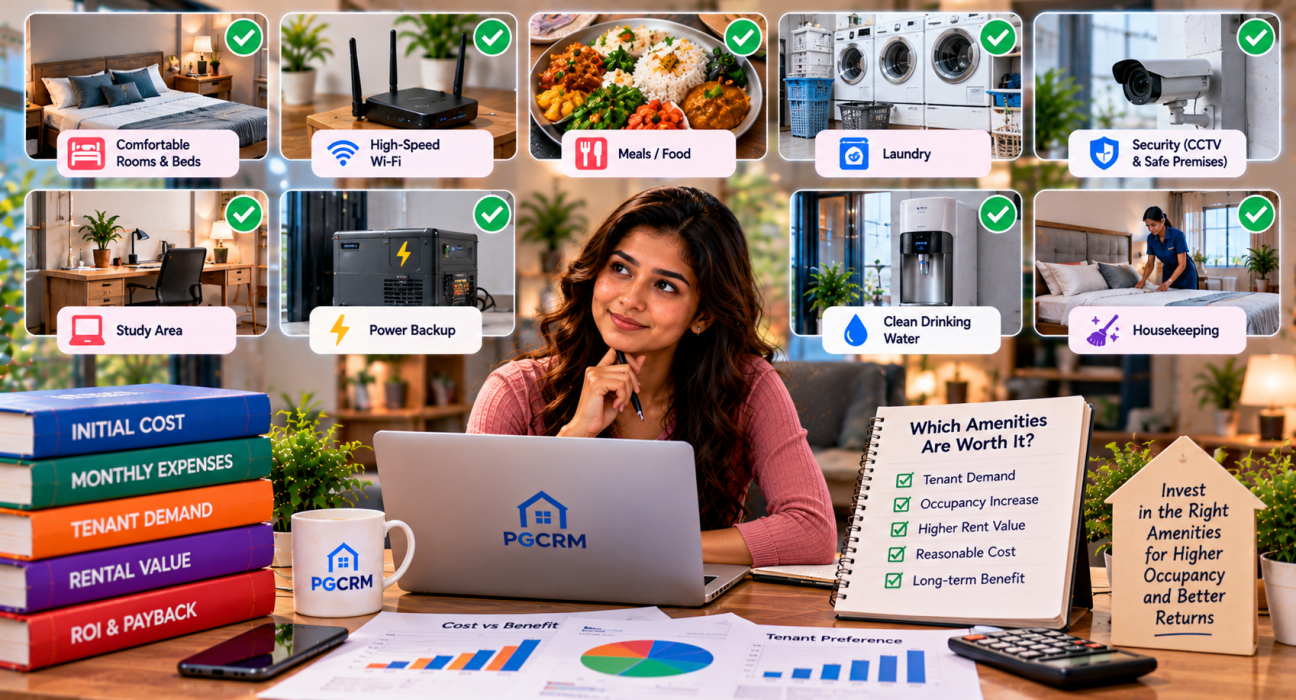
This guide to the best PG amenities for owners is about choosing by payback, not by copying competitors. A good amenity raises your rent, keeps beds filled longer, or cuts complaints. You’ll get a simple test for any amenity, a tiered list of what usually deserves your money, a worked payback example, and a way to check afterwards whether it worked. Good records help with that last part, and PG and hostel management software keeps occupancy, complaints and expenses in one place.
What Makes a PG Amenity Worth Paying For?
An amenity is worth paying for when it does at least one of three things: it lets you charge more rent, keeps your beds occupied for longer, or reduces the complaints and repairs that eat into your time. If it does none of these, it’s an expense, however good it looks in photos.
The four-question test
Run every amenity through these before you spend:
- Who is my tenant? Students, working professionals and women’s PG residents want different things. A gym means little to a first-year student on a tight budget.
- Will it change my rent or occupancy? Think about whether people will pay more for it or choose you because of it.
- What will it cost over a year? Include installation, electricity, repairs and the staff time to look after it.
- Can I maintain it properly? A broken geyser or a dead CCTV camera does more damage than not having one.
If you can’t answer question two with a straight face, wait.
Amenities That Almost Always Earn Their Keep
These are the basics. Tenants judge you on them first, and when they fail, people notice immediately.
Reliable water, hot water and drinking water
Running water at the right time, hot water in the morning and clean drinking water are not extras. They’re the baseline. An RO unit or a good filter costs little compared with the goodwill it buys. Poor water supply is also one of the easiest reasons for a tenant to start looking elsewhere.
Power backup for the essentials
You don’t need to run the whole building on a generator. Backup for lights, fans and the WiFi router is often enough. Tenants, especially working professionals who work from their room, care a lot about staying online during a power cut.
Stable WiFi
Good internet is cheap when you divide it across every bed. A plan that costs a little more each month is a small price for something almost every tenant uses daily. What matters is that it works in every room, not just near the router.
Cleanliness and regular housekeeping
This one is easy to overlook because it’s not a “feature.” But clean corridors, washrooms and common areas shape how people feel about the place. Parents visiting a PG notice this within minutes.
Basic security
Decent lighting, a gate or entry control, a visitor register and CCTV at entry points go a long way. For women’s PGs and for tenants whose parents live in another city, this can be the deciding factor.
Laundry access
A washing machine in a shared space is a practical, low-cost addition that most tenants use constantly. Just set clear timings so it doesn’t become a daily argument.
Amenities That Depend on Your Tenant and Location
This is where owners lose money, because what works in one area flops in another. Here’s a quick way to think about the common ones.
| Amenity | Works best when | Think twice when |
|---|---|---|
| AC rooms | The city is hot, tenants are working professionals, and you can price the rooms higher. | Tenants are budget-sensitive or your electricity cost is hard to recover. |
| Meals/mess | Eateries are far away, or students want food included. | You can’t control food quality, since food complaints get loud fast. |
| Parking | Many tenants own bikes or cars. | Most tenants are students without vehicles |
| Attached bathrooms | Your area has competing PGs that offer them and tenants pay more for privacy. | Retrofitting is expensive and your rents can’t absorb it. |
| Lift | The building has several floors and you want to price upper rooms equally. | The building is two or three floors and tenants are young. |
| Wardrobes, study tables, lockers | Rooms are rented unfurnished or sparsely furnished. | Tenants already bring their own and rarely use them. |
The point of this table isn’t that these are bad ideas. It’s that each one needs a reason that fits your tenants. A quick chat with five or six current tenants will tell you more than any guess.
Amenities That Rarely Pay Back
There are exceptions, especially in premium co-living setups, but these are usually the first to disappoint:
- Gym: It takes space, equipment and upkeep. Many tenants prefer a gym near their office or college anyway.
- TV or recreation rooms: Usually underused after the first few weeks.
- Decorative upgrades: Fancy lobby lighting or wall art rarely changes a decision. Clean and functional beats stylish and neglected.
- Anything you can’t staff or maintain: If nobody owns it, it will break, and then it becomes a complaint.
If you’re unsure, start small. A basic version of an amenity tells you if people care before you commit big money.
How to Work Out Payback Before You Spend
You don’t need a finance degree for this. Use one simple formula.
Payback period (in months) = total upfront cost ÷ net extra monthly income
Net extra income means the extra rent you collect, minus the extra running costs. Here’s an example with assumed numbers. Replace them with your own.
Example: adding AC to four double-sharing rooms (8 beds)
| Item | Assumed amount |
|---|---|
| Cost of 4 AC units, installed | ₹1,40,000 |
| Extra rent you charge per bed | ₹1,500 |
| Extra monthly rent (8 beds) | ₹12,000 |
| Extra electricity and servicing | ₹4,500 |
| Net extra monthly income | ₹7,500 |
| Payback period | About 19 months |
That looks fine on paper. But ask the harder questions. What if two of those beds sit empty for a couple of months? What if tenants resist the higher rent? What if electricity costs more than you estimated? Your payback stretches, and it can stretch a lot.
Now compare it with something small. Say you improve your WiFi plan for ₹1,500 extra per month. If it helps you keep even one tenant who would have left, you’ve likely recovered the cost. Cheaper amenities with broad appeal often pay back faster than big-ticket ones.
Common Mistakes Owners Make
- Copying the competitor. They may have different tenants, a different building, or a higher budget.
- Ignoring running costs. Buying the AC is the easy part. Electricity and servicing keep going.
- Listening only to the loudest tenant. One person asking for a gym doesn’t mean twenty want it.
- Adding and forgetting. An amenity that breaks and stays broken hurts you more than not having it.
- Never checking the result. If you don’t look at the numbers afterwards, you won’t know what worked.
How to Check Whether an Amenity Is Actually Working
Spending on an amenity is only half the job. The other half is checking if it did anything.
A simple 90-day review
- Note your starting point. Before you add anything, write down your occupancy, how long beds stay empty, and the number of complaints about that area.
- Add the amenity and tell your tenants. If people don’t know it exists, it can’t help.
- Track the same numbers for 90 days. Look at occupancy, vacancy duration, related complaints and the rent you’re collecting.
- Ask tenants who move out. Their reasons are some of the most honest data you’ll get.
- Decide: keep it, improve it, or stop spending on it.
Doing this on paper or in scattered notes gets tiring quickly. PG management software such as PGCRM can help here. You can log complaints with a priority and status trail, record expenses by category and building, and look at occupancy, income and expense reports. It won’t choose your amenities for you, but it gives you the records to see what’s working.
FAQ
What are the most important amenities in a PG?
The essentials are clean and reliable water (including hot and drinking water), power backup for lights and fans, stable WiFi, regular housekeeping, basic security and laundry access. Tenants notice these first, and problems here are the most common reasons people leave or complain.
Is AC worth it in a PG?
It can be, but it depends on your city, your tenants and your pricing. AC works best when tenants are working professionals who will pay more and the extra rent covers electricity and servicing. Calculate your payback first. If it takes more than a couple of years, think carefully.
Should I include food in the rent?
Include it only if you can keep quality consistent. Food suits PGs where eateries are far away or tenants are mostly students. If you can’t manage a kitchen well, food complaints can overshadow everything else you do right. Offering it as an optional add-on is a lower-risk way to start.
How much extra should I charge for amenities?
There’s no fixed number, because it depends on your area and tenants. Look at what nearby PGs with similar facilities charge, then check that your extra rent covers the cost and gives a sensible payback period. Charging slightly less than competitors for the same amenity can also help fill beds faster.
Do amenities help fill empty beds faster?
They can, if they fix something tenants actually care about. WiFi, clean rooms and reliable water often make a difference. But an amenity nobody wants won’t fill beds, and nothing is guaranteed. Track vacancy before and after to see the real effect.
How do I find out what amenities my tenants want?
Ask them directly, especially during move-in and move-out. Review your complaint records for repeated themes. Pay attention to what prospective tenants ask about on visits, and compare with nearby PGs. Patterns across many people are more reliable than a single request.
Conclusion
Choosing the best PG amenities for owners comes down to a few habits: know your tenant, count the full cost, work out the payback, and check the results afterwards. Start with the basics that every tenant notices, add conditional extras only where your numbers support them, and be honest about what isn’t paying off.
Good records make every one of these decisions easier. If you’d like a single place to track rent, occupancy, complaints and expenses, explore PGCRM to simplify your PG and hostel management.